Discover our free 12-week half-Ironman training plan: Follow coach guidance leading up to race day
Want to master the middle-distance triathlon, commonly known as the 70.3 or half-Ironman? Dermott Hayes has a 70.3 training plan that'll help ensure you're race ready...

You’ve got your sights set on completing a half-Ironman triathlon and you only have 12-weeks to train. With three months to go, you’ll need to follow a targeted triathlon training plan to hit your goals. Here, we share a plan from our expert tri coach to keep you on track…
Maybe you’re stepping up after racing short course for a few years. Or maybe you’re dropping back down after having completed an Ironman. Whatever your reason, it’s time to make sure you’re ready for the challenge of middle-distance racing. This plan will prepare you to race a 70.3 triathlon to your full potential and smash the 1.9km swim, 90km bike, and 21.1km run (1.2 mile swim, 56 mile bike, 13.1 mile run).
What is covered in the 12-week half-Ironman training plan?
This free downloadable 12-week 70.3 training plan forms what is known as the end of the traditional ‘build’ phase and the complete ‘peak’ phase of training for a middle-distance triathlon, taking you all the way up to your 70.3 race day. With this in mind, if you want to follow this 70.3 training plan, it’s crucial that you’ve already spent time working on the ‘base’ phase for a 70.3 (free 8-week plan here) and that you’ve laid down solid foundations on which to build your training distances.
It’s important to build slowly as jumping straight into this plan from very little training could lead to injury and fatigue very quickly. On the 70.3 training plan you’ll find a healthy balance between swim, bike and run training, with a slight emphasis on the bike, as this is where you can make real gains at this distance.
Sessions in this 12-week plan vary between tempo, race pace, interval and recovery styles, and this varied approach will ensure a high quality of intensity when needed, but also make sure that you train at lower intensities to help with fat burning and endurance. It wouldn’t be a successful plan without bike/run brick sessions, and we include longer traditional race simulation-style sessions that really help to boost endurance.
We also include shorter-duration, multi-transition-style sessions that you can execute at slightly faster paces. You can also use these to practise kit changes.
What level of fitness do you need for this 12-week 70.3 plan?
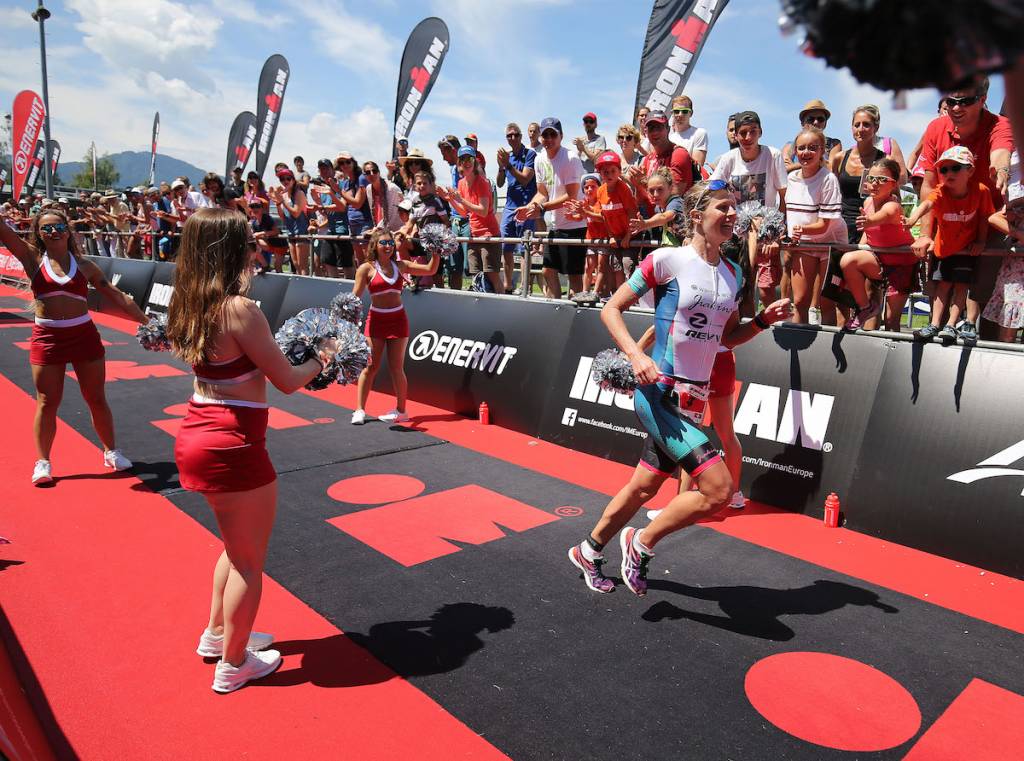
You will need to already be comfortable and capable of completing at least 75% of the distances during a middle-distance triathlon. This roughly translates to 1.5km open-water swim, 70km bike ride, and a 16km run. Crucially, you’ll need to have worked on your endurance and stamina and be capable of performing brick sessions, which is when you do one session of one sport before flowing directly into another workout in a different sport.
This plan brings you to the peak of the longest distances you’ll cover in training, before lowering the distance into a taper ahead of race day. If you are a beginner to the 70.3 distance and especially if you’re new to triathlon or are not currently training regularly, we recommend you start with a longer build-up to race day. Along with the 8-week plan mentioned above, you may also be interested in our 6-month Ironman 70.3 training plan.
What kit do you need for a half-Ironman triathlon?
Beyond the basics, when choosing your kit for race day, you’ll also need to select gear that you’ve tried and tested and that feels comfortable – this means supportive enough for the distance. Along with the necessary triathlon bike, triathlon wetsuit (unless it’s a hot climate), running shoes, bike helmet and bike shoes, you’ll also need a reliable tri-suit to keep transitions quick. Then, there are the ‘nice to have but not essentials’, such as a triathlon watch to track your distance (and to record for Strava gloating afterwards!), bike computer to follow the course profile, triathlon sunglasses, and socks.
Free 12-week half-Ironman training plan
Now that we’ve shared what you can expect in this plan, what fitness level you should start with, and what gear you’ll need, you’re all set to get going with Coach Dermott’s 3-month half-Ironman training plan. You can expect and build to peak volume and training sessions for the weeks leading up to race day.
So without further ado, sign up to gain access to your free 12-week 70.3 training plan below!
Frequently Asked Questions about half-Ironman training
A major part of executing a successful 70.3 is to get your head straight as to what kind of pacing is needed. It’s not just as simple as going a bit slower than you did for an Olympic tri. Nor can you just go faster than you did at Ironman. 70.3 racing requires a real balancing act when it comes to pacing, and that has to be developed through training experiences. Base your initial targets around previous racing experiences. Then introduce those paces into training and see how far off the mark you are. Be prepared to be flexible and keep revisiting your targets. Remember to try and train harder than you need to race – doing the real hard miles in training will make the race easy… kinda.
Do your homework on your race course and try to replicate it in training where possible. Take time to study the route, elevation, terrain and any technical sections so nothing comes as a surprise on race day. Then, try to recreate similar conditions in training, whether that’s practising hills, open-water conditions, or specific bike terrain. If you can, visit the race venue beforehand to complete a course recce, helping you build familiarity and confidence.
Mentally break down the longer training sessions into smaller, more manageable chunks. Long workouts can feel overwhelming, so divide them into clear sections or time blocks to stay focused and motivated. Treat each chunk as its own mini-goal, ticking them off one by one. This keeps your head in the game, makes the workload feel achievable, and helps you maintain consistent effort throughout.
You have to be organised to make 70.3 training happen. Sort out your kit. Sort out your diary. Consistency only works when your life around training runs smoothly, so take the time to plan ahead. Lay out your gear the night before, keep your kit in reliable rotation and make sure everything you need is ready to grab and go. Block out training sessions in your calendar as non-negotiable appointments to ensure you stay committed. That being said, leave some room for flexibility in certain areas, life can be unpredictable sometimes!
Test your equipment, clothing and nutrition in training. Not on race day. Use your training sessions to trial every element you intend to use on the day, from running shoes and tri wetsuits to fuelling strategies and hydration. This helps you identify any issues early and adjust accordingly. Come race day, nothing should be new or untested, giving you the best chance of a comfortable and confident race.
Now you’ve got a 70.3 training plan, find our more about how to train for your first 70.3 triathlon here, and make the most of our expert 70.3 run advice, 70.3 bike tips and 70.3 swim pointers.


 Dermott Hayes