7 incredible things you never knew your Garmin watch could do – from a Garmin convert
We take a deep dive into your Garmin watch's metrics and analytics, plus the cool hardware features you should know about to truly get your money’s worth

If you’re reading this, then you’ve either already got yourself a Garmin fitness watch, or are deliberating about taking the leap. Either way, you’re probably already on the Garmin band wagon, so welcome aboard! Here’s why it’s the place to be…
Depending on the model you go for, a Garmin watch can be a weighty investment. There’s no denying it. Especially if you go for an all bells and whistles, Fairy Godmother-esque, multisport option like the ones we’ve been testing here at 220 Triathlon for years now. Generally, the higher the price tag, the more advanced the software and activity tracking, plus the more hard-wearing the build.
But these days, there are so many features to take note of that it can feel overwhelming. What exactly is worth the extra money and what upgrades can you do without? The best way I can answer those questions is to uncover the key features and tips you need to be aware of if you’re looking to upgrade your watch or make the most of the one you have now.
Read on for some of the best-kept Garmin secrets, plus why I’m a Garmin convert for life – and why you should be too.

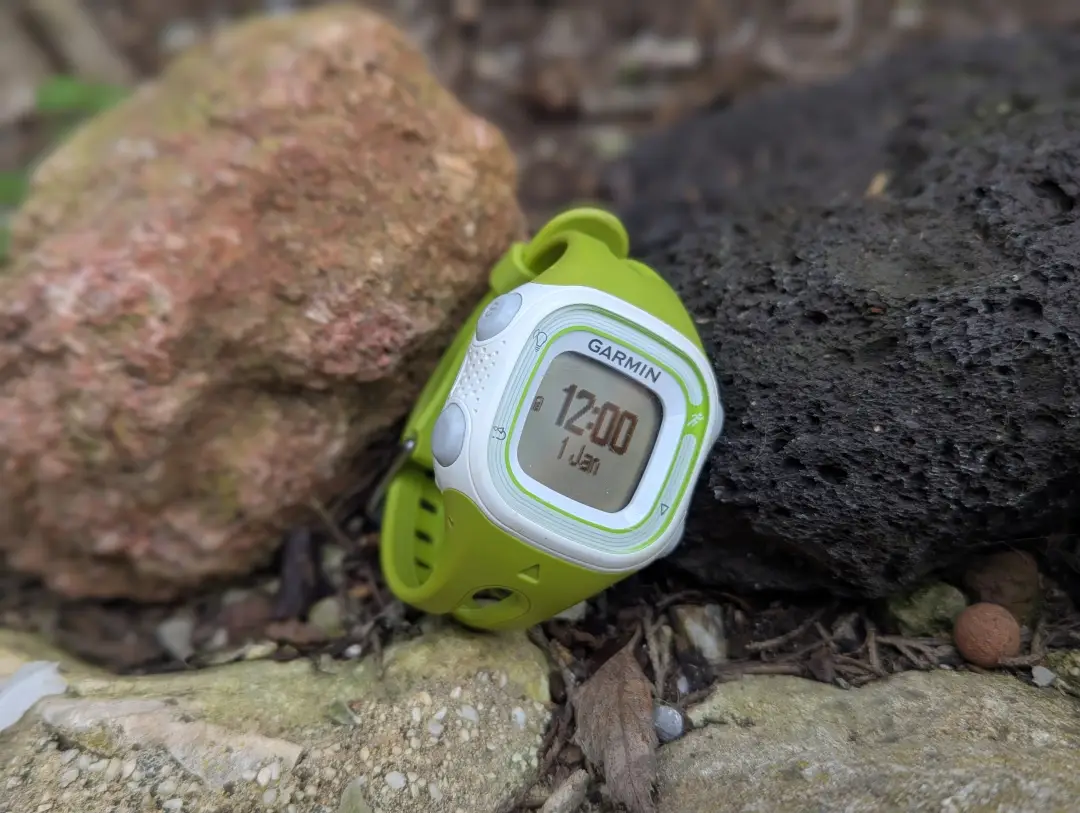
My first ever watch was a Garmin Forerunner 10 back when I was running track for Team Bath in my teens and mainly needed a means to tell the time and keep track of my splits and rest for interval work.
At the time, sports watches were pretty basic, and the most sophisticated ones tracked GPS, distance, and time. I’ve still got the minty green number up in my office somewhere (see picture above) gathering dust.
Point is, even at the tender age of 17 when Garmin was just becoming a household name, I knew I’d stumbled upon something good. And as the years went by, Garmin has proved time and time again with the expansion of their watch range, that they really know their stuff, and just keep getting better.
1. Advanced activity tracking that learns as you train
Any decent smartwatch these days will track your activity, other than the standard GPS and heart rate, some Garmin watches like the most recent Forerunner 970 will also provide performance stats on heart rate and power zones, as well as the training effect on your aerobic and anaerobic fitness, and the amount of impact load caused by your run.
After the first few minutes of a run, the watch will let you know whether you’re trending to perform better than usual, at baseline, or lower – a good indication on whether you should adapt your session. Then post-run, there’s also how your performance has shifted your current recovery time, VO₂ max, lactate threshold, race time prediction, hill ability, the list goes on…
What’s key to note here is that Garmin’s advanced activity tracking learns from the patterns in your training over time. That means that every run, ride, swim, and cross-training session will feed the system inside your watch with more information surrounding your fitness level, effort, and habits. Far from providing generic advice, the watch then adapts its insights based on your training trajectory. The result is guidance that evolves with you. If you choose to follow one of the Garmin Coach training plans, this will also adapt with you as you complete the sessions.
This is particularly useful when it comes to recovery and baseline fitness. If worn overnight, your Garmin watch (all comments here are based on the 970) will harvest sleep data, including respiration, oxygen saturation, and the all-important HRV. Granted, your watch isn’t going to be as exact as hospital equipment, but all these biometrics combined tend to give a pretty good idea of how your body is coping, adapting, and improving during training. For athletes juggling multiple sports, this advanced tracking is particularly useful as far from treating each sport in isolation, it provides a glimpse of the bigger picture.
- Garmin Fenix 8 vs Fenix 8 Pro: Are phone-free messages and calls worth the upgrade?
- ‘Masterful trolling’: Is Kristian Blummenfelt’s ‘record’ VO2 max all it seems?
2. Industry-leading location tracking

It’s no secret that Garmin watches are known for their accurate and reliable GPS tracking and I’m going to tell you exactly how they’ve achieved this. Garmin uses a multi-band satellite system, which includes GPS (USA’s satellite system), GLONASS (Russia’s satellite system), Galileo (Europe’s satellite system), QZSS (regional satellite system in East-Asia and Asia-Pacific, developed by Japan), and BeiDou (China’s satellite system).
Through the use of Garmin’s smart SatIQ technology, the watch is able to automatically switch between different satellite modes depending on the environment and location, capitalising on tracking systems in the most efficient and least battery-sapping way. When used together, these satellite systems provide incredibly accurate positioning, meaning it’s quick to find GPS at the start of a session, and tracking like pacing, elevation, distances, and splits are highly and consistently accurate.
It’s a real plus, particularly for those who train in built-up areas or like to explore in remote locations. Here, your watch can be your lifeline. If you get lost, your watch can route you home. If you veer off-course, your watch will guide you back to your route. Of course, Garmin also provides clear and crisp visual colour mapping on-watch that’s also pretty hard to find better elsewhere.
3. Incidence detection
Training outdoors comes with a certain level of risk, especially if you’re going it solo. Incident detection is designed to add a layer of reassurance, without getting in the way of your workout. Using motion sensors and activity patterns, the watch can recognise when a sudden impact or unusual movement suggests you may have taken a fall or experienced a crash. If that happens, your Garmin automatically sends an alert to your chosen emergency contacts with your current location. There’s also typically a short window where you can cancel the alert if everything is fine. It’s a simple feature, but one that can make a big difference and bring peace of mind to those around you.
4. Body battery

Think of Body Battery as a simple way to visualise how much energy you actually have in the tank, not how much you ‘think’ you do. (Note, stubborn athletes, listen up!) Instead of guessing whether you’re ready for a hard workout, the watch continuously estimates your energy levels by analysing heart rate variability, stress signals, sleep quality, and daily activity. All of that data feeds into a score provided by your watch that rises and falls throughout the day. For instance, a good night’s sleep might recharge your score, while a tough workout, a stressful work day, or poor rest can drain it.
The beauty of Body Battery is how easy it is to interpret. Rather than digging through complex metrics and coming up with a guess of your own analysis, you can glance at your watch and immediately understand whether your body is primed for effort or in need of more gentle recovery. Over time, patterns start to emerge, too. That awareness can help you make smarter decisions about when to train hard, when to go easy, and when to prioritise recovery.
5. Look mum, no hands!
Whether we like to admit it or not, triathlon watches these days are capable of far more than simple activity tracking. If you’ve invested well in your Garmin watch, then it’s likely to have heightened connectivity features. Don’t ignore these! They can make a busy athlete’s life a lot easier. Like many watches in the Garmin range, the 970 offers hands-free connectivity when paired with your phone – letting you answer calls, receive notifications and messages, and interact with apps, all on the watch.
You can quickly see who’s calling, read incoming messages, or manage alerts with a simple tap or voice command, depending on the model. It’s all designed to keep you connected without disrupting what you’re doing. For athletes who train outdoors, it also means you can stay reachable while leaving your phone tucked safely away. If runs or rides are your opportunity to unplug, then by all means simply switch this feature off for now. But for those of us who need to remain reachable for kids or work, it’s a brilliant feature that I personally find feels natural, rather than intrusive.
6. Guided workouts

If you’re not a fan of following a training plan, but still appreciate some guidance or training inspiration from time to time, then the guided workouts feature on your Garmin watch can bring some structure to your training, without feeling prescriptive. You can choose from a few workout suggestions that the watch will then instruct you through. This could be something like an interval run, yoga session, or strength routine.
As you train, the watch prompts you when to speed up, slow down, rest, or change exercises. Clear on-watch alerts and visuals make it simple to follow along. No need to try and remember a plan or count intervals. It’s a useful and often underused feature, especially handy for improving workout consistency, without overthinking it.
7. VO₂ max
VO₂ max is one of the most widely recognised indicators of cardiovascular fitness, and having an estimate available on your wrist can be incredibly useful for tracking progress. In simple terms, it represents the maximum amount of oxygen your body can use during intense exercise. The higher the number, the greater your potential for endurance performance.
A Garmin watch estimates this value by analysing data such as heart rate, pace, and workout intensity over time. While it’s not as accurate as a laboratory test, the estimate can still offer valuable insight into how your fitness is improving or reducing over time. If your VO₂ max steadily improves, it’s a strong signal that your training is working. If it plateaus or drops, it may indicate fatigue, inconsistent training, or the need for more recovery. The other golden metric on your watch to look out for is heart rate variability, or HRV, but we’ve already gone over why you should pay attention to HRV here.
Disclaimer: This article is in no way, shape, or form sponsored by Garmin, I just really rate the brand. Though this article focuses purely on top-range Garmins, there are a lot of other smartwatch brands out there also doing seriously great stuff too – Coros, Suunto, Polar, to name a few.


 Kate Milsom
Freelance sports journalist
Kate Milsom
Freelance sports journalist