Garmin Fenix 8 vs Fenix 8 Pro: are phone-free messages and calls worth the upgrade?
The Garmin Fenix 8 Pro recently supplanted the Fenix 8 at the top of this series. But does extra cost translate into performance? We've tested both to find out.


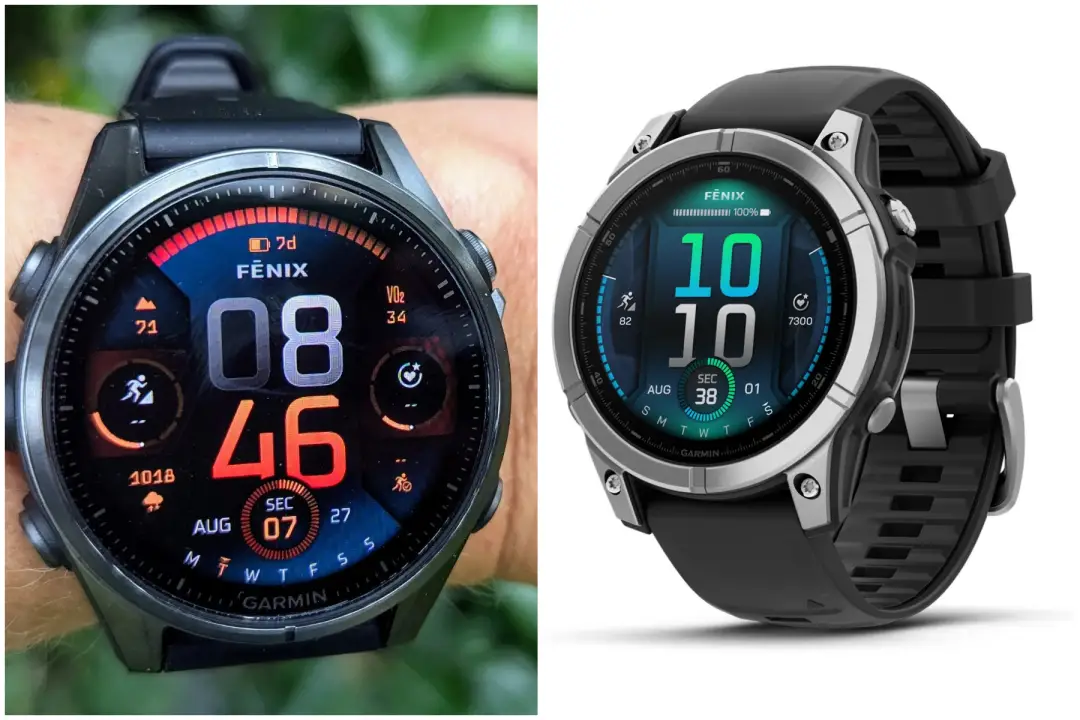
The best multisport watches don’t come much more expensive than the singing-and-dancing Garmin Fenix series.
To substantiate this argument, the US tech brand has surpassed itself with the new Fenix 8 Pro, which retails for $1,299 / £1,199.99 in the 51mm, AMOLED build.
That’s about $100 more expensive than the decidely premium Fenix 8 at $1,199.99/£949.99.
For the extra cash, the key thing you gain is satellite and cellular connectivity and hence the option to leave your phone at home.
To answer if that is beneficial, we’ve tested the Garmin Fenix 8 vs the Garmin Fenix 8 Pro.
220 Triathlon editor Helen Webster reviewed the first. As a qualified open-water swim coach and marathoner she knows what to look for in a multisport watch.
Former 220 magazine editor and now freelance sports writer and author James Witts, who has abundant smartwatch-testing experience, reviewed the Fenix 8 Pro.
Features and design

The Garmin Fenix 8 has a built-in speaker and microphone, enabling you to make voice-activated commands (for example, to start a strength workout), make/take phone calls and send messages in the Garmin Messenger app.
All these features require the watch to be paired and connected to your smartphone.
By contrast, the Fenix 8 Pro can do these things, send SOS alerts and a LiveTrack for your loved ones to follow your progress without one.

Its cellular and satellite connectivity (costing an extra $7.99/£7.99 a month for an InReach subscription) let you leave your phone at home or still communicate when it runs out of battery or doesn’t have signal.
Otherwise the watches’ features and design are similar.
In terms of the screens, you can pick from three sizes of a crisp AMOLED display or memory-in-pixel screen with solar charging in the Fenix 8.
Garmin offers two sizes of AMOLED display in the Fenix 8 Pro as well as an ever brighter MicroLED for an additional $400.
Both watches are rugged, tested to US military standards, include a built-in LED flashlight and have exhaustive feature lists.
Helen highlighted the Fenix 8’s voice commands, high waterproofing and dive depth, advanced strength training, and suggested activity routes.
Meanwhile James praised the Fenix’s ‘myriad features’ such as climb and pace guidance, blood oxygenation (for altitude training), recovery assessment, sleep scores, and running economy.
Garmin Fenix 8 vs Fenix 8 Pro specs
As you can see below, a comparison of the two watches’ specs tells largely the same story.
| Fenix 8 (Standard) | Fenix 8 Pro | |
| Available sizes | 43mm, 47mm, 51mm | 47mm, 51mm |
| Display type | AMOLED or Solar (MIP) | AMOLED or MicroLED |
| Thickness | 13.8mm to 15.2mm | 16mm to 17.5mm |
| Weight | 2.12oz to 3.35oz / 60g to 95g | 2.72oz to 3.28oz / 77g to 93g |
| Messaging | via Smartphone, Bluetooth | Built-in satellite and LTE |
| SOS capability | Requires phone connection | Standalone SOS via Satellite/LTE |
| Voice interaction | Bluetooth calling / Voice commands | Satellite voice & text / Voice commands |
| Sensor | Gen 5 Elevate HR, SpO2, ECG | Gen 5 Elevate |
| Waterproof | 10 ATM (Dive-rated) | 10 ATM (Dive-rated) |
Performance and fit

With essentially the same software and hardware, the Garmin Fenix 8 and the Fenix Pro 8 are closely matched in use.
They have the same impressive mapping and navigation from multi-band GPS and heart-rate measuring accuracy (for a watch) from their identical sensor.
Like the Fenix 8, James found the Fenix 8 Pro to be exceptionally powerful, usable and accurate.
But the older watch has the edge in two areas: battery life and fit.
As this table shows, the Fenix Pro 8’s run time suffers, presumably because the satellite and cellular connectivity drains battery juice.
Compared to the solar-charging Fenix 8, the Fenix 8 Pro is even worse, although the price difference is slim.
| Model and Size | Gesture mode | Always-on |
| Fenix 8 (43mm) | Up to 10 days | Up to 4 days |
| Fenix 8 (47mm) | Up to 16 days | Up to 7 days |
| Fenix 8 (51mm) | Up to 29 days | Up to 13 days |
| Fenix 8 Pro (47mm) | Up to 15 days | Up to 8 days |
| Fenix 8 Pro (51mm) | Up to 27 days | Up to 15 days |
| Fenix 8 Pro (MicroLED) | Up to 10 days | Up to 4 days |
Helen also appreciated that the Fenix 8 is offered in a 43mm size, which fits better on slimmer wrists. The smallest Fenix 8 Pro size (47mm) could be too big for people with narrower wrists.
Price and value

The Garmin Fenix 8 Pro is much more expensive for features most triathletes are unlikely to use.
The 51mm version James tested is $1,299.99 / £1,999.99 and the other 47mm is $100/£100 less.
For slightly less, you can buy the priciest Fenix 8 Solar for even better battery life. In other words, the Fenix 8 Pro doesn’t provide much more bang for your buck.
Only intrepid adventurers and ultra athletes stand to benefit from the phone-less messaging and you’ll have to add the InReach subscription on top.
That said, the Fenix 8 is still very pricey at $999/£949.99 and cheaper Garmin models, such as the Forerunner 955 Solar, rival its performance for less.
Verdict
The Garmin Fenix 8 is our winner here because the newer model doesn’t justify its higher price tag for triathlon.
Helen concluded it is ‘not cheap but ticks all the training boxes’ by providing ‘all the data you’d want’.
Nonetheless, James wrote that the Fenix 8 Pro is ‘undoubtedly a superb watch’ and it could excel in trips to the back of beyond.
How we test multisport watches
Our expert and independent reviewers take each watch on several runs, rides and swims to rigorously test them. They then write an honest, unbiased review to help you make informed decisions. For more details, see how we rate and test products.


 Helen Webster
Editor, 220 Triathlon
Helen Webster
Editor, 220 Triathlon With contributions from