‘Masterful trolling’: Is Kristian Blummenfelt’s ‘record’ VO2 max all it seems?
Sports scientists have called the seemingly world-beating result into question. Was the test just a publicity stunt?

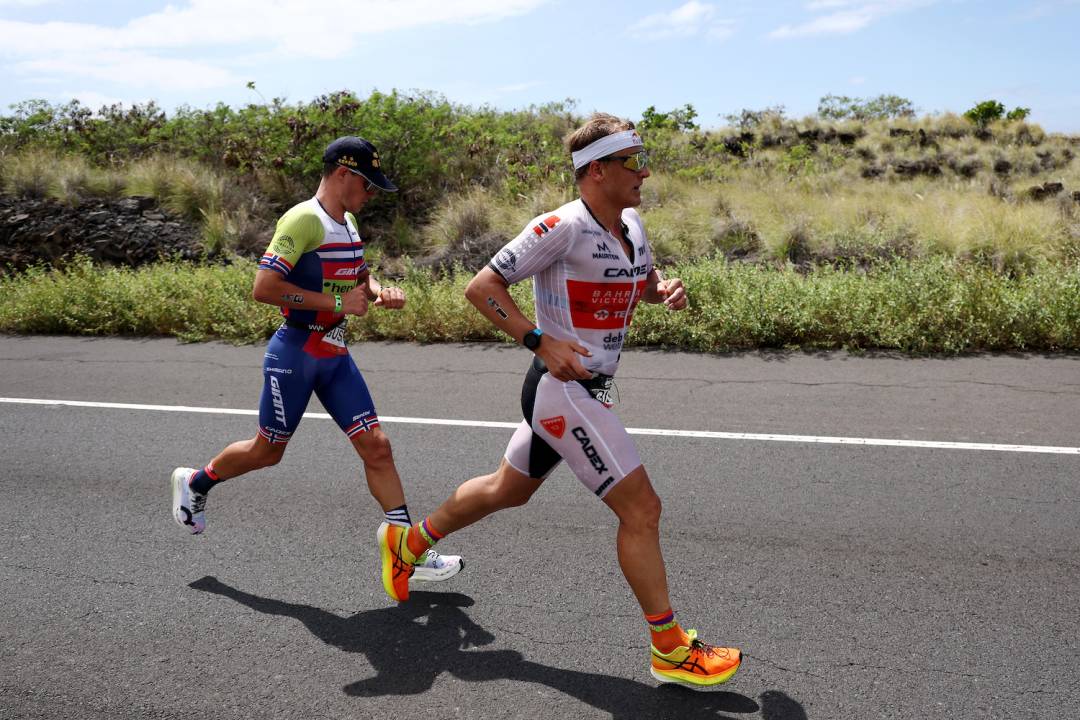
On 27 January, Kristian Blummenfelt uploaded a post to Instagram that appeared to show a world record relative VO2 max. Or did it? Some sports scientists are sceptical about the test’s validity.
VO2 max measures the maximum volume of oxygen an athlete can absorb per minute per kilo of bodyweight and is a key indicator of endurance sports performance.
If valid, his value of 101ml/kg/min would beat the previous best of 97.5ml/kg/min recorded by Norwegian cyclist Oskat Svendsen in 2012.
It would also give Blummenfelt a higher VO2 max than four-time Tour de France champion Tadej Pogačar. Sports scientist Ole Kristian Berg estimated his VO2 max to be 91-96ml/kg/min based on climbing performances.
Is the Tokyo 2020 champion’s performance to be believed though? Among sports scientists, there’s doubt. Some speculate that the 101 number briefly shown on a computer screen during the test might not be representative of Blummenfelt’s true aerobic capacity.
Unanswered questions
The scarcity of information surrounding Blummenfelt’s test has sports scientists and physiologists searching for answers.
Other than that Blummenfelt recorded the ‘record’ on a treadmill, the photos he posted revealed little.
In an Instagram reel, Mike J. Ormsbree PhD, an endowed professor at Florida State University, drew attention to the RER (respiratory exchange rate) of 0.93.
RER is the ratio of carbon dioxide produced to oxygen consumed. It’s used in a VO2 max test to measure substrate utilisation, ie how much fat you are using relative to carbohydrates, and assure the effort is maximal.
An RER higher than 1 indicates exclusive carbohydrate metabolism, and Ormsbree says a VO2 max test requires an RER exceeding 1.1. Therefore, the 0.93 RER looked low to him.
Ormsbree also drew attention to the length of the test. The Instagram video seems to show a duration of one hour 14 minutes. Because a typical VO2 max test lasts 20 minutes, this raises questions about the testing protocol.
He wondered if the testing equipment was calibrated prior to Blummenfelt’s protocol. Speaking on the Peter Attia podcast, Olav Alexander Bu said that he usually calibrates the equipment before Blummenfelt records. Whether this happened on this occasion remains unclear.
A super-human single breath?

Writing on his github page, Jem Arnold, an exercise physiologist from the University of British Columbia, questioned whether 101ml/kg/min represents the typical definition of VO2max. This is the peak average oxygen uptake recorded over 30 seconds.
The PhD candidate says: “More likely, I suspect, the 101 value represents something more like the highest single breath recorded during the trial, not a formal 30-sec VO2peak.”
Assuming that the variability between breaths is 2-5%, Arnold extrapolated that Blummenfelt’s 30-second mean VO2peak value would be about 97-92ml/kg/min.
He wrote: “The higher estimate is still basically world-record setting, whereas the lower estimate is still pretty ridiculously high.”
In addition, the researcher speculates that the Norwegian duo could have boosted the headline value by doing threshold efforts beforehand and dietary or environmental manipulations.
Commenting on Linkedin, breath and movement scientist Eric Harbour asked if Blummenfelt could have manipulated his breathing. For example, temporarily withholding breath might have led to a sudden spike in oxygen consumption.
A silly result for triathlon silly season?

Early in the year when triathletes are in pre-season training camps and racing is still on the horizon is triathlon’s silly season. The paucity of real news makes journalists and fans more likely to latch on daft stories.
Is Blummenfelt’s ‘record’ VO2 max one of these? Quite possibly given the well-informed scepticism of people who know much more about these things than you and me.
Under a heading titled “Conclusion: masterful trolling’, Arnold wrote: “Kristian’s social media team really knows how to troll us by teasing these values.”
So let’s assume the Norwegian’s test was a stunt. The timing makes this plausible and Blummenfelt and Bu have a track record at garnering non-racing related headlines. Were they really serious about switching to pro cycling?
Triathletes have sponsors to keep happy and the world’s best like Blummenfelt have a family shopping list’s worth.
These sponsors pay for exposure all year round, not just in the racing season. Did Blummenfelt and Bu have this in mind? I’d be surprised if they didn’t. The Instagram post in question has nearly 30,000 likes at time of writing.
The publicity factor is more pertinent for Blummenfelt than usual following 2025. While he won the Ironman Pro Series Men’s Title netting a cool $200,000, he lost to countrymen Casper Stornes and Gustav Iden in the Ironman World Championship, a title he’d probably prefer to have.
The argument that Blummenfelt massaged his VO2 max value to psych out his rivals is less convincing. A gamed test is unlikely to leave Stornes and Iden shaking in their triathlon running shoes because they are training partners.
Unless Blummenfelt and Bu elaborate we’ll never know for sure. Nonetheless, we can be more confident that Blummenfelt is one of the world’s best endurance athletes with an exceptional VO2 max, although perhaps not as high as one number might suggest.


 Jack Evans