“I’m swimming in the middle of the Sahara Desert!” We hear from the winner of this year’s Saharaman
With an eye on the full distance win, it was time for our man Iain to take on the sand dunes at Saharaman.

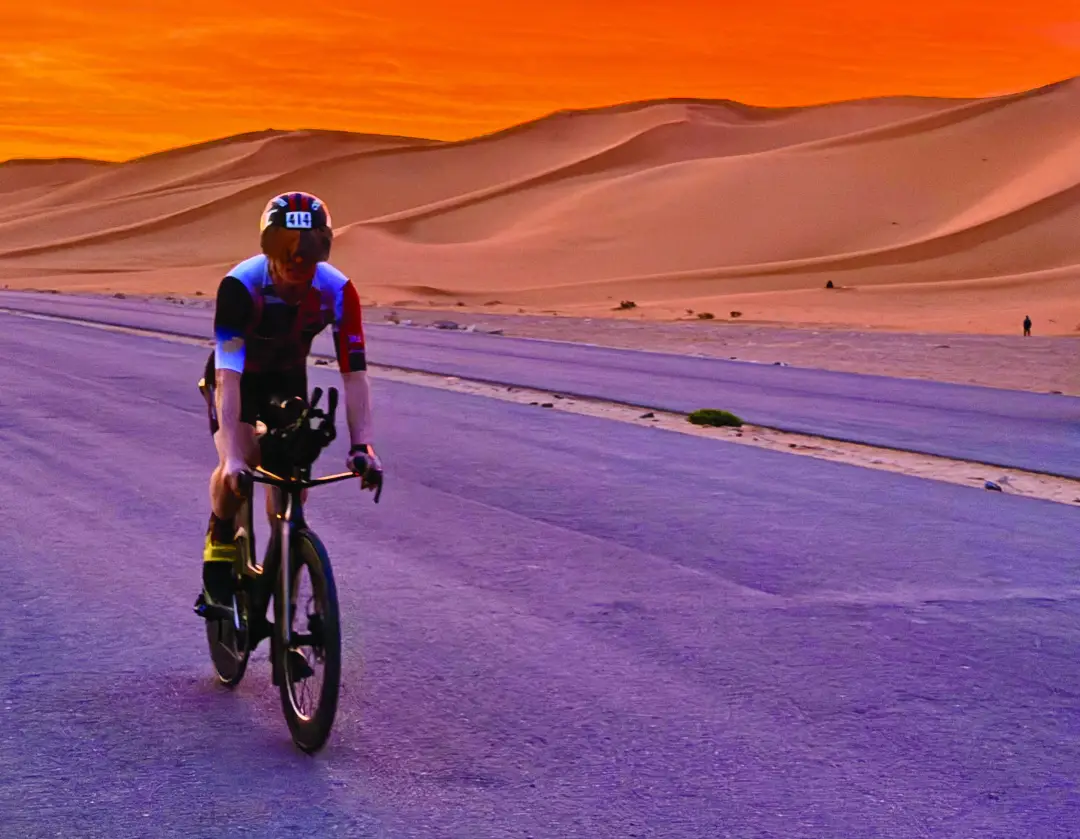
The heat is real now. Intense sun from above and the road radiating heat up from below. My tri-suit feels like a microwave bag, stuffy and claustrophobic. I’m a pale, middle-aged Scotsman. I wonder if there is a worse combo for surviving a hot climate. Was this a silly idea?
As these thoughts start to fester, I’m directed off the road and towards endless mountains of sand. The ground underfoot swallows my trainers and with every step they get heavier from the grains that have now hitched a ride. Then the elevation kicks up! Reality hits: I am deep in the Algerian Sahara Desert taking part in the Saharaman Extreme Triathlon.
Breaking the mould
The Saharaman race was born from a simple but radical idea. To take the sport of triathlon and place it in one of the most demanding environments on Earth.
The race founders, Algerian endurance athletes and race organisers, believed that modern triathlon had become too clean cut, lacking adventure. They wanted something different. Something that instilled passion and left a mark on its competitors.
The Sahara, vast and unlike anywhere else on earth, was the obvious venue. From the start it was never about creating the biggest race or the most commercial event. It was designed as an experience-led triathlon, where the environment would be front and centre.
Each discipline shaped by the desert. Swimming in remote desert waters, cycling along exposed roads under vast open skies, running on sand and in heat that would force competitors to slow down and take everything in.
An unlikely start
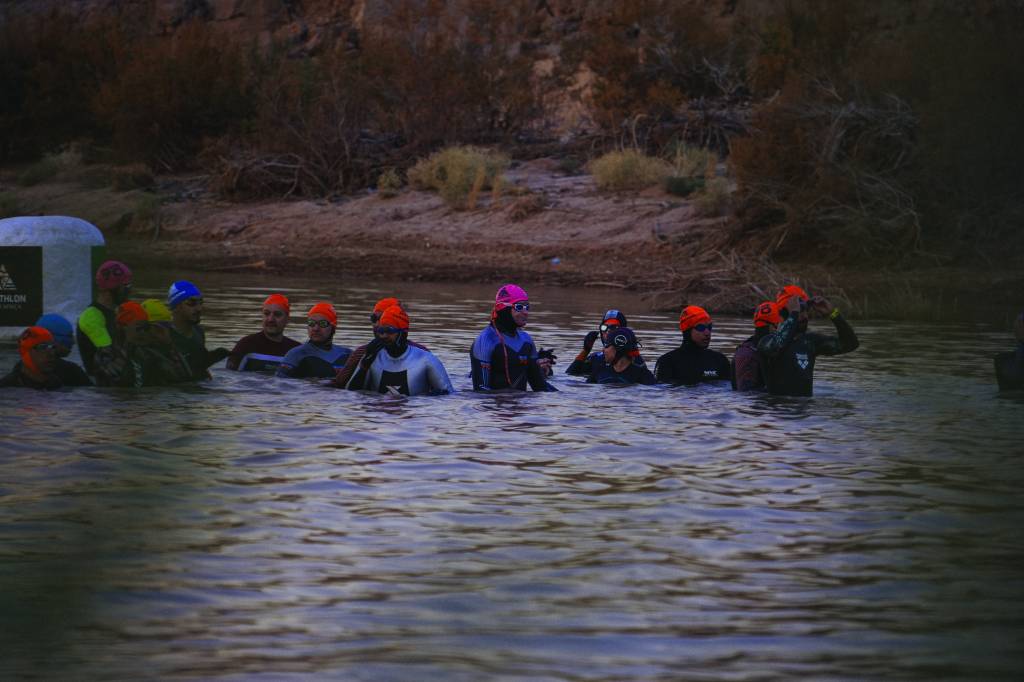
The venue for the 3.8k swim is a striking contrast to the rest of the event and its surroundings. Set in an oasis, fed by melting ice from the Atlas Mountains, it is cold. Water temperatures rarely reach higher than 10-12 degrees.
We enter after a stunning sunrise that lights up the water and surrounding dunes in an array of colour. As we get our game faces on, so too does the desert. It starts to hint at the heat to come.
The horn goes for the deep water start and something strange happens. Instead of the usual sprint to the back, I hold my position at the front. This is unheard of. I know my place in the food chain and top swimmer (or even average) I am not.
I think a couple of things were at play here:
1) The other athletes were mindful of the huge task ahead and were really holding back.
2) I, too, had promised I would take the swim and bike easier. Removing the pressure of trying to go fast I swam relaxed and, as a result, actually swam faster than normal.
After the first of the four laps, I did begin to fall back from the front, but not by much. Instead of being the usual grind of self-loathing that I’m used to, I was enjoying myself.
The multilap format was fun. The support from the banks was raucous and loud. The sheer other worldliness of the location kept things interesting. I kept thinking “I’m swimming in the middle of the Sahara Desert!”.
Apart from some persistent cramp in my left calf, I felt good and by the fourth lap I’d even passed some of the athletes that had gotten away early on. As I was hoisted out of the water by the volunteers at the end I was told that I was in second place and only 30s back from the leader. As well as help getting out of the water, there were multiple hands to help with getting neoprene off and handing me my kit.
The volunteers were really on top of everything with huge amounts of enthusiasm. I left transition in 1st place, buzzing from shouts of encouragement and delighted/bemused by my position at the front.
Power struggle
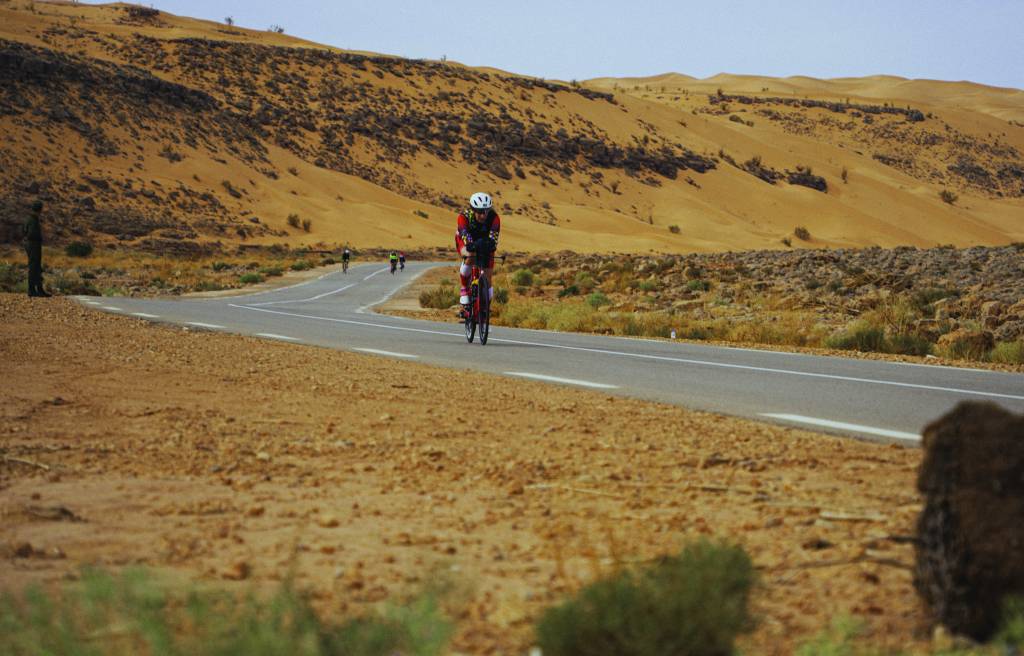
The 182km bike is split into two parts. Three shorter laps to the south of the swim and four longer laps to the north with a section connecting the two loops.
The southern loop is rolling with some hills, the northern is mainly pancake flat. Both are on generally very good road surface. The desert air was still cold. While I had been toasty during the swim wrapped up in neoprene the start of the bike was chilly.
I soon warmed up and then started to pay attention to my surroundings. The landscape was like nothing I have ever seen. Towering mountains of sand on one side. Lush palm tree lined oases and huge red rock cliffs peppered with neolithic engravings on the other. The contrast was bewildering and beautiful.
Annoyingly, my power meter had decided to take the day off. I worried that the early excitement from taking the lead and being amped up by my incredible surroundings would make pacing difficult to gauge. I made a conscious effort to back off the pressure on the pedals.
I had about a 5 min lead on second-place Petr Vabrousek and made a deal with myself that, within reason, I would gauge effort based on how this gap developed. After about 10km, coming into a village I hit a speed bump and four of my five hydration bottles went airborne. I stop to collect them but realise the aero bracket holding two has snapped completely.
Two bottles have cracked badly and now leak. I’m reminded of a friend’s advice before the race: “Nutrition is critical in this place mate, miss a bottle or forget to eat, and you’ll pay for it later”. A new year’s resolution of mine has been to swear less. Standing at the side of the road, holding my broken bracket and bottles I fall off the wagon.
I allow myself a full vein-popping, white knuckle download of expletives before collecting myself, glancing self-consciously around and getting back on my bike.
The remaining south loops go smoothly. The views continue to be incredible. There is a real sense of past meeting present. The new, smooth road we are on passing through dunes and rock formations that feel ancient.
One minute passing traditional mud huts, goat herders and barefoot children. The next being tracked by an FPV drone piloted from a shiny new land cruiser.
The ride to the northern loop is equally spectacular but now the heat is starting to become a factor. It shouldn’t be a surprise. We are in the Sahara Desert but coming from Scotland, where my last long ride was in the snow, it packs a punch.
Despite the temperature, the northern loops go well. The aid station team from Infinite Nutrition does a great job providing me with a fresh carbohydrate/ electrolyte bottle for each loop. Even better, my guts don’t complain about the last-minute change. I manage to hold the same gap over Petr, and we have both moved well clear of third-place Radek.
Organisation and atmosphere
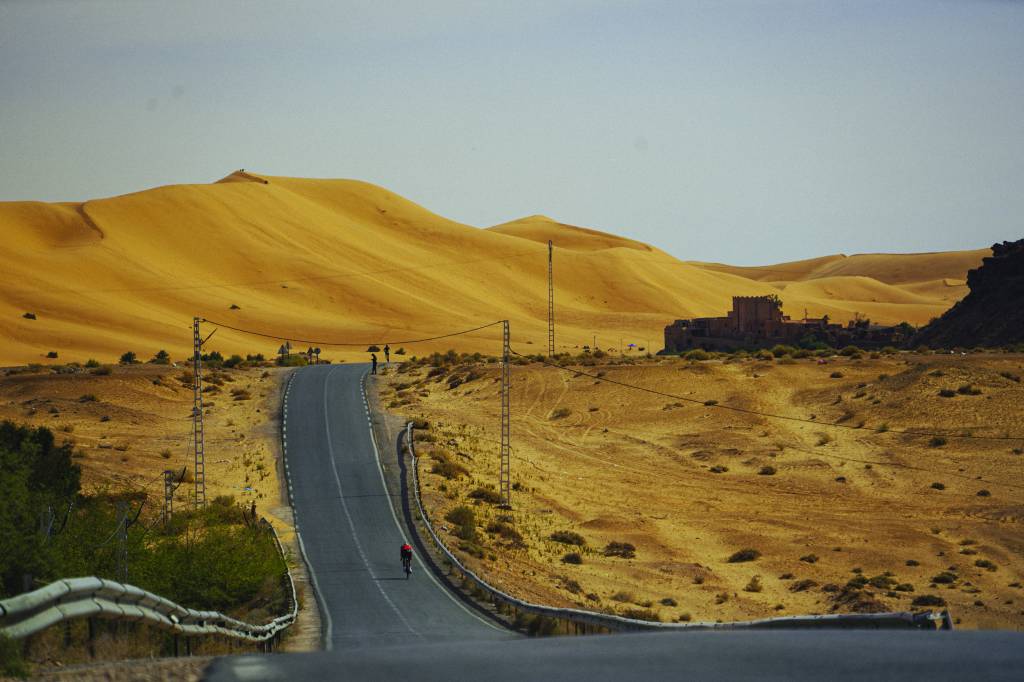
Despite the extreme location and conditions, the organisation was excellent. Aid stations were well placed, volunteers were incredibly supportive, and everything ran smoothly. Competitors encouraged each other, knowing everyone was fighting the same battle against the elements.
One of the highlights of the Saharaman is what it clearly means to Taghit and the surrounding community. The race brings attention, visitors, and energy to an area that doesn’t often sit in the global spotlight. Locals are involved, from volunteers to people lining the course, cheering with genuine enthusiasm and curiosity.
A local volunteer I spoke to described the race as “more than a sporting competition. It’s a celebration of Algeria. It creates a bridge between athletes from around the world and the local culture”. For Taghit, the race is a chance to show the world its hospitality, and beauty.
Running on fumes dunes
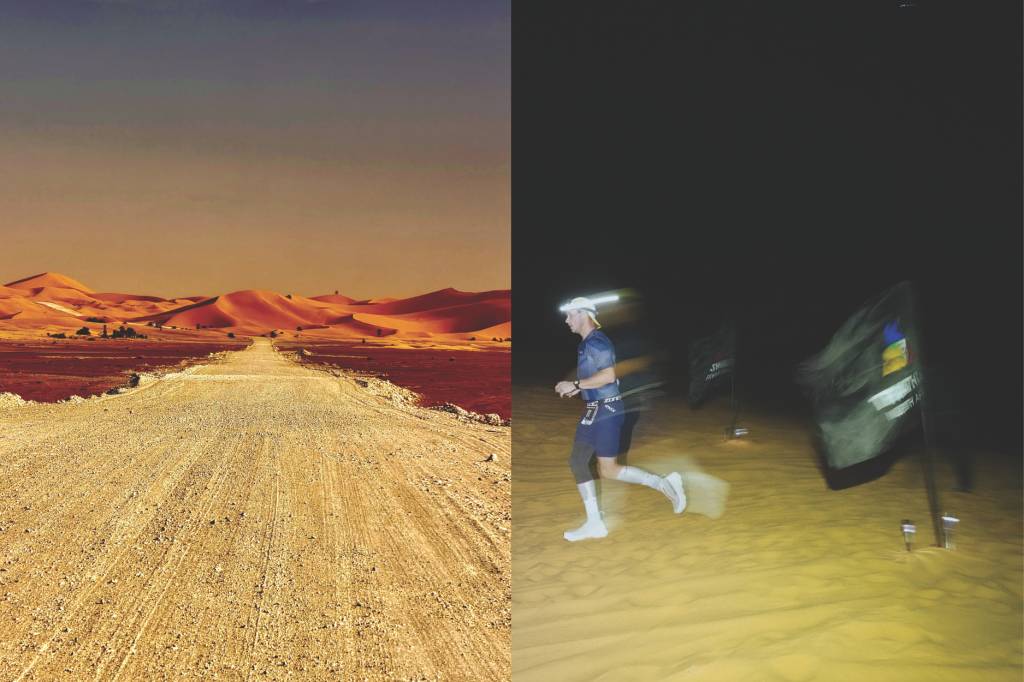
Starting the marathon, I was extremely aware of how hot the day had become. I was now also in direct contact with the tarmac that radiated heat upwards. I kept reminding myself to go easy, even with Petr so close behind I avoided the temptation to push too soon.
The terrain around Taghit plays a massive role in shaping the race. None more so than with the run. The desert is no longer just a backdrop. It now exerts a direct toll. The wind, the heat, and the light are all now at their peak and then there is the sand!
After 6km on the road, I start the first out and back section over the dunes. I’m tired and hadn’t quite gotten into my running. I was apprehensive about the sand, but these sections actually become my favourite parts.
They were slow and they were hard work but navigating the terrain required concentration. I found myself forgetting about the suffering and just dialling into the process of moving through the terrain.
Despite the difficulty, or maybe because of it, the atmosphere on this section is ramped up a notch. Athletes support each other in quiet, meaningful ways. A nod, a few words, shared smiles of disbelief. There’s a sense of camaraderie that I’ve rarely felt elsewhere.
Because of the lap format, there are always people around too rather than being a long and lonely day out that some extreme events can turn into.
With each sand section, I realise that my lead is growing and at the halfway point I decide to slow things down slightly and really savour the experience of this place. Even so, I approach the finish line very much shattered and grateful to be able to soon stop.
Finishing, I feel quite emotional. Delighted with the result, physically wrecked, relieved to have coped with the heat. Most of all feeling overwhelmingly lucky to have experienced that place and guilty for not having shared it with my family whom I suddenly miss. There is something quite magical about Taghit and the dunes. In that moment, sharing it felt very important.
Whether you are a hardened triathlete looking for serious competition, a weekend warrior looking for something wonderfully different, or a social media influencer looking for content that will blow followers minds this event has it all.
The heart of the Saharaman is the challenge and the race itself. The soul is undoubtedly the desert and its people. Together they make for an unforgettable experience. A truly unique, incredible adventure run by people who care about sharing the sport of triathlon with their people and sharing their wonderful country with the world.
Let’s go
How to get there? Athletes make their own way to Algiers (Algerian capital city). I flew from Edinburgh via Paris. The flights were surprisingly cheap and easy with air France. From Algiers the race organiser provide a private chartered jet to Bechar and then coach transfer to Taghit.
Accommodation: In Algiers I stayed at the Hyatt Hotel at the airport. It was relatively cheap; the gym and pool were good and it was literally a 5 min walk (1 min shuttle ride) from the terminal. The hotel in Taghit was provided by the organisers. It was lovely with nice swimming pool, good food, friendly staff and lots of extra tourist activities for those that wanted. It would be a great base for a family if they were accompanying.
When can I race? The 2027 race will take place on Thursday 28th Jan 2027.
Meet Iain
Father of three wonderful boys, husband to a wonderfully tolerant wife and business owner, Iain masquerades as a triathlete in his spare time. He’s the course record holder of Braveheart extreme triathlon, Starman extreme triathlon, Roc England, Wales and Scotland extreme triathlons. Plus, runner up at last year’s Celtman Extreme Triathlon.


 Kate Milsom
Freelance sports journalist
Kate Milsom
Freelance sports journalist