Suunto Vertical 2 review: brighter and better multisport watch continues Finns’ run of form
James Witts tests the adventure-ready Suunto Vertical 2, updated to include an AMOLED screen and flashlight, and enhanced navigation.

220 Triathlon Verdict
Impressive training tool with an impressive battery life, but on the smaller size and no music storage. Score: 85%
Pros
- Great training and adventure features
- Long battery life
- Larger, brighter screen
Cons
- Only pairs via Bluetooth
- No music storage
- Screen is smallish
Chapeau to Suunto as, reassuringly, the Vertical 2 continues the Finnish brand’s recent run of excellent form after the excellent Race multisport watches.
In fact, the software and feature list is essentially the same as the Race 2.
The main points of difference come in the hardware. So that’s where we’ll start this review off…
How we test multisport watches
Our expert reviewers take triathlon watches on several rides, runs and swims to assess their heart-rate and GPS accuracy, multisport modes, health and fitness metrics, comfort, clarity of screen, connectivity, value for money and extra features. For more details, see how we rate and test products.
Bright light and screen

Following the Garmin trend, this is the first time Suunto’s integrated a flashlight into one of its watches.
It’s impressive and easily activated, helping to light your way on dark trails, albeit it’s clunky to turn off.
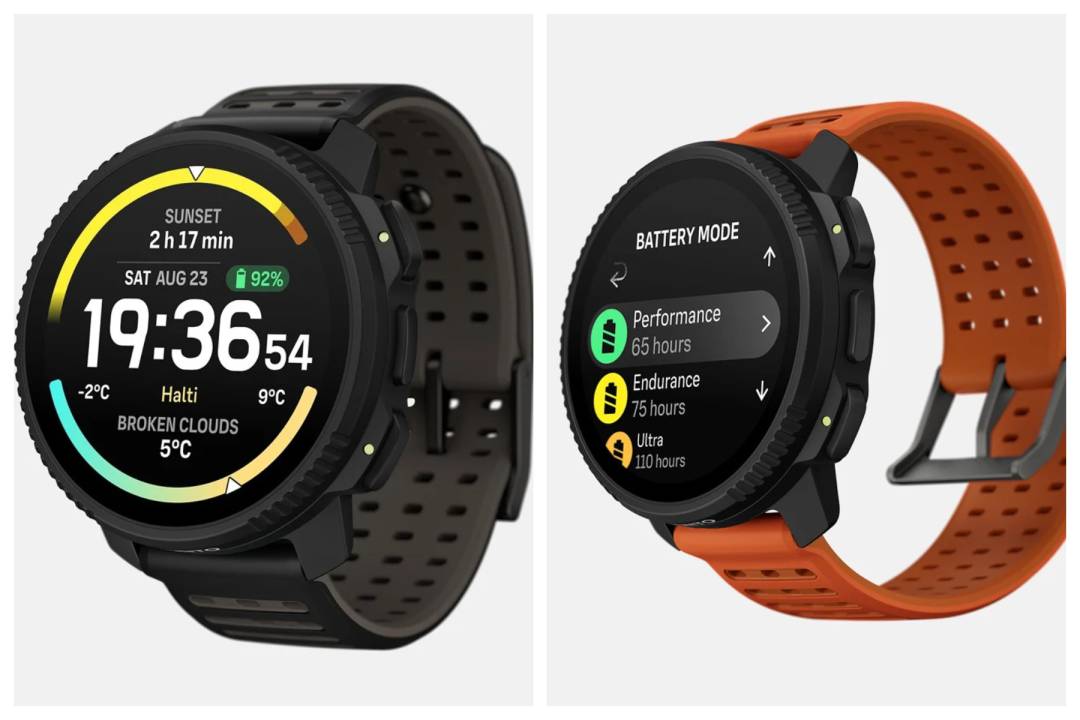
A minor thing but something to tweak for the Vertical 3. Unlike the Vertical 1, the screen is now AMOLED.
As ever with AMOLED, that means a clear, crisp display. The payback for that brightness is generally reduced battery life.
But this is where we doff our helmets as even in its most accurate GPS mode, you’re given up to 65 hours of charge. That is truly impressive. Simply used for daily smartwatch use and it’s 20 days.
There are over 115 sport modes that, like the many other features, are activated via three physical buttons and the touchscreen.
When you activate the required sport, the data’s more accurate than times gone by thanks to a new optical heart rate sensor.
GPS and navigation

GPS pick-up was good, though took a while to activate in build-up areas, but when it did connect and start tracking it sustained things nicely.
Its navigation is clear and accurate, and rather neatly you can download maps from the Suunto app without a cable. It’s neat.
As is Climb Guidance that helps you plan for elevation, gradient and surface changes on upcoming trails.
Similar to watches at this price point, you’re also given sleep assessment, a VO2max estimate, a compass, heart rate variability…
In the pool you can measure stroke rate, plus stroke efficiency, which is always a useful metric to work on over the off-season period.
Via Bluetooth it seamlessly syncs to your power meter, as long as it’s Bluetooth; that said, these days most are with ANT+ a rather dated mode of connection.
It also picks up Zwift swiftly to display your heart rate on the screen.
Running, you’re talking power, a neat ghost runner to race and many other useful metrics.
Suunto Vertical 2 bottom line
All in all, it’s impressive with just one wee desire in that the screen could have been a little larger.
But that’s personal preference and some who find the latest batch of sports watches just too huge may prefer this.
Plus, there’s no musical storage, which isn’t the end of the world for me but might deter some who want their tunes on their wrist without having to carry a phone.
Read our round up of the best bike computers if you’re after a dedicated cycling device.
Suunto Vertical 2 spec
| Price | $599/£529 |
| Weight | 87g/3.07 oz |
| Battery life | 65 hours GPS mode, 20 days smartwatch mode |
| Features | Integrated flashlight, offline maps, 100m water resistance, 24/7 health tracking, dual-band GNSS |
| Connectivity | Bluetooth only |
| Screen | AMOLED, 1.5in |
| Storage | 32GB, no music |
| Strap colours | Black, grey, orange, green |


 James Witts
Freelance sports writer and author
James Witts
Freelance sports writer and author