Van Rysel XCR Tri review
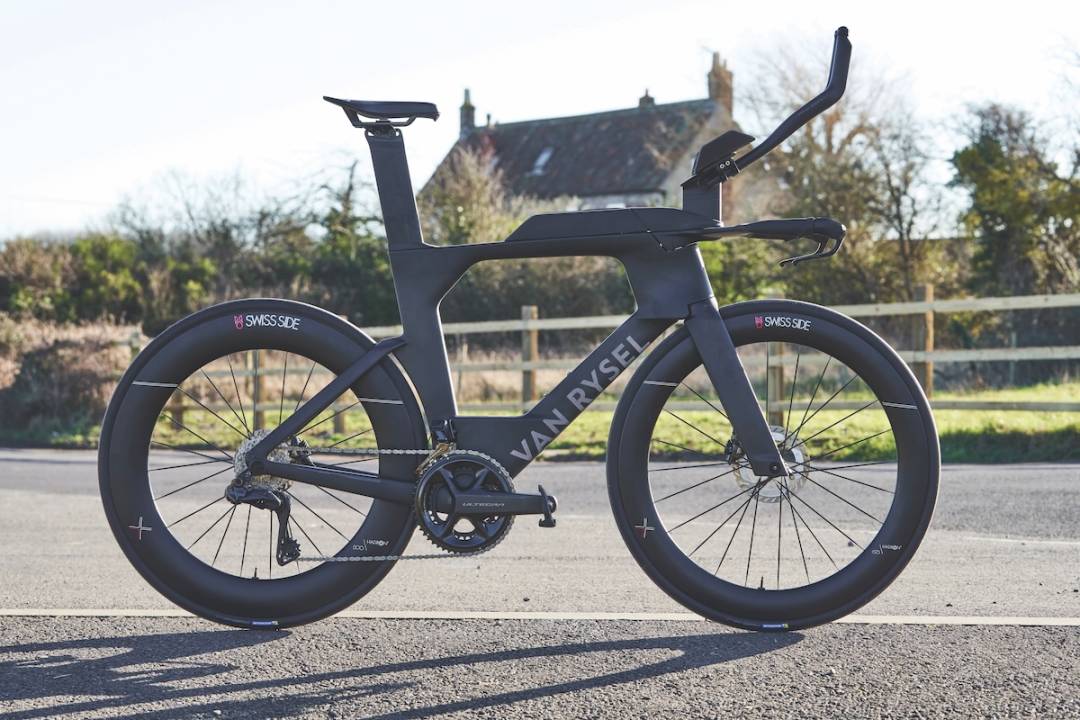
The Van Rysel XCR Tri is the Decathlon in-house brand's first triathlon bike. How does its debut effort stack up?

220 Triathlon Verdict
Another triumph of a bike from Van Rysel which I struggled to find much to improve on. Score: 85%
Pros
- Reassuring handling
- Quick
- Compliant
- Lots of cockpit adjustment
- Good value spec
Cons
- Wheels can feel a bit sluggish
- Bento box isn’t top quality
The Van Rysel XCR Tri is the French brand’s first triathlon bike and follows the launch of its RCR road bike, which hugely impressed me.
At £7,000, the XCR Tri isn’t cheap. But it costs less than its premium competition and features Shimano Ultegra Di2, Swiss Side deep-section carbon wheels and a carbon cockpit.
Has Decathlon’s in-house brand cut corners? Or is the XCR Tri a high-performing bargain? Let’s hop on board and find out.
How we test triathlon bikes
Every triathlon bike we review is tested on similar roads during rides of different durations and speeds for at least several weeks. We assess the bike’s adjustability, triathlon-specific features, ride feel, handling, comfort and value for money. For more detail, see how we rate and test products.
Van Rysel XCR Tri frame

First up, this isn’t solely a Van Rysel venture. For both this and the RCR, Decathlon’s in-house brand tapped into the services and expertise of Swiss Side. As the name suggests, Swiss Side is a Swiss company that specialise in aerodynamics.
The founder, Jean-Paul Ballard, spent 14 years as a lead engineer in Formula One including as head of concept design at Sauber. He’s also a keen cyclist and is clearly uber-qualified in the world of slipstreaming speed.
The XCR is the follow-up to the XCR UCI-legal time-trial bike that’s used by WorldTour cycling team Decathlon AG2R La Mondiale and the likes of Ben O’Connor, who finished second at last year’s Vuelta a Espana.
UCI-legal frame with triathlon accesories
The XCR Tri features a UCI-legal frame but non-UCI-compliant accoutrements like the bars. As well as Swiss Side, Van Rysel sought the input of some of its sponsored athletes including two-time European Ironman champion Denis Chevrot.
No doubt, Denis had a say in the myriad triathlon-specific features including a built-in toolbox with included tube, CO2 inflator, valve extender, tyre levers and 6mm Allen key, plus bento box and what Van Rysel calls a ‘trash box’.
It doesn’t include integrated hydration but does come with between-the-extensions and behind-the-saddle mounts, albeit not on my test model.
The other visual standout is that cockpit, which offers a huge amount of adjustability. I’ll come back to that shortly. It comes in five sizes and two build options: Shimano Ultegra Di2-equipped with Swiss Side Hadron triathlon wheels, which I tested; and loaded with SRAM Rival AXS groupset and Fulcrum Wind wheels.
All in all, there’s a lot going on. Before I dig deep into the ride, I must comment on its looks, which I really rather like. In my eyes, you can’t go wrong with a dark, brooding colourway (that often reflects my mood on a long, painful ride, especially into a headwind).
It certainly drew glances on my usual Somerset test route that weaved its way from the Severn Channel over to the Mendips and back again. That said, if you’re a fan of something a little lighter, it’s mooted that a holographic white version will be available soon.
Impressive adjustability

Before I’d set cleats onto pedals, it was all about nailing the set-up, which is always a little more involved on a tri bike than a road bike, especially on the XCR Tri due to the sheer amount of adjustability. The proprietary cockpit offers up to 95mm spacers, so you can adjust their height to your heart’s content, while there’s 30° of tilt. I’m a fan of a pretty vertical set-up as I find it more comfortable.
Swiss Side’s also shown from testing that the ‘praying mantis’ position is extremely aerodynamic, though not for everyone. It depends on your body position, hand position and arm position. Neither of mine are textbook for drag-reducing purposes but they are comfortable, which is a sustainable win in my books. That said, there’s loads of fore-and-aft adjustment for the most aggressive of aero positions.
Riding the Van Rysel XCR Tri

Once set up, it’s clear that one of its major attributes is just how smoothly it hoovers up the tarmac. Unless you’re married to the likes of Zwift or Rouvy, or have no sense of feel, riding upon UK roads can often feel akin to the white gravel roads of Tuscany. That’s relatively fine on a versatile road bike but can be somewhat disconcerting on a triathlon bike, especially when hunkered down on the extensions.
But with the XCR Tri, comfort flows with every pedal stroke. Why is always down to multi-factorial reasons but one of the major ones is the choice of carbon lay-up. The French brand reportedly chose the high-modulus option over ‘super’ high-modulus option because the latter was too stiff with the XCR’s tube shapes, which are airfoil, albeit with chunky forks for the air to be smoothed out around.
Whatever reason lay behind the comfort, it’s noticeable and arguably highlights the attention that’d gone into research, designing and creating the XCR, which Van Rysel says took over three years.
It also involved 14 prototypes of refinement before the bike went to market. According to the company’s white paper, each frame also consists of 586 carbon parts, albeit I couldn’t break the bike down to verify!
Van Rysel XCR Tri handling

What about what I feel is the most important aspect of a triathlon bike: handling? Not only is an unstable triathlon bike rather dangerous – especially when the sidewinds doth blow – but it’s also incredibly fatiguing, as you attempt to wrestle your bike into a straight line. Thankfully, the XCR Tri handles impressively, even in sidewinds.
The XCR Tri also handles well on the basebar, though some might find the length of the grips a touch long.
Stable, fast wheels
That handling and stability is helped by the Swiss Side Hadron2 wheels, which are a combination of the 625 upfront and the 800 outback. That equates to a 62.5mm-deep and 80mm-deep rim, respectively.
They’ve been out for a few years now but stand the test of time. Their handling and stability attributes could be down to the decrease in steering moment from edition one by 26%. Steering moment is the force applied through the handlebar by air pressure acting on the front wheel and results in greater stability.
Without comparing incarnations one and two in the wind tunnel, it’s impossible to back up the claims but it works where it matters most: in the real world.
If there’s one minor complaint, it’s that they’re not the fastest to accelerate from a brief interlude of deceleration like rolling in and out of a corner, but that’s being very picky.
That said, you’re helped to peak velocity by the Di2 bar-end shifters. Yes, this is nothing new on a top-end triathlon bike, but it’ll never become boring shifting through the gears with an effortless press of a button.
Being able to remain in the aero position while rapidly rolling up and down the gears is one of the gamechangers of recent times, especially on a technical course that requires multiple gear changes.
Hitting your optimum gear for your optimum cadence depending on the terrain is another win, as you don’t leach energy, which pays off on the run.
All in all, I might not be the quickest of triathlon cyclists but I certainly can’t blame the bar-ends for that.
Sensible gearing and integration

As for the Shimano Ultegra Di2 gearing set-up, the choice of a 52/36T crankset upfront and 11-34t cassette outback should be sufficient for all but the amateur Chevrots out there.
And it weighs around 21.5lbs / 9.75kg for the large, which is pretty competitive for bikes at a higher price point than this. That relative lightness is noticeable when ascending.
As for the triathlon-specific accoutrements, the integrated top-tube bento box is a nice touch and accommodates numerous gels that’ll at least keep you riding until the next feed station. A new one to me is the ‘trash box’ next to it, that’s essentially a separated extension of the bento box.
It’s a nifty idea, though might be more useful to store your sodium capsules if that’s part of your hydration strategy. One negative is that the bento is a little flimsy.
Finally, the bottom-bracket-based toolbox is a nifty addition, though thankfully I didn’t have to employ the services of its contents.
Van Rysel XCR Tri bottom line

Similar to the RCR, Van Rysel’s created a product that will surprise many.
When you think Decathlon, you think general sports gear, camping equipment and, well, generally products that are utilitarian not premium.
You could argue that perception might stop many from spending their money on a bike brand that, on the face of at least, doesn’t have the cachet of your Cervelos or Scotts.
But don’t let that cloud your judgement. This is an impressive triathlon bike for the most experienced of triathletes. It’s even more impressive when you consider it’s their debut effort.
It’s comfortable, handles nicely and is fast, though on that last point and with a nod to the future, we’d be interested to see just how fast a Van Rysel triathlon bike could be if the frame didn’t adhere to UCI regulations. That’s for another time. For now, chapeau to the French brand.
Van Rysel XCR Tri specs
| Price | $6,500 / £7,000 |
| Components | Shimano Ultegra Di2 with Inpeak power meter, Swiss Side Hadron2 wheels, Michelin Power Cup tyres 700x25c, Van Rysel carbon aerobars, Fizik Aeris saddle |
| Weight | 21.5lbs / 9.75kg |
| Sizing | XS, S, M, L, XL (156-196cm / 5’11”-6’4″) |


 James Witts
Freelance sports writer and author
James Witts
Freelance sports writer and author