What is a good swimming pace? Coach shares the key swim benchmarks for triathletes
Want to know how your swimming pace during a triathlon compares to others? Coach Andrew Sheaff shares the swim benchmarks you need to know and how you can get faster…

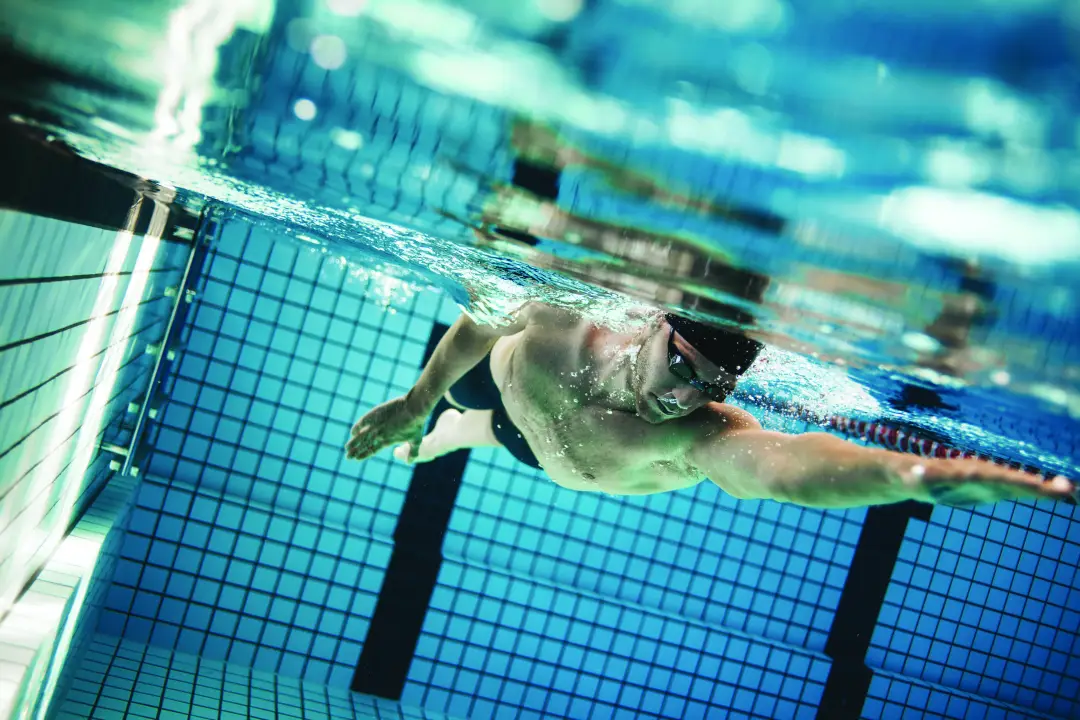
A lot of athletes want to know what’s an appropriate pace when swimming. Unfortunately, there’s not one answer for every person in every situation, but there are certain guidelines you can follow.
Swimming pace will depend a lot on your experience, the distance you’re trying to cover, and the environment you’re trying to cover it in. It’s also important to invest in the right gear if you want to improve your swimming speed. For example, invest in a pair of the best swimming goggles that won’t cause you to stop every few lengths to evacuate water.
This article will try to provide insight by providing different paces in different contexts, information you can use to determine what’s appropriate for you. In almost every situation, the best approach is to find out where you’re at right now and aim to get better over time. Before you know it, your swim will have improved drastically!
What’s a good swimming pace in the pool?

A good swimming pace in the pool will be determined by your ability levels as well as the distance that you’re swimming over. The first step in determining an appropriate pace for you is to start paying attention.
Note what pace you use over various distances. You can also perform several time trials over several distances and note your speed. You can use these results as a baseline to evaluate progress and for comparison.
What’s a good swimming pace in open water?

Swimming speed in open water will often be dramatically slower than in a pool. This effect can be even more dramatic depending on weather conditions, and it affects different individuals differently. You can expect to swim 5-20 seconds slower per 100m depending on the circumstances and the individual.
As a frame of reference, elite 6mi/10km open-water swimmers can finish their race well under two hours, which equates to a pace of 1:12/100m. These are elite athletes focusing exclusively on swimming, so adjust your expectations accordingly!
What’s a good time for a 100m swim?
The world record over 100m freestyle for men is currently 46.40 seconds (Pan Zhanle, 31 July 2024) and the world record for women is 51.71 seconds (Sarah Sjöström, 2017). For someone without a competitive swimming background, swimming 100m under 60 seconds is exceptional and swimming under 1:10 is very good as well.
How do swimming strokes affect pace?
Different strokes will have a different impact on swimming speed and pace. Far and away, freestyle swimming is the fastest and most sustainable stroke. For those comfortable with it, backstroke is also sustainable if you have good technique, although not as fast as freestyle.
Butterfly swimming can be fast over very short distance, but most individuals find it incredibly difficult to sustain speed with butterfly. While breaststroke is the slowest stroke, many find it so be sustainable due to the ease of breathing, espeically in colder water during a triathlon.
What is a good swimming pace for pro triathletes?

The top 10% of Ironman swim legs average around 1:35 per 100m. However, pro triathletes that excel at the swim can achieve performances of under 1:20 per 100m for the women and under 1:15 per 100m for the men, depending on the water conditions.
Smooth water, the addition of a good triathlon wetsuit, and a helping current will all aid performance. There can be a very large range of paces used by pro triathletes depending on their relative skill in the swim. Some excel, while others use it to prepare for the upcoming legs of the race.
What is a good swimming pace when racing triathlon?
In a sprint triathlon, covering the 750m swim in 22-28 minutes would be a good performance for an age grouper. A good swimming pace for a 1500m Olympic Triathlon swim leg would be between 30 and 40 minutes. This compares to 18-22 minutes for elite men and 20-24 minutes for elite women targeting fast triathlon times.
At the long-distance triathlons, the median age-grouper swim speed is about 2:00/100m for men and 2:10/100m for women. Therefore, for a Half Ironman’s 1900m swim, a strong performance would be 40 minutes and upwards for a non-elite. While setting record triathlon times for 70.3, Taylor Knibb and Marten van Riel finished their swims in 24:45 and 22:49, respectively.
And a time of 1 hour 20 minutes would be an average swimming pace for an Ironman swim leg. Elite women complete their Ironman swim leg in 47-60 minutes and the top men take 45-55 minutes.
Is swimming 1km in 30 minutes good?

Swimming 0.6mi/1km in 30 minutes is averaging 3:00 minutes/100 meters, which is not very fast assuming standard conditions. With proper instruction and training, many individuals are capable of achieving performances that are faster than this.
As typical Ironman swim performance average around 2:00 minutes/100 meters, 3:00 minutes is below average. However, that means there is a lot of opportunity for improvement!
At this level of performance, the fastest way to get faster is often through better body position, which can be improved through exercises like the Ball Float shown in the video below:
What’s a good 1km swim time?
At the elite levels of pool swimming, men can swim 0.6mi/1km in under 10 minutes whereas elite women can swim it in less than 10:30. When it comes to open-water swimming for the non-elites, swimming 1km in a time of under 20 is respectable and under 15 minutes is very good.
Is 1,000 meters a good swim workout?
A good swim workout is one that challenges you and helps you move closer to your goals. If that can be accomplished in 1,000 meters, it’s absolutely a great swim workout for you. Once the distance becomes manageable, or once more swimming is required to accomplish your goals, you may need to swim for longer.
Those aiming to compete over the Olympic triathlon distance or longer will need to complete longer workouts, at least on occasion.


 Andrew Sheaff
Swim coach
Andrew Sheaff
Swim coach