“The win at all costs mentality is good until it puts you in physical danger.” Exploring the dark side of elite racing
When heat becomes the fiercest rival on course – as we saw in Kona last year – those who master their pacing, fuelling and thermoregulation will thrive. But with the planet only getting hotter, how can athletes – both pro and age-groupers – continue to race safely? Liz Barrett investigates...

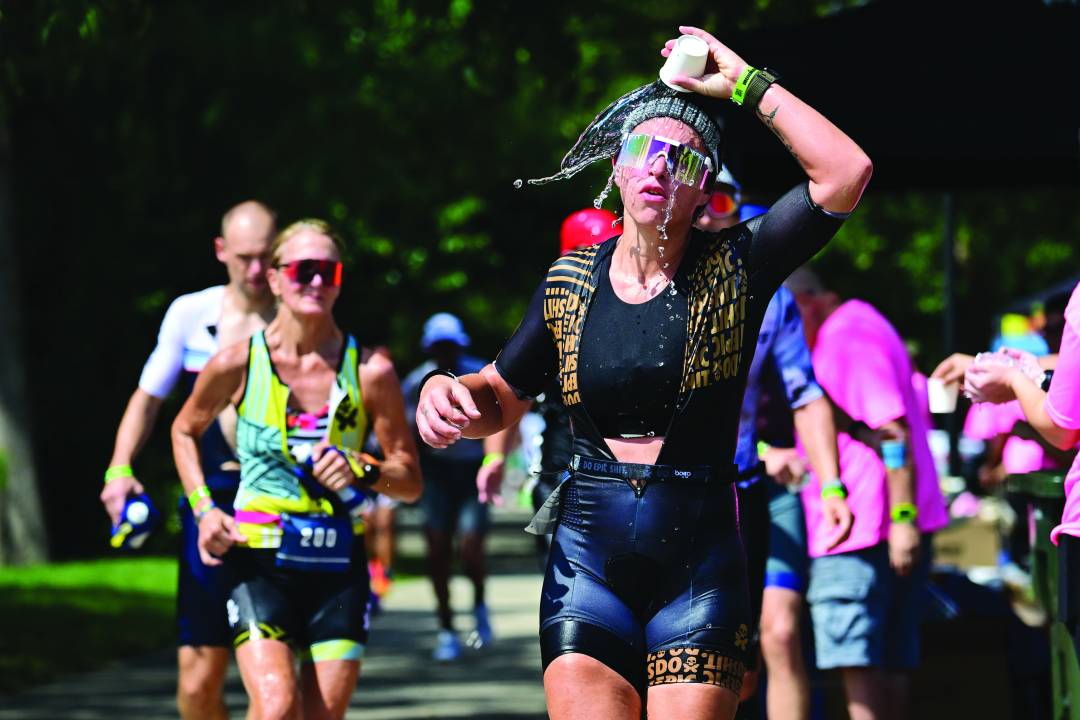
What was your standout moment from the 2025 women’s Ironman World Championship in Kona? Was it Lucy Charles-Barclay collapsing into husband Reece’s arms and calling it a day after pushing her body to its absolute limits?
Perhaps it was seeing the US powerhouse Taylor Knibb sitting on the side of the Queen K having done the same? Or was it Norway’s Solveig Løvseth’s incredible debut win? Kat Matthews’ outstanding marathon leg that saw her cross the line just 35secs behind Løvseth?
There were countless other performances on 11 October that combined to make those champs one of the greatest – and most punishing – in the sport’s 47-year history. But one of the key protagonists in Kona that day was also the heat.
Temperatures in the Energy Lab section of the run course reached as high as 40°C (104°F). The humidity hit 70%. It was these punishing conditions that caught out the likes of Charles-Barclay and Knibb, two elites, who have been racing at the top for many years, but who both suffered heat-related illnesses.
“I did not imagine that ending before the race,” admitted Knibb on her Instagram post-race. “Heading back into town, it was definitely very, very hard and getting worse by the minute. I walked an aid station. It was hard to get running again.”
“In that moment I fully committed to doing everything I could to hold my position. Just keep moving forward. Step by step. And I overheated myself completely with less than 3k to go. Sometimes our greatest strengths can also be our greatest weaknesses”
“Knowing what I know now, of course I would have adjusted how I approached that section and the race. But only knowing what I knew in the moment when I made/was making the decision, I wouldn’t.”

Charles-Barclay was as equally honest in her race appraisal: “I stuck to my plan, nailed my nutrition, and used all of my usual cooling strategies. It was all going so well… until it wasn’t.”
“I’m endlessly grateful for the love and care my husband showed in stepping in and taking me off the course. Health will always come first.
“As special as this race is, there will always be another start line, another chance, another year for the history books. That’s the unpredictable nature of Kona; it’s what draws us all in, to its beauty and its brutality.”
But how could two of the sport’s top athletes, who have both raced Kona before, get it so wrong?
“Motivation is almost always a precipitating factor in these top-level athletes,” believes Lindsey Hunt, senior sports scientist at Precision Fuel & Hydration.
“These athletes are incredibly tough and strong individuals psychologically, and can push past and are indeed even training to push past these biological feedback mechanisms that tell us to slow down or stop. There can also be hydration strategy issues that exacerbate any overpacing.
“If we don’t drink enough fluid, and lose body mass and blood volume, our sweat rate will drop below our evaporative requirement for heat balance, and we’ll start to store body heat, leading to finite exercise duration.”
In Taylor’s case, Hunt says it was almost certainly a case of exertional heat illness – “Her core temperature was still >41ºC when she arrived at the medical tent around 45 minutes after she pulled out of the race.
“As we all observed, she was unable to control her body, a clear sign of central nervous system disruption and dysfunction, which is incredibly dangerous and life-threatening.”
As for Charles-Barclay, Hunt thinks a fluid balance issue led to her DNF: “It sounds like she was experiencing severe thirst early on in the bike. That said, she’s reported feeling super cold on the run, which can be a sign of a heat illness as well.
“I would suggest that part of the reason she was able to bounce back for the 70.3 Worlds [which she won four weeks after Kona, with Knibb crossing the line in second] was that she pulled out ‘early’ and did not go so deep at Kona.”
Thermoregulatory strategy

Even eventual Kona victor Løvseth said she feared she would be another victim of the harsh conditions, had the race been just a few kms longer. Yet the first-time Kona racer crossed the line looking fresh as a daisy. So what did the young Norwegian do compared with the more established names to make sure she stayed upright until the end?
Hunt again is the man to ask, as Løvseth has been a PF&H product fan for many years. “My specific work with her before Kona focused on thermoregulatory strategy, not on product selection,” he says. “We targeted two key areas – pacing in the early bike and run, and fluid intake targets based on her predicted sweat losses.
“We discussed the need to moderate early power and pace on the bike and the run, so that her sweat rate had time to rise and match the increased metabolic heat production at race intensity. This is essential because sweat rate does not instantly reach its steady-state; if intensity spikes early, heat production rises faster than evaporative cooling capacity, leading to avoidable heat storage.
“By pacing appropriately in the opening kilometres, she allowed her sweat rate to ‘catch up’, helping limit the cumulative heat storage and ultimate rise in core temperature later in the race.
“In our post-race debrief, she even noted this in particular on the bike, where some athletes passed her early on, and then came back to her as she passed them further into the bike, and then ultimately on the run as well.”
If you don’t know the brand, PF&H offer online tools and in-person sweat tests to create personalised hydration and fueling strategies for athletes. They then match an athlete’s specific sodium and carbohydrate requirements to their range of products, including electrolyte drinks, energy gels, and chews.
Løvseth, for example, is a moderately salty sweater, which aligned very well with the sodium concentration across her drinks during the race (868mg of sodium per litre of fluid), which ultimately supported fluid balance and relieved the risk of cramp across such a long and hot race.
“Solveig’s predicted sweat rate for Kona was ~2.2–2.4 L/h on the run,” says Hunt. “At these losses, even small pacing errors or insufficient fluid intake will accelerate dehydration and reduce sweating efficiency.
“Our pre-race strategy centred on sustaining an appropriate, manageable level of dehydration, rather than allowing it to progress to the point where sweat rate declines and core temperature rises sharply.

“We selected fluid targets on the bike and run to almost match her sweat losses on the bike, and then for the run, it was simply to mitigate her cumulative level of dehydration to give her the best chance by maintaining an appropriate level of dehydration (2-4%) based on her sweat rate – which turned out to be in excess of 1.5L/h on the run.
Maintaining sufficient fluid intake on both the bike and run supported her ability to maintain her sweat rate to its highest level throughout the marathon, which was decisive in the final outcome.”
In pre-race interviews, Løvseth described her heat training as her “most effective cooling strategy”. But what about age-groupers who don’t have access to a brand’s personalised expertise and tailored advice? How should they approach this key element of racing on a planet that is only getting hotter? (Hunt told us that average air temperatures in Kona are around 1.5ºC warmer than in 1950 – “a small but significant change”.)
“Athletes racing in warm environments need to respect the what and adjust their pacing targets, especially early in the race to the conditions they are racing in,” says Hunt.
“Elite athletes either do already or should focus on more: heat acclimation, pacing discipline, fluid intake that limits dehydration (body mass loss) to appropriate amounts for the race duration, conditions, and tolerance level (typically 2-4%), cooling strategies, practising race nutrition in the heat, and finally replacing the right amount of sodium in their drinks to individualise their hydration strategy even further.
“Age-groupers can replicate all these strategies with similar, if not more influential benefits, given that elites are generally less impacted than regular athletes by hot and humid conditions.”
So just how important is it to know your numbers regarding sweat composition and volume?
“Sweat rate determines individual fluid requirements, and these can vary from nothing up to 3.5L/h at the extremes,” says Hunt. “Sweat sodium concentration determines sodium replacement, and again, these losses are incredibly individual. We’ve tested over 31,000 athletes and see sweat sodium losses from as little as 200mg/L up to over 2300mg/L.
“Without this information, hydration strategies can easily under- or overshoot physiological needs, leading to poor race outcomes like DNFs and medical tent visits.”
Duty of care

A lot has been written lately about the duty of care among race organisers (notably by columnist Tim Heming), and how they can do more to help mitigate the effects of racing in the heat.
For Hunt, he only had the highest praise for the medical team in Kona last year, saying he’d not seen a more dedicated and well-organised team to deal with heat stress cases on site.
However, he believes more could be done regarding information and education on pacing, hydration, and heat acclimation ahead of racing in hot and humid events, such as Kona or other extreme-condition events like Ironman Cozumel, to better prepare athletes and enhance safety.
“We’ve seen organisations like Tennis Australia employ extreme heat policies to keep athletes as safe as possible in extreme conditions, which is seen as the gold standard for events management these days.
The AO Heat Stress Scale assesses extreme heat conditions during play – air temperature, radiant heat, humidity, and wind speed – and assigns a rating from 1 to 5 to determine when to implement measures like extended breaks for players or suspending matches to ensure player safety.
However, with the goal to determine the fittest athlete, this often comes with the notion that they should be the fastest in any condition, and indeed able to handle anything, potentially at the detriment of their health.
“That being said, with the lower exercise intensity during an Ironman in Kona (compared to shorter races), cases of exertional heat illnesses are actually lower than shorter, faster races in more mild and much less extreme conditions.”

I remember being at the finish line of the 2010 World Championship Series race in Hyde Park when Alistair Brownlee experienced extreme heat exhaustion. Despite vastly different racing conditions, Alistair’s body temperature, like Knibb’s in Kona, hit 41°C as he crossed the line in 10th place, down from first. He would go on to lose consciousness and wake up in hospital.
Six years later, he would sweep up his brother Jonny down the finishing straight at the 2016 Grand Final in Cozumel, Mexico; the younger sibling also having succumbed to heat exhaustion.
“I vaguely recall feeling weak, Alistair grabbing me, and then everything goes blank until I woke up surrounded by doctors,” Jonny posted to his Instagram in November last year.
The incident made the front pages across the globe, and did more to promote the Brownlees – and the sport – than their two previous Olympic Games successes combined.
Yet for all the ‘brothers in arms’ and ‘hero’ headlines, underneath them remains a serious message – get your fuelling and heat adaptation wrong and it could have serious consequences.
Jonny believes that his body has never been right since that Cozumel race. And as Alistair said about his London experience only last year: “The win at all costs mentality is good until it puts you in physical danger.”
How can athletes optimise their fluid intake for peak performance?

Hunt provides his top tips for a smooth race day. Replace a proportion of sweat (fluid) losses, not all, to maintain adequate blood volume and sweating.
- Conduct sweat rate testing – plan to keep body mass loss within 2-4% for your race. Use the free Fuel and Hydration Planner to get a gauge of appropriate fluid replacement for your event.
- Match sodium intake to personal sweat sodium concentration. Undertake a sweat sodium test to understand your losses and supplement appropriately. If you don’t want to get a sweat test, start at 1000mg/L (around our average) and adjust up or down accordingly (more if you cramp or don’t feel good, less if you start getting really thirsty because you’re ‘over salting’).
- The goal is not zero body weight loss but a controlled level that still allows effective thermoregulation by limiting overall fluid loss, and the maintenance of central blood volume and overall fluid balance.
What to eat and drink leading up to and during an Ironman.
Hunt provides a brief overview of the key things to consider when planning your race nutrition strategy. Head to our advice section for more race nutrition strategies for all distances.
- Pre-race – High carbohydrate intake in the 24-48 hours prior (8-12g/kg of carbs each day). Familiar, low-fibre foods (leave the wheat, pizza, pasta, and grab the rice). Steady fluid intake to start the race well hydrated.
- During the race – Carbohydrate intake in the commonly recommended Ironman range (e.g 60-90g/h or more if well trained for it). Fluids guided by sweat rate and individual tolerance. Sodium intake adjusted to sweat sodium concentration. Caffeine only if already well tolerated in training.
Gimmick or godsend?

You might have noticed a few athletes, Løvseth and third-place finisher Laura Philipp included, sporting what looked like a diamond-encrusted headband during the Kona marathon. This is the Omius, which is effectively a band of 20 graphite blocks designed to help manage body temperature.
It works by absorbing and spreading sweat through the porous graphite material and small cooling blocks before being evaporated. To work properly, it needs to be kept moist.
“The whole thought process is based on the central governor theory, which suggests that if you make your brain h,appy it can tell the rest of your body things are good,” says Jay Weber, chief commercial officer at Omius.
“While it’s not directly cooling core temperature, the brain can still respond by lowering heart rate, and we’ve seen reductions of four to seven beats per minute when athletes wear it.”
As 220 columnist Tim Heming reported in September, a study from the Université de Sherbrooke in Quebec tested 10 trained male runners, who completed 70 minutes at a submaximal pace followed by a 5km time trial while wearing the Omius.
“Forehead temperature and perceived thermal comfort were significantly better with the Omius headband compared to a sham version, but there were no significant differences in rectal (core) temperature, heart rate, or perceived exertion,” he cited from the results.


 Liz Barrett
Freelance sports journalist, copywriter and editor
Liz Barrett
Freelance sports journalist, copywriter and editor