Could a crystal choker lookalike hold the key to the Ironman world title?
It looks like jewellery, but Omius’s graphite blocks could be the hottest accessory in the battle to stay cool at the Ironman World Championship in Nice.

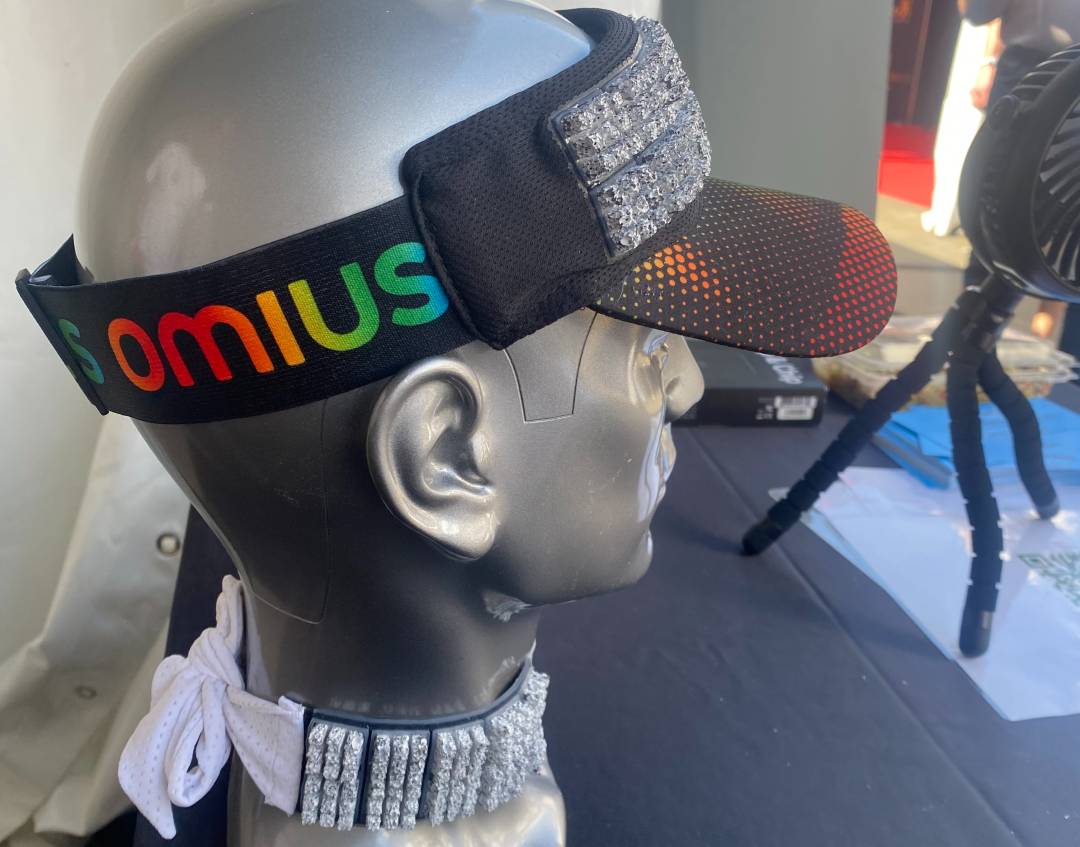
It looks like a crystal choker necklace – but could it be the jewel in the crown for competitors in the men’s Ironman World Championship on Sunday?
The Omius device – a connected sequence of 20 small graphite blocks used to help manage body temperature – has been worn by athletes as a headband in endurance races for around five years.
The system works through evaporation, using a porous graphite material and a structure of small cooling blocks to maximise surface area. Sweat is absorbed and spread, accelerating evaporation. To function properly, it needs to be kept moist – typically by dousing with water from course aid stations.
But for the first time ahead of the race on the Côte d’Azur on Sunday, the Omius will also be available in a neckerchief format, which could provide an even greater cooling effect. The idea is that it presses against the carotid arteries in an attempt to cool the blood flowing to the brain, helping the wearer feel more comfortable during the race.
“The whole thought process is based on the central governor theory, which suggests that if you make your brain happy it can tell the rest of your body things are good,” said Jay Weber, Chief Commercial Officer at Omius.
“While it’s not directly cooling core temperature, the brain can still respond by lowering heart rate, and we’ve seen reductions of four to seven beats per minute when athletes wear it.
“Another advantage of carotid cooling is that, unlike on the head, there’s no hair on the neck, so you can wear it forward or backwards.”

Weber believes some athletes may even use the device on the bike, depending on how quickly they can tie it on in transition after the swim.
The idea behind the Omius headband dates back to 2013, when inventor Gustavo Cadena was studying at Tec de Monterrey in Mexico and developing early prototypes. It first appeared in endurance sport in the years just before the pandemic and has since grown steadily within triathlon.
But does it really work? A study from the Université de Sherbrooke in Quebec tested 10 trained male runners, who completed 70 minutes at a submaximal pace followed by a 5 km time trial.
Forehead temperature and perceived thermal comfort were significantly better with the Omius headband compared to a sham version, but there were no significant differences in rectal (core) temperature, heart rate, or perceived exertion.
So is it worth investing in an Omius device, which retails at around $200 in the US, but more in Europe due to taxes?
Possibly. In long endurance events, which often become battles of willpower, any method of reducing discomfort – psychosomatic or otherwise – may prove beneficial.
As with most events in elite triathlon, expect to see many of the top professionals wearing the device – this time around the neck as well as the head – on Sunday.
It is also worth noting that, while scepticism about professional athletes’ use of products is common, Omius does not pay a single dollar in sponsorship. Those racing this weekend are wearing it because they believe it offers them an edge.


 Tim Heming
Freelance triathlon journalist
Tim Heming
Freelance triathlon journalist