Outdoor winter training isn’t your enemy, it’s your greatest ally say experts
Indoor training has its place, but the greatest gains this off-season lie outdoors, where cold winds, muddy trails and icy waters toughen both body and mind…

Indoor training is a triathlete’s off-season staple due to the technological revolution and apps like Zwift; heat training is very much in vogue due to research over the past few years extolling the benefits of cranking up the mercury to boost performance in all climes. Both clearly have their merits and have their place in your winter training.
But as triathletes, your maximal gains will come from heading outside and battling Mother Nature. As you’ll discover, she delivers myriad benefits that you simply won’t find inside…
What is the cold?

But before you swim, pedal and stride forth through the elements, it’s relevant to ask: what is cold? A stupid question? Not at all, says Dr Michael Kennedy, associate professor in the faculty of kinesiology at the University of Alberta who specialises in an athlete’s response to extreme environments.
“First off, what’s cold to some Canadians will differ to what is ‘cold’ compared to people living in the warmer UK. Personality, gender and long-term cold exposure all contribute to what you perceive as cold.”
“But for the interests of consistency,” Kennedy adds, “thermoregulation researchers would say your body perceives cold at 20°C in a semi-nude state (light t-shirt and shorts).
“At 15°C your skin, mouth, nasal passages and lungs start to sense cold via nerve endings. At 0°C most people will feel significant cold discomfort, especially if there’s a large area of skin that’s exposed or you’re under-dressed.”
That’s why when you’re training outdoors this winter, you should layer your clothing, both on the bike and run. “This helps provides air pockets between layers that is helpful to maintain micro-climate heat and preserving your comfort,” says Kennedy.
“You should also wear a thin neck covering and beanie when especially in the 0°C range of temperatures, while leggings and bib shorts should be worn with Pertex and Gore Windstopper good choices.”
“Interestingly, put Vaseline on your lips and nasal passages to help reduce exposure,” Kennedy continues. “My current research is looking at other pharmacological aids that might block afferent receptors in the skin of the face and lips and mouth but I can’t tell you what those results are yet…”
Wearing clear glasses slashes the chances of damage to firing up corneal receptors, which can be uncomfortable, while insulative and breathable gloves are a must-have.
As for outdoor swimming, a thicker wetsuit, plus neoprene gloves, booties and head attire are definites (as is an everlasting Thermos of tea).
All of this will prep you for a winter of outdoor training, which as you’ll see is worth the effort…
Journey to racing weight

When it comes to cool training – especially swimming – arguably one of the benefits is expending more energy (calories) in a short timeframe. That’s because we cool two to five times more quickly in cold water due to the thermal conductivity of water being 25 times that of air.
According to a 2016 paper co-authored by Mike Tipton, professor of human and applied physiology at the University of Portsmouth, who’s spent 40 years working in the area of thermoregulation, “Physical exercise increases metabolism by as much as 15 to 20 times the resting metabolic rate.”
That’s significant, especially as humans are an inefficient machine, turning just 25% of fuel into propelling you forward. The rest is mainly heat, so a potential challenge during summer races, but a plus in the cold.
In theory, the cold cranks up your calorie-burning potential, which will certainly pay off once Santa’s dusted off the cake crumbs.
Back to the paper: “As shivering intensity increases and more muscles are recruited to shiver, whole-body metabolic rate rises, typically reaching about 200 to 250 watts during resting exposure to cold air but often exceeding 350 watts during resting immersion in cold water.
“Maximal shivering is difficult to quantify, but the highest metabolic rate reported in the literature to date appears this corresponded to 46% of that test subject’s maximal aerobic power.”
In short, your fired-up metabolism will burn more calories, plus there’s evidence that you better manage glucose. Just note that you must always be aware of the dangers of winter swimming. Swim with a friend, build up from small dips and let your breathing adjust before crawling away.
2026 race benefit: Anything that helps the calorie burn – within reason, of course – without losing muscular power will pay off in the races, especially if there are hills involved.
Go with the increased flow

You’ll also enjoy a cardiovascular boost from training outdoors. That’s because to fend off hypothermia, you conserve heat by shutting off the blood supply to the extremities. The colder it is outside, the stronger the response. For a triathlete not regularly conditioned to temperature shifts, vasoconstriction is painful.
However, persist because even if you’re physically fit, your circulatory muscles might actually be weak, which is a side-effect of living in a very narrow band of temperature variation. As circulatory diseases contribute to almost 30% of the world’s mortality, the benefits of training in the cold are as clear as your breath on a cool winter’s ride.
2026 race benefit: Strong circulation is linked to better bloodflow, which means greater amounts of oxygen delivered to working muscles for a stronger you. Stronger circulation’s also linked with greater immunity for more consistent training. The result? Faster racing.
Pump up the powerhouses

Regular exposure to the cold gives your engine an upgrade, too. How? Well, a team of researchers from the University of Nebraska in America discovered that training in the cold generated more amplified cellular signals to create more mitochondria.
This birth of new mitochondria – or mitochondrial biogenesis – is particularly alluring for the endurance athlete because mitochondria are the powerhouses within every cell that convert nutrients like fat and glucose into energy.
In turn, greater numbers of mitochondria means you can burn more energy to fire up working muscles to propel limbs to work harder and faster.
A further study by Dominique Gagnon hammers home the mitochondrial point. Gagnon had 34 subjects interval train on the bike thrice weekly for seven weeks.
The 34 were split into two with one group training at 0°C and the other at 25°C. Before and after the training period, each subject had muscle biopsies, which involves slicing off muscle from the leg (as a side note, this is one reason why elites are rarely the guinea pigs in sport-science studies) in order to analyse how much mitochondria was present.
Sure enough, the group that trained at zero enjoyed a significantly greater increase in several different markers of mitochondrial content.
2026 race benefit: Bigger and more numerous mitochondria is akin to buying a larger, more powerful oven – you’ll burn more energy to fuel your muscles into ticking off a new personal best.
Burn the cool fat

Those of you who are fans of ‘The Iceman’ – aka Wim Hof – will be aware that one reason the Dutchman is a big fan of plunging into bodies of icy water is that it ignites a fiery furnace that activates brown fat.
Unlike white fat whose main job is to store energy, brown fat’s remit is to burn energy to generate heat, which is why babies, who have yet to develop their shivering system, have a higher proportion of the stuff than adults. It’s mostly located around the neck and upper-chest area, along the spine and around the kidneys.
It’s activated during mild cold exposure, around when you begin to shiver. Those who aim to acclimate to the cold, like those training to swim the English Channel, will possess what’s termed ‘greater non-shivering thermogenesis’ due to greater activation of brown fat compared to non-acclimated swimmers.
Tipton doesn’t necessarily agree that its burning qualities are significant, suggesting a hard, long interval session could see a triathlete generate 3,000 watts of energy compared to brown fat that would reach a rather tepid 30 watts; that said, he does suggest that activating brown fat still pays dividends by improving cardiovascular health. That’s supported by 2020 research in the journal Arteriosclerosis, Thrombosis and Vascular Biology.
2026 race benefit: A lighter, more proficient you can only result in more speed come the 2026 race season.
Technique matters

Training outdoors this winter isn’t solely about the physiological – it’s about the technical, too. While the likes of Zwift and Core KickR are great for cranking up your fitness, even the most realistic app and smart trainer can’t hold a candle to outdoor riding for skill development. Braking, balance, cornering… All of these are improved by a ride as simple as a commute.
Naturally, this boosts your riding confidence, ensuring you react to real-world changes, be it when riding in a group or stopping abruptly at traffic lights. You become more aware of the madding crowd, meaning you become a safer, smarter, speedier triathlete.
As for running, head off-road and the benefits are even greater as you engage stabilising and synergistic muscles, not just the main muscles that you activate when pavement pounding.
Every step is different, which improves proprioception. This mean your brain is more in tune with your body’s position in space, without having to rely on visual cues alone. This sub-conscious improvement in balance is particularly important as we age.
2026 race benefit: Indoor training – aside from pool work – simply can’t replicate the nuance and detail of racing. Train hard outdoors to race fast outdoors.
Strengthen your mind
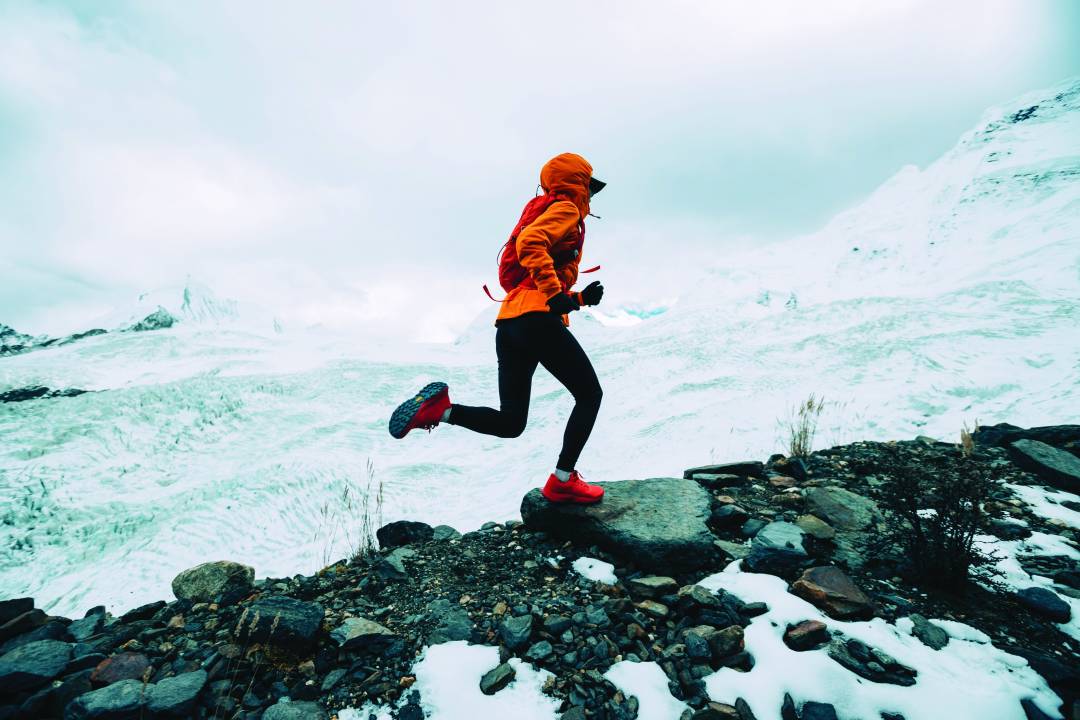
So, training outdoors will shape significant physical gains. As anyone who’s spent four hours riding against a backdrop of sleet and wind can testify, there are also some pretty hefty psychological victories that’ll transcend to sunnier race climes with the first being resilience.
Anecdotally, it’s pretty clear that if you can dig deep and tick off another chilly session, you’ve mentally reset your bar for how much pain you can tolerate. You then carry that into subsequent sessions, progressing the overload for improved performance.
At a more forensic level, regularly forcing yourself to ‘embrace’ the inclement elements results in you exerting what’s called ‘top-down control’ over the depths of your brain that regulate reflexive states.
This process taps into your prefrontal cortex, an area of your brain involved in planning and suppressing impulsivity. By facing your cooling demons, you’re emboldening the prefrontal cortex, which manifests itself as ‘resilience’ that you can carry over into both the racing amphitheatre and life itself.

Staying up top, numerous studies have shown an improvement in mood straight after cold exposure, aka a cold-water dip. Take a 2021 study by John Kelly and Ellis Bird of Chichester University.
They had 42 cool characters stand in chest-deep water at 13.6°C sea waters in the United Kingdom one November for up to 10 minutes. Compared to the warmer control group of 22, as well as displaying a red rawness that’s standard with a winter plunge, the brave 42 registered higher scores on the Profile of Mood States scale.
In short, they exhibited a more positive sense of being, primarily due to dopamine flooding the body. Adrenaline has also been shown to rocket during cold-water immersion, again bolstering mood.
As for riding and running, a 2023 study in the journal Scientific Reports highlighted how exercising outdoors is better for your mind than exercising indoors, while further research that year showed that walking outdoors prompted a bigger increase in the brain waves associated with relaxation compared to walking on a treadmill.
Those who walked outdoors on the trail dotted with trees showed more significant connectivity between the areas of the brain associated with attention, sensory perception and reasoning. The researchers concluded that the individuals who walked outside had better focus on the current moment.
There’s also an increasing body of evidence extolling the benefits of outdoor green and blue spaces. Simply being in the presence of nature can be beneficial, as natural settings have been found to regulate physiological functioning by decreasing stress responses such as heart rate and blood pressure.
Evidence suggests that being in nature for more than 150min a week is related to excellent mental health and wellbeing.
2026 race benefit: We all know that triathlon can be a mind game as much as a physical. Strengthen what goes on up top can only help but accelerate and sustain what goes on down below.
All in all, outdoor winter training isn’t your enemy – it’s your greatest ally. Exercising through the cold builds resilience, sharpens skill, amplifies energy systems and ignites a mental toughness that no app can replicate. So, let others hunker down in climate-controlled comfort, wrap up, step out and let Mother Nature sculpt the athlete who’ll shine bright come the race season.
Consistency equals rapidity
Five tips to ensure you stay safe when training outdoors this winter…
- Indoor warm-up. One of the responses to cold is shutting down blood flow to your peripheral arteries. When that happens, it’s hard to open them up again, impairing your session. So warm up inside before heading out for a ride or run. Stepping up and down a staircase for 10min will get the blood flowing, but not to the stage of sweating.
- Ice bath to prep you. When it’s cold outside, endurance legend Sean Conway has a quick ice bath. He says that the ice bath is so cold that all of a sudden the outside conditions feel ‘warm’ and it resets his resilience bar. A cold shower works, too.
- Ensure you’re dressed for the elements, whether that’s the cold, wind or/and rain. That means layering, which more readily controls your temperature.
- Deflating your tyres by 15–20psi from your normal levels will increase the tyre’s contact with the road and so strengthen grip. You could also choose wider tyres, like 28mm, for further contact.
- Avoid ambiguous ice. You see that white line and manhole cover? Innocent road furniture, aren’t they? Don’t you believe it. The rain turns them into a surface that resembles ice, so keep away. If you can’t avoid, do not brake or turn on them. Learn from what has gone wrong in the past in order to make sure it doesn’t happen again.
Off-season excitement
Here’s a quintet of races to see you through till the main season…

New Year’s Day Triathlon
1 January 2026, Royal Commonwealth Pool, Edinburgh.
400m pool swim, 11-mile bike, 3.5-mile run.
Celebrate the New Year by satiating your competitive appetite (albeit maybe check the start times before signing up if you’re planning to really celebrate Hogmanay!).
Dorney Duathlon
18 January 2026, Dorney Lake, Windsor.
10km run, 38km bike, 5km run.
The standard-distance offering is one of five race options. The remaining quartet are sprint, sprint relay, standard relay and super-sprint.
The Frosty Aquathlon
1 March 2026, Littlehampton, West Sussex.
800m swim, 10km run.
Sign up for some south-coast swim-bike fun with the choice of two distances: 400m swim, 5km run or the above.
Hampton Pool Chilly Triathlon
8 March 2026, Hampton outdoor pool, London.
432m swim, 20km bike, 5km run.
Take part in one of four distances and disciplines including the sprint and super-sprint aquathlons, the super-sprint triathlon and the above sprint.
Ribby Hall Triathlon
22 March 2026, Ribby Hall Village, Preston.
400m swim, 11-mile bike, 5km run.
Enjoy a fast, flat sprint triathlon on quiet country lanes around the beautiful Lancashire countryside.
For more cold water advice, check out our list of the essential cold water swimming gear you need to keep you warm and safe year-round.


 James Witts
Freelance sports writer and author
James Witts
Freelance sports writer and author