‘I never stopped believing I could do it’: How Alanis Siffert went from beginner runner to a 2:45 marathon


Challenge Roth champion Alanis Siffert only started running a few years ago. She tells 220 Triathlon how patience, consistency and trusting her body helped her produce a remarkable 2:45 marathon.
To run a 2:45 marathon, you need to average three minutes and 55 seconds per kilometre (6:18/mile). That’s a daunting pace even for experienced runners. Now add a 3.8km swim and a 180km bike ride beforehand, plus the fact you only started running three years ago, and the achievement becomes even more remarkable.
Yet that’s exactly what Alanis Siffert produced on her way to victory at Challenge Roth earlier this month, storming through the marathon in 2:45 to seal the biggest win of her career.
“It was just a day where everything aligned,” she says a couple of weeks after her dominant performance in Bavaria. “I felt fit, my legs were there, and mentally I was in such a good headspace. I was in this flow where you don’t really think – you just keep pushing and go for it.
“I experienced Roth last year. I got off the bike, and I felt awful. This time it was the opposite. I got off the bike, and I don’t want to say it felt easy, but I was in a rhythm. I didn’t have to fight against myself.”
Reaching that point, however, required patience, careful planning and trust in the process. Coming from a competitive swimming background, Siffert’s body wasn’t accustomed to the impact that running places on the body.
Getting started with running
Siffert has always led an active life. Growing up in Fribourg, Switzerland, she was surrounded by sport, with her family spending much of their time outdoors.
“We’d go skiing and hiking. I was playing football, doing gymnastics and swimming,” she says. “I’d go outside and play with my friends, running around.”
When the Covid pandemic forced swimming pools to close, Siffert suddenly found herself without the sport that had shaped her routine. Instead, she joined her parents on trail runs and rode her bike in the mountains with her brother, discovering a love of triathlon along the way.
For someone who had spent most of her sporting life staring at the bottom of a swimming pool, running offered something completely new.
“When you’re a swimmer, nine times a week in the pool, it’s kind of an aquarium,” she says. “Then I discovered a whole different world.”
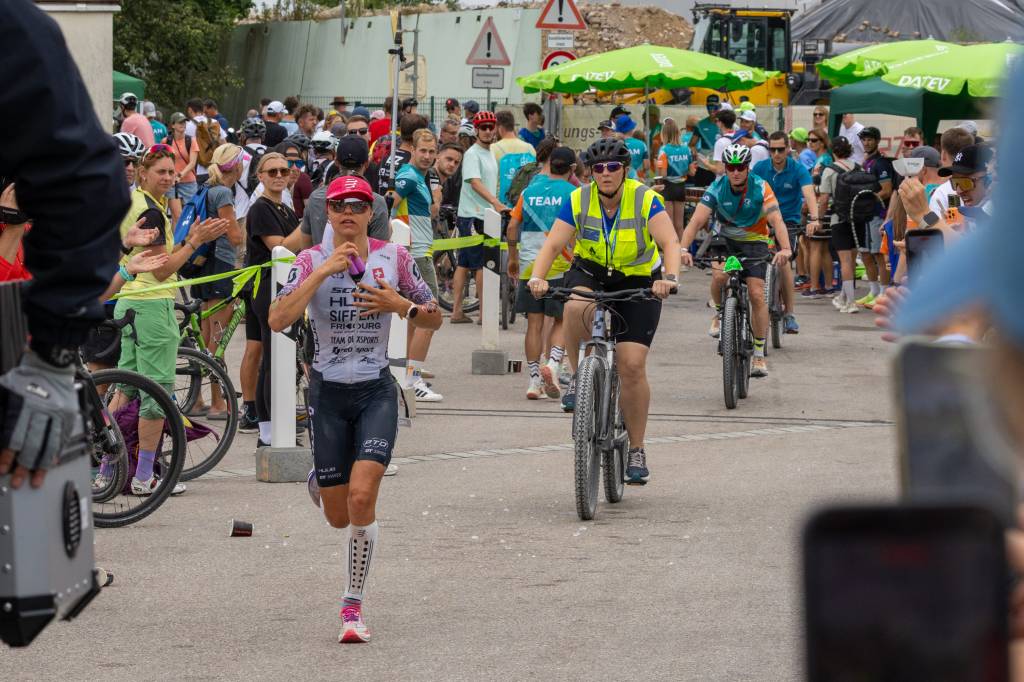
At first, running was simply something she enjoyed. Sunrise runs with her parents and mountain trails weren’t about pace or performance, but about spending time together and appreciating the outdoors.
Everything changed when she committed to triathlon full-time and joined Brett Sutton’s team in 2023. Running became structured, but Sutton’s experience coaching former swimmers meant there was no rush to increase her mileage.
“I had to be really careful as a swimmer because you don’t have that impact on your bones and body. Swimming is a really gentle sport in that respect. I’m really lucky my coach had that experience. My father is a physiotherapist too, so I was supported and had good advice.”
Patience proved crucial. While continuing to train heavily in the pool and on the bike, Siffert completed only a handful of runs each week, gradually building the durability needed to cope with running without overloading her body.
“If I saw my teammates, they’d run around four times as much as I did when I started,” she says. “I was running, but we were aware it was going to hurt me or make me injured if I went straight into the programme. We just had to be careful and do what I could do.”
Understanding her body
One of Siffert’s biggest strengths is knowing when to push and when to back off. Years spent in the pool helped her develop a strong awareness of how her body feels, something that’s proved invaluable as she’s built her running.
“I think my strength is that I would address it straight away,” she said of the first signs of any discomfort. Rather than trying to push through a niggle, Siffert adjusts her training to prevent it from developing into something more serious.
Supported by Sutton and her father, that cautious approach has paid dividends. Nearly four years after taking up running, she has yet to lose training time through injury.
“I run now more than I’ve ever run, looking back at the years,” she said. “Now, it’s a mix where we do everything from long runs to track sessions and speed sessions.”
Although her training has become far more structured, it’s often the simplest sessions she looks forward to the most.
“When you are in the forest, and you are in nature alone,” she says of her favourite training runs. “You don’t have to stick to pace. If you feel good, you go a little faster. If you feel sh*t, you go easy and enjoy the surroundings. I live in Switzerland, so I love nature, I love animals. If you wake up early and then you see some deer in the forest, that’s my favourite run.”
That awareness also shapes her racing. Much of Siffert’s training is guided by feel rather than pace, giving her the confidence to trust her body when it matters most, knowing when a pace is comfortable, a push, or too hard.
“I checked my watch one or two times, and I knew that was really fast, so then I didn’t want to know how fast I was running because then you might start to think, ‘I’m going too fast, and I’m going to blow up’,” she said about her run leg at Challenge Roth.
“I kind of just ran, and that’s also how I train – by feel. I trusted myself and trusted my feeling, and it paid off.”
‘I knew I had to be the hardest worker in the room’
Siffert knew joining Brett Sutton’s squad would raise the bar. The renowned coach has guided some of triathlon’s greatest athletes, including Daniela Ryf, Nicola Spirig, Chrissie Wellington, Emma Snowsill and Julie Derron. If she wanted to develop into a world-class runner, she knew she’d have to earn it.
“I knew I had to be the hardest worker in the room if I wanted to get my run going,” she says. “But it was a challenge, so I kind of like challenges.”
Every run came with the same objective – “hang on” for as long as possible.
“I always tried as hard as I could and I never gave up. I could have been like, ‘Oh, they’re faster,’ but I always tried to just be a bit closer and closer. It always motivated me to see the level I needed to reach.”
Being the slowest runner in the group wasn’t a source of frustration. Instead, Siffert viewed it as motivation. Having come from a swimming background, she knew she could only ever improve. Over time, she progressed from simply trying to stay with the group to occasionally leading track sessions – a moment that made her realise just how far she’d come.

The improvement, however, wasn’t instant. Like any endurance athlete, Siffert experienced periods where the progress wasn’t obvious, despite months of consistent training.
“You sometimes do six months of training and you feel stuck in a place where you’ve not improved, and then all of a sudden you make a jump forward,” she says. “I think the key is just to keep believing, to keep putting in the work and not doubting that it’s going to work.”
That mindset carried her all the way to Challenge Roth. Rather than worrying about her rivals or chasing a target pace, she trusted the process that had brought her there, running almost entirely by feel to produce a marathon she still finds hard to believe.
Now, after proving she can run 2:45 off the bike, Siffert isn’t looking to put a ceiling on what’s possible.
“I guess do it again,” she says when asked about her next running goal. “Every course is different. If I can run those times again, it would be amazing, and I could show that’s the level I’m capable of running now.”


 indiapaine