Suunto Race vs Polar Vantage M3: which is the best Garmin alternative?
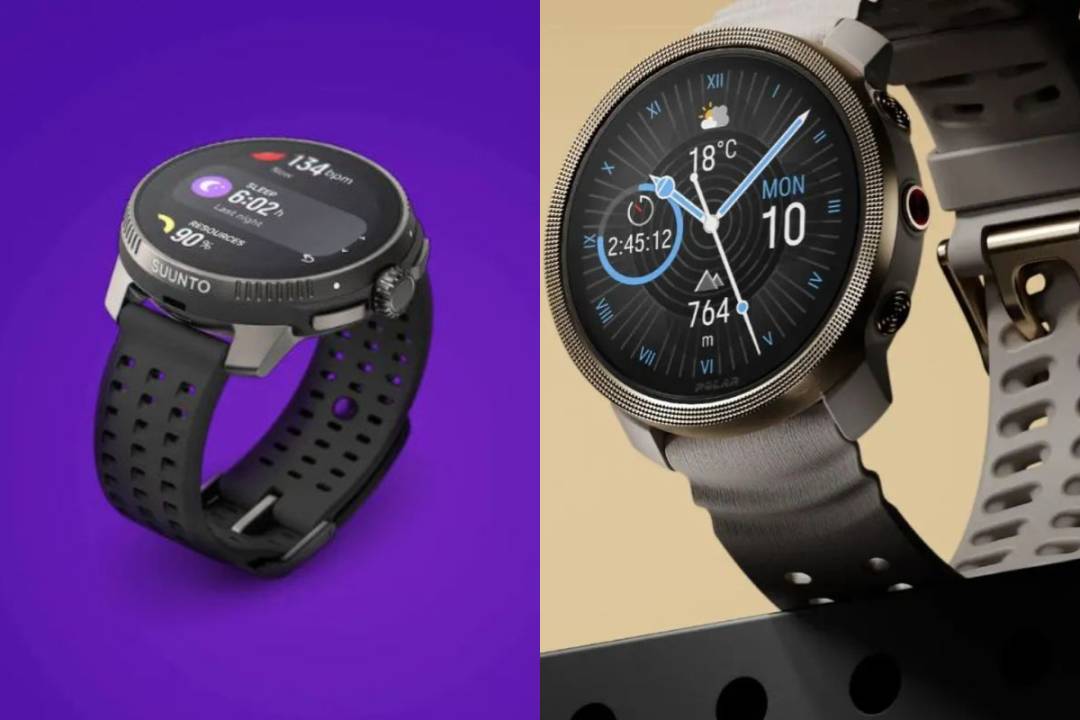
We put the Polar Vantage M3 and Suunto Race head to head to see which is the best Garmin alternative.

Garmin is dominant in the triathlon watch market and justifiably so. Its products regularly receive rave reviews from us. But there are many alternatives out there, which run Garmin’s more premium models close with their activity tracking, health and fitness metrics and GPS prowess.
Take, for example, the Suunto Race and the Polar Vantage M3. These Finnish challengers to Garmin are similarly priced and have scored highly in our independent reviews by James Witts. James is a former 220 Triathlon magazine editor and cycling author who has tested many of the multisport watches featured on 220 Triathlon.
So which should you pick if you don’t want a Garmin? Scroll down to read our head-to-head breakdown of each watch’s strengths and weakness before our final conclusion.
Suunto Race vs Polar Vantage M3 specs and features

As you can see from the side-by-side comparison of the Suunto Race and the Polar Vantage M3, their spec and features are similar but the Race is $100 / £90 cheaper.
The Race has the larger of the two AMOLED displays (the brightest and clearest kind of digital watch screen), longer battery life in GPS mode and a better app based on our experience.
The Vantage M3 is lighter but this weight saving comes from its plastic case and buttons. These may prove less durable than the Race’s stainless steel case and buttons.
It has twice as much storage for maps as the Race, but we noticed that its maps lacked a little clarity. Both watches have dual-frequency GPS (also known as multi-band GPS). This features maximised GPS accuracy by using a combination of GPS signals to position you.
They also both use a touchscreen and side buttons as controls.
As for activity tracking and connectivity, both watches have the crucial multisport mode for triathletes along with hundreds of other profiles. They can connect to sensors via Bluetooth but not ANT+.
| Suunto Race | Polar Vantage M3 | |
| Price | $449 / £389 (stainless steel) | $549 / £479 |
| Display | 1.43in AMOLED | 1.28in AMOLED |
| Weight | 2.93oz / 83g | 1.87oz / 53g |
| GPS | Dual-frequency | Dual-frequency |
| Mapping | Colour maps, 16GB storage, offline maps | Colour maps, 32GB, offline maps |
| Connectivity | Bluetooth | Bluetooth |
| Key health metrics | Training Stress Balance, Training Stress Score, Chronic Training Load, HRV | Blood-oxygen, HRV, nightly skin temp, Training Load Pro |
| Battery life (GPS on) | 40 hours | 30 hours |
| Controls | Touchscreen, digital crown, two buttons | Touchscreen and buttons |
| Companion app | “Usable and comprehensive” Suunto app | Polar Flow app “feels in need of a refresh” |
| Key flaw | Can only pair to one sensor of the same kind | Map detail could be clearer |
Suunto Race vs Polar Vantage M3 performance

The Suunto Race has the longer claimed run time of 40 hours while Polar says the Vantage M3’s will last 30 hours in the same setting. So if you want to have to recharge your watch less frequently, go for the Suunto.
We found the Suunto companion app much easier to use than Polar’s Flow app, which feels “a little outdated”. Suunto has licensed several fitness and fatigue metrics from Training Peaks, which makes the app more insightful than Polar’s.
It’s very straightforward to sync routes over WiFi although you can store fewer of them on the Suunto. Its maps are displayed in higher definition than the Polar’s too.
Neither watch shines in terms of connectivity because they are limited to Bluetooth connections. More premium rivals incorporate ANT+ so you can pair to more devices simulataneously, which is especially handy when cycling indoors on a turbo trainer. And frustratingly, the Suunto Race will only remember one sensor of a given kind, ruling out having multiple heart-rate monitors or power meters stored at once.
Although both watches record your Heart Rate Variability to track your recovery, the Polar Vantage M3 also measures your nightly skin temperature to offer greater insight. Each watch’s wrist-based, optical heart-rate monitor seemed pretty accurate, but we’d always recommend using a more accurate chest strap.
Suunto Race vs Polar Vantage M3 value for money
Both watches are competitively priced. The Suunto Race is cheaper than its direct AMOLED competitors, comparing favourably to the Garmin Forerunner 965 ($499.99 / £499.99).
Meanwhile the Vantage M3 undercuts models in Polar’s range such as the $749.95 / £649 Grit X2 Pro while using similar software to them.
Head to head, the Suunto Race looks a better deal. Its large screen should be easier to read on the wrist and its steel case and buttons are likely to be sturdier. Arguably they contribute to a more premium look too.
Suunto Race vs Polar Vantage M3 verdict

The Suunto Race offers better battery life, build quality, and map clarity. Its 40-hour GPS mode run time, metal construction, and companion app are impressive at $479 / £389 price. Its weakness is that it only connects to only one sensor of a given type.
The Polar Vantage M3 will appeal to data nuts who want advanced training and recovery analytics in a lightweight watch. It inherits the high-end software of Polar’s more expensive watches, like Training Load Pro and HRV status However, it has inferior battery life and build materials, and a dated companion app.
As a result, the Suunto Race wins this close battle.
How we test multisport watches
During the test period of at least a month, we take the watches for multiple swims (in the pool and open water), bike rides and runs.
We evaluate battery life, HR and GPS accuracy, usability, connectivity, companion app quality, additional fitness features, health and fitness metrics, and lifestyle features.
For more details, see how we rate and test products.


 James Witts
Freelance sports writer and author
James Witts
Freelance sports writer and author