Canyon Speedmax CF-SLX 8 first ride: it surpassed my need for speed
Built to cheat the wind and annihilate personal bests, Canyon’s new Speedmax is the most advanced triathlon bike the brand has ever produced. The question is simple: just how fast is it? I headed out to Austria to discover whether the latest superbike lives up to the hype.

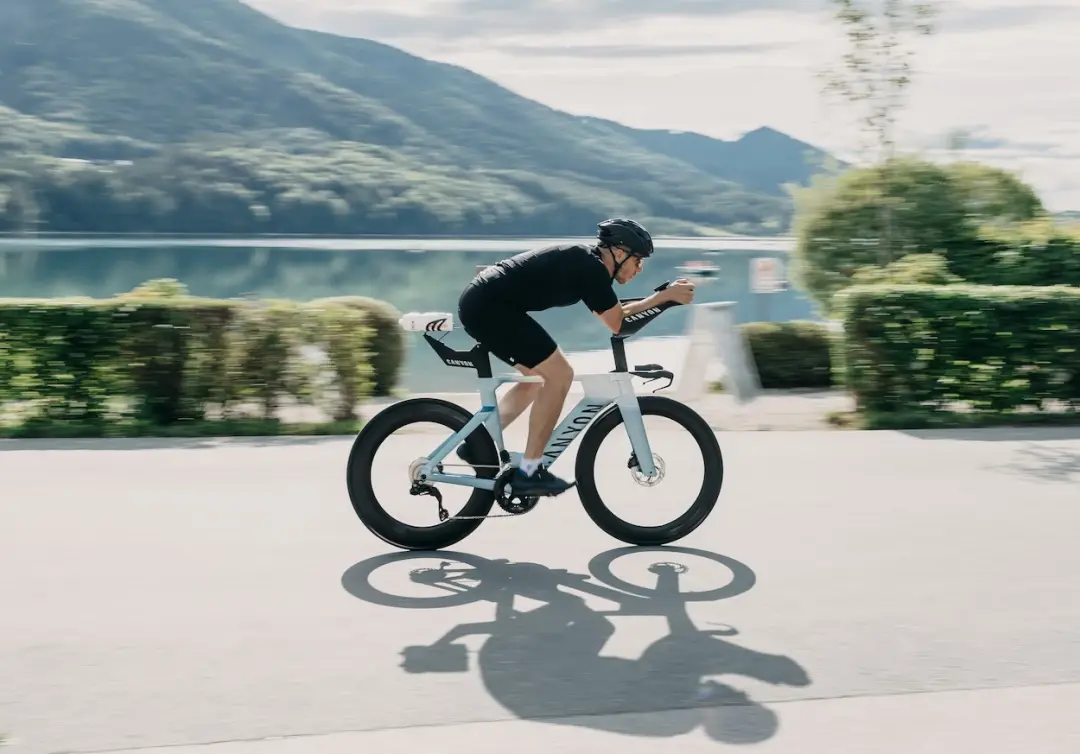
They say you should never meet your heroes… and with a mouth full of sick and a heart rate of 196bpm, I was beginning to see why. In fairness, it wasn’t all Kat Matthews’ fault, as she and the many other pro riders I was chasing were only doing what came naturally on Canyon’s all-new Speedmax CF SLX 8 triathlon bike, as we powered up a slight incline at 28.3mph.
To them, that might have seemed normal, but to me, those were the kind of numbers I never imagined I’d see on the flat, let alone on a climb in the Austrian Alps. But I also never imagined I’d have the privilege of being behind the bars of what’s likely to be the fastest production tri bike the world has ever seen.
Why you can trust 220 Triathlon
Our team of experts rigorously tests each product and provides honest, unbiased reviews to help you make informed decisions. For more details, see how we rate and test products.
In the last ten years alone, the Speedmax has powered no less than eight world championship wins, and the German brand is hellbent on maintaining its reign at the sharp end of the triathlon bike scene. So, hot on the heels of the outgoing model, which was proven to be the fastest bike of its breed, Canyon’s doubled down on its flagship pacemaker with a box-fresh Speedmax for 2026.
Canyon Speedmax CF-SLX 8 launch
Seeing it for the first time at the brand’s training camp at Fuschl am See, the new Canyon Speedmax CF SLX 8 (buy) looked reassuringly similar to its predecessor in key areas, but the closer I got, the more the changes started jumping out… and there were plenty of them. According to Canyon, the project involved the development of more than 50 new components (roughly three times more than you’d expect in a normal bike development cycle), yet was completed in a similar timeframe thanks to what the team behind it described as an all-consuming passion from a relatively small group of very committed athletes, engineers and designers.
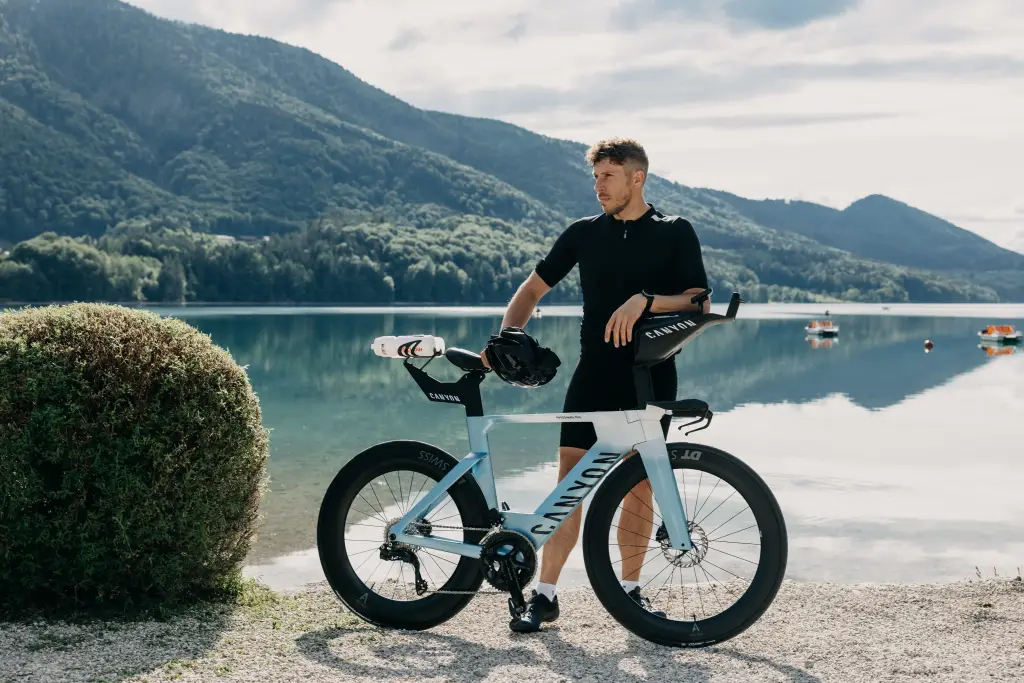
As you can imagine, no stones were left unturned in the process of this six-year-long venture, which makes it all the more interesting that the front end of the frame is largely the same as the last Speedmax’s. Why so? Well, because the last one was about as slippery through the air as a greased baking tray… so getting it even slicker simply wasn’t possible. But pretty much every other inch of the frame saw some drastic changes. One of the biggest casualties was the old top-tube storage compartment. Handy? Yes. Structurally brilliant? Apparently not.
The Speedmax’s Product Manager, Mortiz Heif, acknowledged that the huge cut-out compromised stiffness and disrupted airflow between the rider’s legs. By ditching it and relocating storage lower down the frame, they managed to create a bike that’s lighter, stiffer and cleaner through the air. And lighter by quite a margin too.
The frame of the new Canyon Speedmax CF-SLX 8 (buy) saves 547g over the previous generation, despite packing in even more aerodynamic trickery. Canyon says that didn’t come from one magic breakthrough… it came from obsessing over every tiny detail. Tube edges were softened, profiles slimmed down and even the chainstays straightened because engineers decided the old shaping simply wasn’t earning its keep aerodynamically.
Canyon Speedmax CF-SLX 8 fit
During the model’s presentation, we also learned that the brand’s fit philosophy has evolved massively, too, since the last version arrived on the scene. Canyon believes modern triathlon is trending towards longer, lower riding positions because they’re generally faster through the air. The problem is, many riders achieve that by slamming stems and adding huge cockpit extensions, which can make bikes feel nervous and unstable. The solution? A lower seat-height starting point across every frame size, allowing riders to size up for extra stability while still achieving an aggressive position.
Clever stuff, and exactly the sort of detail normal humans would never think about. Then there’s the cockpit, which looks like something stolen from a stealth bomber. Canyon calls it the “Aero Shield”, and the idea is brilliantly simple: instead of just supporting the rider’s arms, the cockpit actively manages airflow around them. Huge sidewalls cradle the rider’s forearms, helping maintain an aero tuck while reducing muscular fatigue over long distances. Basically, it holds your arms in place, so your body isn’t fighting itself after hours of pedalling misery.
Developing that system became a project within a project. Canyon studied more than 180 riders’ forearm shapes before creating two versions; one a highly adjustable setup, and another being a more extreme “Aero Shield Pro”, that’s available in seven sizes to closely match individual arm profiles. Yes, we’ve officially reached the point where your forearms need sizing like ski boots. But the really clever part is Canyon’s new “Aero ID” system, which attempts to simplify one of cycling’s most intimidating dark arts: bike fitting.
Instead of drowning riders in geometry charts and endless measurements, Canyon asks for height, inseam length and a few riding preferences… such as whether you prefer a lower or more compact position. From there, the system calculates frame size and cockpit configuration automatically. The aim is to deliver near pro-level fit straight out of the box without requiring a wind tunnel session and a second mortgage.
Aerodynamics and storage
And then there’s the storage. Or more accurately, the aerodynamic storage. Because in the world of triathlon, apparently even carrying your snacks becomes a science experiment. Canyon identified three areas where adding storage could actually improve aerodynamics rather than hurt it. The first sits between the rider’s arms, where specially shaped modules stabilise airflow in what’s normally a turbulent low-pressure zone. The second sits behind the saddle on a new splitter-style seat post design, smoothing airflow while keeping bottles easy to grab. The third integrates hydration directly into the downtube itself, complete with internal bladders and drinking hoses.
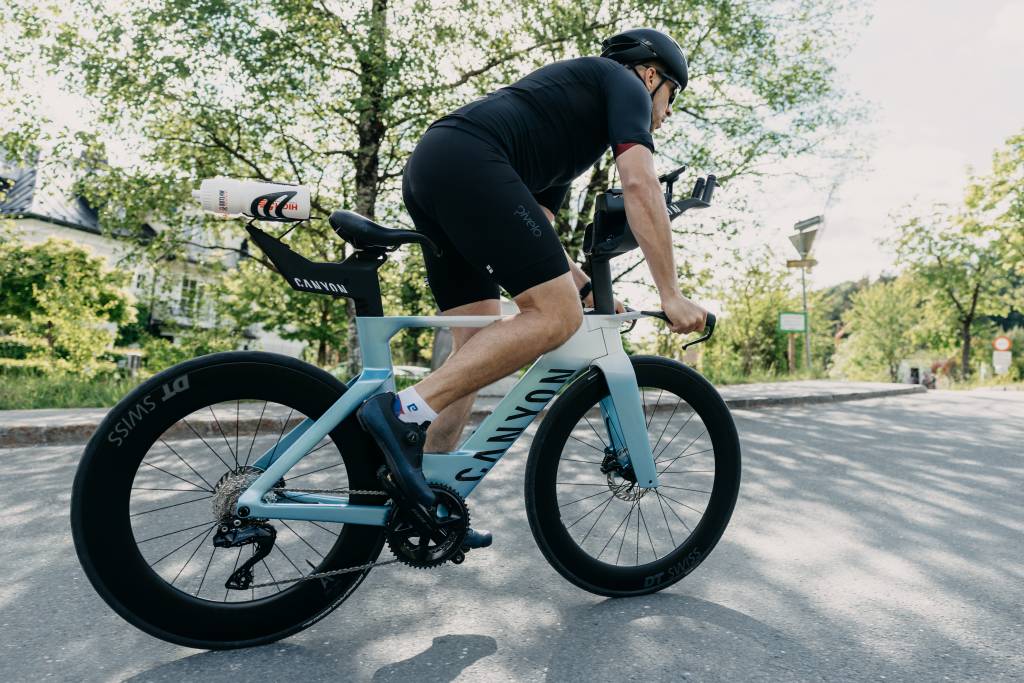
The result is a bike that lets riders eat and drink without constantly sitting up and punching a giant hole through the air every few minutes. Perhaps the boldest claim concerns outright speed. Canyon tested the new Speedmax against its own heavily customised race bikes previously used by their world champions… machines refined over years of wind tunnel testing and professional racing. According to the engineers, this new production bike outperformed those bespoke setups straight out of the box.
Remarkably, Canyon doesn’t lean heavily on huge watt-saving claims because rider position changes everything. Instead, the company focuses on helping riders unlock their own aerodynamic potential. That’s because, according to the team, the riders themselves account for roughly 75-percent of the total aerodynamic picture.
Despite all the space-age tech, usability remained hugely important throughout development. Back at the front of the bike, engineers wanted massive adjustability of the Aero Shield without requiring a toolbox full of spacers and three hours of swearing. One of the coolest features on the new bike is a seat post-style adjustment system that allows stepless changes to the stack’s height, whilst reach and tilt are also effortlessly altered with just the loosening of a few bolts. There are two types of Aero Shields on the cards, with the stock fitment being, ironically, even more adjustable than the ‘pro’ version, but with that range comes a slightly less aero advantage and a bit more weight too.
For me and the other few journalists who bagged the chance to go on the Speedmax launch, Canyon had gone all-in. Waiting for us were an abundance of CF SLX 8-spec bikes, already built and gleaming in the Austrian sunshine. To make sure we got the most from them over two days of riding, Canyon paired each of us with a mechanic for a rudimentary bike fit. With my own pedals and saddle slotted into place, the process became a game of tweaking here and nudging there, in pursuit of the perfect position. Pretending I knew exactly what I was looking for only lasted so long before Kat Matthews’ husband, Mark, stepped in with some much-needed guidance.
Truth be told, tri bikes are something I’ve had limited experience with. I’ve generally favoured a road bike with clip-on extensions. Comfort has always been a big factor on the full and half distance triathlons I typically do, often outweighing the lure of free speed that comes from a committed tri bike. That being the case, within ten minutes, Mark had transformed the Speedmax into something that felt it had been crafted specifically for me and my 5ft 9in frame. One thing worth noting is that my test bike was a medium, despite my Aeroad being a small. Canyon has completely revised its sizing philosophy, ditching the old XS frame with its less common 650c wheels. While a small would likely have worked, the medium offered a broader adjustment window and greater flexibility.
Canyon Speedmax CF-SLX 8 first ride
With the faffing complete, the first ride was a relatively relaxed 35-mile spin featuring a few climbs and plenty of flat roads. It served as a gentle introduction ahead of the longer, hillier and considerably more demanding route planned for day two. My immediate thoughts were drawn to the Aero Shield cockpit. I wasted no time settling into it, my forearms disappearing between the tall sidewalls and the sizeable central Bento box, which was already stuffed with gels. It felt snug… very snug. Every time I moved in or out of the position, I risked unsettling the bike. As someone with the flexibility of a paving slab, I’d requested the tallest stack height available, and while that improved comfort, it also amplified the effect of any sudden movements. That said, it was something I adapted to quickly. What I didn’t adapt to quite so easily was the speed.
I’d class myself as a decent, enthusiast cyclist, but seeing mid-20mph figures appear so regularly on the Garmin was eye-opening. Another surprise was a protruding tab positioned between the index and middle finger on the extensions. It might sound insignificant, but it provided noticeably more purchase and control. A tiny detail perhaps, but one I appreciated more with every mile. The ergonomics were difficult to fault, while Shimano’s Di2 shifting – operated from both the extensions and base bar – was flawless.
As a long-time SRAM user, this was my first meaningful experience with Shimano’s latest system. Gear changes were crisp and predictable, though the Synchro Shift function occasionally caught me out. More than once, a rear shift triggered an automatic front derailleur change to the smaller front ring, suddenly removing resistance and nearly launching my legs through the tarmac. The further I rode, the more at home I felt, being able to anticipate and brace for the change in cogs.
Climbing on the Canyon Speedmax CF-SLX 8
The Speedmax climbed far better than I expected and remained impressively composed on fast, technical descents where speeds nudging 50mph became as common as a cold. I’ll roll the dice as much as the next rider on a fast downhill section, but I’ll admit self-preservation occasionally won out over aerodynamics when pelting downhill and navigating a few fast sweepers. The Aero Shield was a cosy place to be, but not cosy enough to keep me locked in when blasting down steep descents, knowing I’d be sampling the local hospital’s finest cuisine if I pushed my luck any further. Besides, with gravity in my favour, holding onto the base bars still delivered some eye-watering speeds, whilst bring me a shed-load more confidence.
As first spins go, that inaugural joyride was really quite special, but the real revelations came on day two. Twenty-four hours later I found myself rolling out amongst Lionel Sanders, Xea Kleiter, Alex Kukla and Kat Matthews. Determined to hang onto the pros for as long as possible, I settled into the group until disaster struck… all of six miles in. A mis-timed gear change sent the chain off the big ring while descending at over 40mph. Thirty seconds later, the group had vanished into the distance whilst I was still scrambling back onto my saddle.
Faced with waiting for the riders in the trailing pack or attempting the impossible, I chose the latter. Head down, locked in and breathing through every available orifice, I launched into pursuit. The Speedmax responded magnificently. On the flat I was seeing close to 30mph, slowly reeling the group back in while they cruised comfortably and I operated somewhere near cardiac arrest. Twenty-five miles later, a set of temporary traffic lights provided a welcome slice of luck, allowing me to rejoin the leaders.
Any thoughts of recovery disappeared almost immediately as the pace resumed, and my nose was once again buried over the bike computer, trying to make myself as small and aerodynamic as possible. Never before had I ridden a bike that responded so dramatically to reducing my aero footprint. The lower and more compact I became, the faster the Speedmax seemed to surge forward, aided further by the sizeable draft offered by the riders ahead. It was a surreal experience; one of those rare moments where the numbers on the screen almost stop making sense.
Canyon Speedmax CF-SLX 8: quick by nature
Sadly, it wasn’t destined to last. By the 50-mile mark, with more than 2,500ft of climbing already completed, I was still averaging 23.3mph… making it the fastest 50 miles I’d ever ridden. Yes, I was working harder than ever, but the Canyon had also shown me another level of speed to what I’d ever known. Soon afterwards, the pros inevitably brought me crashing back to reality. As the longer climbs arrived, they disappeared up the road with an ease that bordered on offensive, while my increasingly unhappy legs and burning lungs collectively decided they’d suffered enough for one day.
Still, I couldn’t have cared less. With any ambitions of hanging onto some of the world’s best now firmly extinguished, I happily slipped into tourist mode, soaking up the spectacular Alpine scenery and admiring the equally striking lines of the Speedmax beneath me. The design and function of the Canyon had exceeded my every imagination and, after a couple of solid riding experiences, the performance on tap had equally blown me away. Fast, sophisticated and ridiculously capable are words that no one would ever use to describe me, but I can’t think of better adjectives to adorn the Speedmax with. To cut to it, it feels less like a bicycle and more like a rolling engineering manifesto; one where aerodynamics, comfort, hydration and rider fit all merge into a single-minded pursuit of speed. The result is a machine so complete, so thoroughly thought through, that it’s difficult to imagine it being anything other than a defining force in triathlon for many years to come.
Ask a pro: Kat Matthew’s take on the Canyon Speedmax CF-SLX 8
Intro> If there was one person hoping the new Speedmax would live up to the claims being made by Canyon’s engineers, it was reigning Ironman World Champion Kat Matthews. Having worked closely with the brand throughout the bike’s development and spent countless hours helping refine the finished package, few riders are better placed to judge whether the new Speedmax delivers on its promise. We asked her for her verdict on it…
“I think Canyon’s made a big jump over the last Speedmax, especially with the handling. As a small person, the ergonomics now work for someone who’s shorter, thanks to the way they’ve redesigned the frame. It means I’ve now got the proper stack height and seat-post height appropriate to the frame size, so I’m able to get in a more comfortable and effective aero position. I think the key thing here is that it means that everybody my size can also benefit here. Last year I had to have personalised, professional parts on my bike to make it work for me, but now that fit works anyone with a smaller frame size.
In terms of performance, we’ve got the data and we do believe it is a faster frame, so I’m excited to see how that plays out. It’s definitely lighter and, again, with the improved ergonomics I feel it handles a bit more like a road bike, so I can climb more freely, which is a big bonus.
As for the cockpit, I had something similar on my bike last year, albeit it on the old frame. But now everyone can get that pro-level, tucked-in cockpit that offers a better connection with you and the bike. And I like the overall look of the Speedmax. It’s something I’ve known about for a while. A couple of years ago Canyon first introduced me to the concept and got me out on a prototype test bike, to help find the right shape and make sure my knees weren’t hitting on the handlebars, for example, and to sample the modular system at the front, making sure it wasn’t too big for the small-sized frame. Then last year I had a more rounded test of a much more finished version, being given the opportunity to offer some feedback on stuff like which bottles should be refillable and how I rated the Bento systems, and suchlike. So, yeah, I guess I feel quite involved.”
Canyon Speedmax CF-SLX 8: word from the designer
We asked the man who masterminded the new Speedmax what it meant to him, his team and the brand? This is what Product Manager Moritz Hief had to say…
“Our new 6th generation Speedmax is the culmination of all our aerodynamic learnings since we started investing in making athletes go as fast as they can. The Speedmax is the flagship of our aerodynamic credentials – with the name playing across to time trials and track cycling too – and with the records it’s achieved, it’s no understatement to say it’s changed the triathlon landscape for pros and amateurs. Our hopes for the new version? For all athletes to be able use our AeroID concept to unleash their aerodynamic potential straight out of the box.”
Pricing, models & customisation
Final UK pricing is still to be confirmed at the time of writing, with Canyon expecting GBP figures to land shortly after our print deadline. Based on current European pricing, the new Speedmax range starts at €6,499 for the Speedmax CF SLX 7, rising to €7,999 for both the CF SLX 8 Di2 and CF SLX 8 AXS models. At the top of the tree sit the flagship CFR bikes, available with either Shimano Di2 or SRAM AXS transmission, both priced at €11,000.
The new range comprises three CF SLX models available across five colour options, alongside two CFR models offered in six colours. Buyers can choose between Shimano Di2 or SRAM AXS electronic shifting, while every bike comes equipped with a power meter, DT Swiss ARC wheels, Continental Aero 111 tyres and a Fizik Transiro saddle as standard. Below the new models, Canyon’s existing Speedmax CF 7 Di2 remains in the line-up as the entry point to the family, refreshed with two new colour schemes and priced at €4,999.
Canyon is also expanding its MyCanyon customisation programme across the Speedmax range. All CFR and CF SLX models can be tailored with alternative cockpit options, cockpit posts, crank lengths and saddles. CF SLX 8 and CFR customers can additionally choose between 11-30T and 11-34T cassette options, while CF SLX 8 models can be upgraded with the Splitter Plate Pro seatpost that comes as standard on the CFR. Buyers opting for a CFR model can go further still, selecting alternative DT Swiss wheelsets or upgrading to Zipp 454 or 858 wheels, while also having the option of bespoke artwork finishes to create a truly individual machine.


 brucewilson