Garmin Forerunner 165 review: top marks for value, but is it triathlon-friendly?
Our expert reviewer finds out whether the Garmin Forerunner 165 is worth buying and where it sits in the Forerunner range.

220 Triathlon Verdict
Great watch for the price, but no multisport profiles rule it out for tri. Score: 80%
Pros
- Smaller fit, nice design
- Garmin Connect app is excellent
Cons
- Not suitable for multisport profiling
- Battery life is limited
The Garmin Forerunner 165 joins the long list of multisport watches in the Forerunner category. So where does the 165 fit in?
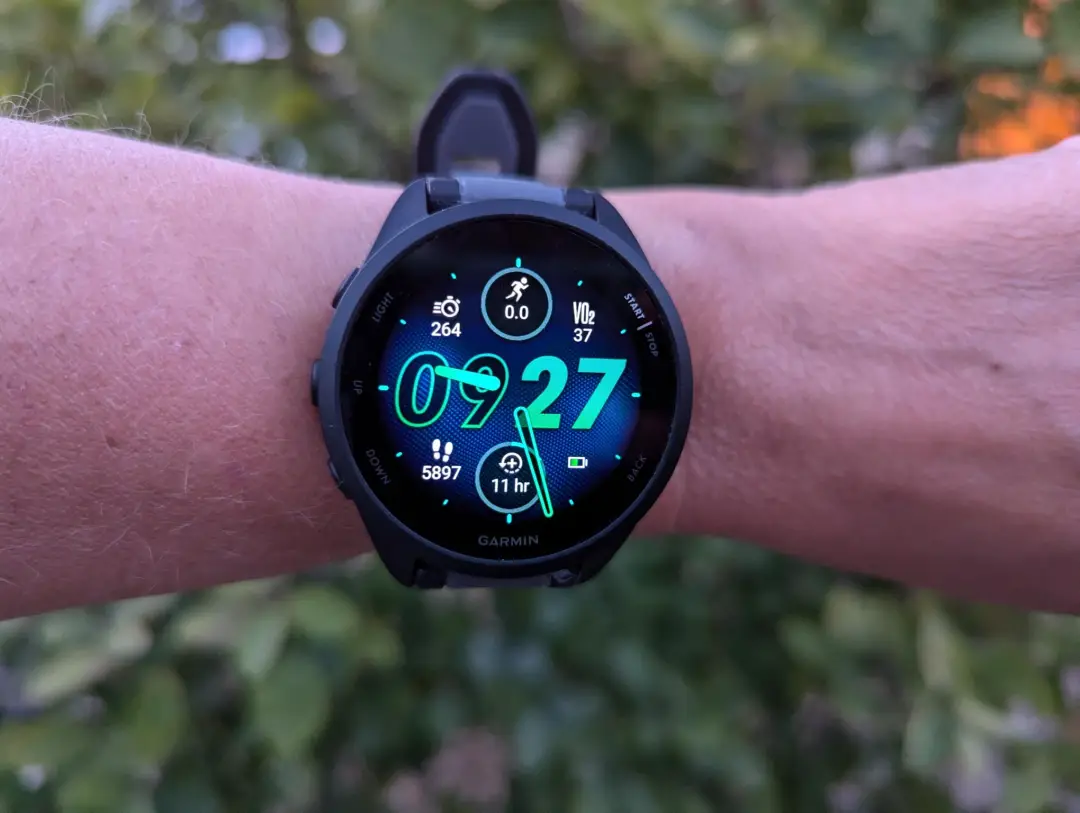
Putting it most simply, this is a trickle-down option and the main highlight is the AMOLED screen, which we’ve only previously enjoyed on higher-specced Forerunners as well as the top-end Epix and Marq editions (update: on 27th August Garmin also launched a version of the Fenix, the Fenix 8, with an AMOLED screen).
How we test multisport watches
Our team of expert reviewers has tested each watch for at least a month. During this time, they wore each watch for several runs, rides and swims in urban and rural areas and at different intensities to test GPS and HR accuracy. They also assessed battery life, comfort, screen readability, ease of use, fitness and health metrics, activity tracking, and value for money. For more details, see how we rate and test products.
First impressions
Coming in around $240 / £180 less ($249.99 / £249.99) than the next Forerunner with this tech (the 265) it’s an attractive option if the ultra-bright, clear screen and the ability to display things like photos on your screen matters to you.

And I’ll be honest – after being lucky enough to try out an Epix last year, I quickly found any other screen I went back to dull and more difficult to read clearly in low light or when swimming – so I count myself in the number seduced by the whizzy tech here!
That aside, the 165 has a nice feel out of the box. Slightly smaller than others in the range with a 43mm screen, it’s unobtrusive and ideal for daily wear, yet still clear enough to see at a glance while training.
Battery life and activity features
Like all the AMOLED versions, the battery life takes a hit. It’s 11 days in smartwatch mode (or 20 days in battery-saver smartwatch mode), and down to 17 hours in the all-singing all-dancing all-systems GNSS mode, which should (just!) squeeze you through most events in the endurance calendar, unless you’re planning an ultra-iron distance, of course.
Triathlon is where you hit a snag with the 165, though. The list of activity profiles here includes running, trail running and ultra
running, and you also get biking, indoor biking, pool swimming and open water swimming… But no multisport profiles.

So to use it for triathlon, you’d have to stop your activity after each leg and restart in a new profile.
Not a deal-breaker for training, perhaps, but this would likely rule the 165 out of contention for anyone who wants to record their multisport event stats.
Garmin Forerunner 165 verdict
This is a shame, as other than that this is a good package – the GPS did well even on my test runs and swims around the remote Cornish coast, the health feedback and tracking was at a good and useful level, including heart rate and stress monitoring and morning reports giving feedback on training readiness, sleep and heart rate variability.
So would we buy it? Sadly, not as a triathlete. For me, other Garmin multisport watches such as the Forerunner 265 ($449.99 / £429.99 ) or non-AMOLED Fenix (from $649.99 / £519.99) tick the triathlon boxes.
Garmin Forerunner 165 specs
| Price: | $249.99 / £249.99 |
| Display size: | 30.4 mm, (1.2″) diameter |
| Weight: | 1.4oz / 39g |
| Battery life: | Up to 11 days in smartwatch mode, up to 17 hours GPS mode |
| Display type: | AMOLED |


 Helen Webster
Editor, 220 Triathlon
Helen Webster
Editor, 220 Triathlon