How to use heart rate variability to optimise your triathlon training
Heart rate variability measurements can tell us a lot about our state of readiness to train and are central to optimising performance. James Witts explains…

Heart rate variability training (HRV) looks at the variation of your heart rate from beat to beat. You see, even when heart rate is stable, say at 60bpm, the gap between each beat is not always 1sec. It varies. The extent to which it varies is called HRV.
“We’re interested in this because HRV links back to two important branches of the autonomic nervous system (ANS),” says elite triathlete Chelsea Sodaro’s coach, Dan Plews.
“Greater variations between beats (i.e. increases in HRV) are associated with the parasympathetic activity (rest and digest/recovery), while reductions in the variations between beats (i.e. decreases in HRV) are associated with the sympathetic activity (fight or flight/stress).”
In other words, a higher HRV is a sign of good health, fitness, and a rested state. Whereas a low HRV can be an early indicator of overuse, oncoming injury, and illness.
What influences HRV?

HRV’s influenced by everything, from hydration, to fuelling, sleep quality, the list goes on. This is the beauty of HRV. Your autonomic nervous system regulates just about every organ in the body, so if something is wrong, your body will attempt to deal with the problem, which will affect your HRV.
It’s why HRV is a good metric to gauge state of readiness to train, or when to focus on recovery. With HRV, you have the figures at hand to see whether you’re stressed or prepared.
How to use HRV in training
But what about training? Can the results prescribe the intensity of a session as well as power and HR training?
“No, it can’t prescribe within-session intensity,” Plews answers, “but it can possibly prescribe between sessions. For example, if you wake up one morning and HRV is substantially low and you planned a high-intensity session, you may decide to do a recovery/aerobic session instead. And vice versa.”
Like all training tools, HRV is certainly not the silver bullet and should be used alongside other variables to inform our decisions when it comes to training.
Other monitored variables may include performance, sleep quality, training load, and motivation to train via commonly used tools like power meters.
What are the best tools to measure HRV?

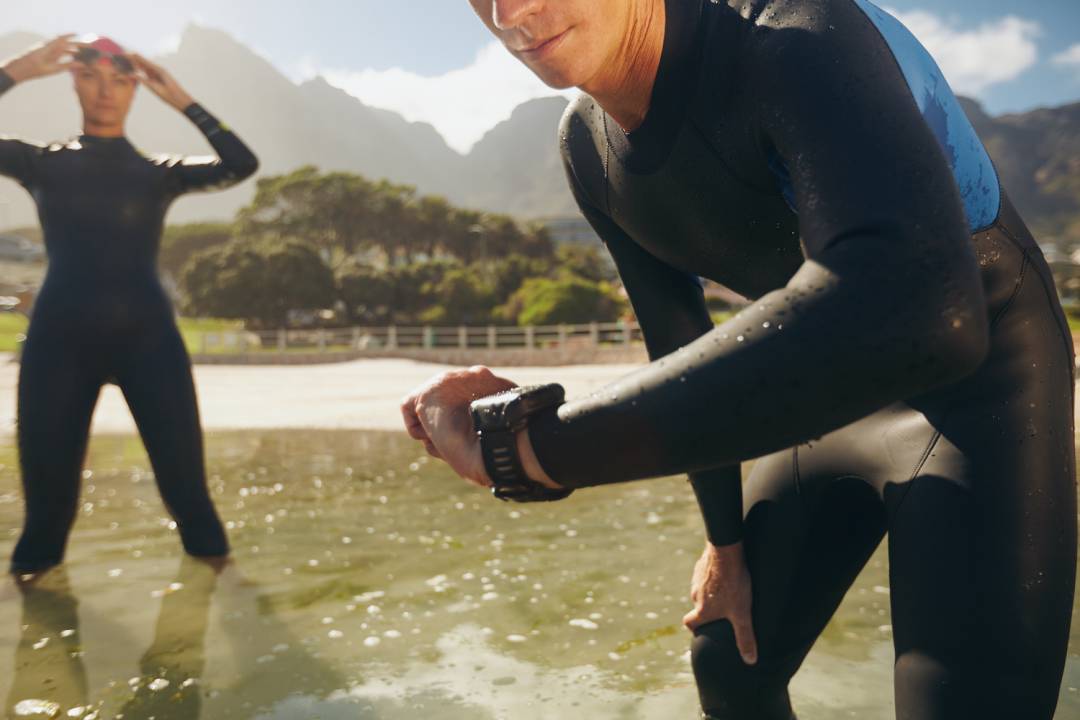
As for the best tools to measure HRV, they’re pretty reliable on triathlon watches like top-end Garmins and Polars, or fitness trackers like Whoop and Oura Rings. There are also some good applications for your smartphone that just require a finger press of the finger.
“The best apps are HRV4training and Elite HRV,” says Plews. “The two creators, Marco Altini and Jason Moor, have a good handle on HRV and understand its benefits and limitations.
“Their apps also include other metrics when it comes to making daily training decisions. Jason also offers an affordable course for people interested in learning more about HRV.”
How does HRV change in training?
Plews is an HRV expert and is a pragmatist. He knows that HRV is part of the picture and not the whole picture.
“When it comes to HRV, we also have to understand that too much HRV can be just as bad as too little,” he says. “It’s all about establishing the optimal value for you.
“Part of the training response is for HRV to change, but what’s important is that it returns to within your individual range as you rest and recover.
“We also should consider HRV changes in the context of training. For example, the response of HRV after longer duration/low-intensity training will be different from short duration/high-intensity training.”
For more advice on training to heart rate, check out our guides to the best heart rate zones for running and heart rate training zones for cycling.


 James Witts
Freelance sports writer and author
James Witts
Freelance sports writer and author