What is cyclocross? And how CX can sharpen your winter form and bike skills
Cyclocross incorporates two of tri’s three disciplines in a frenetic format that’s great for off-season fitness. Nik Cook flings himself at the filth to find out more

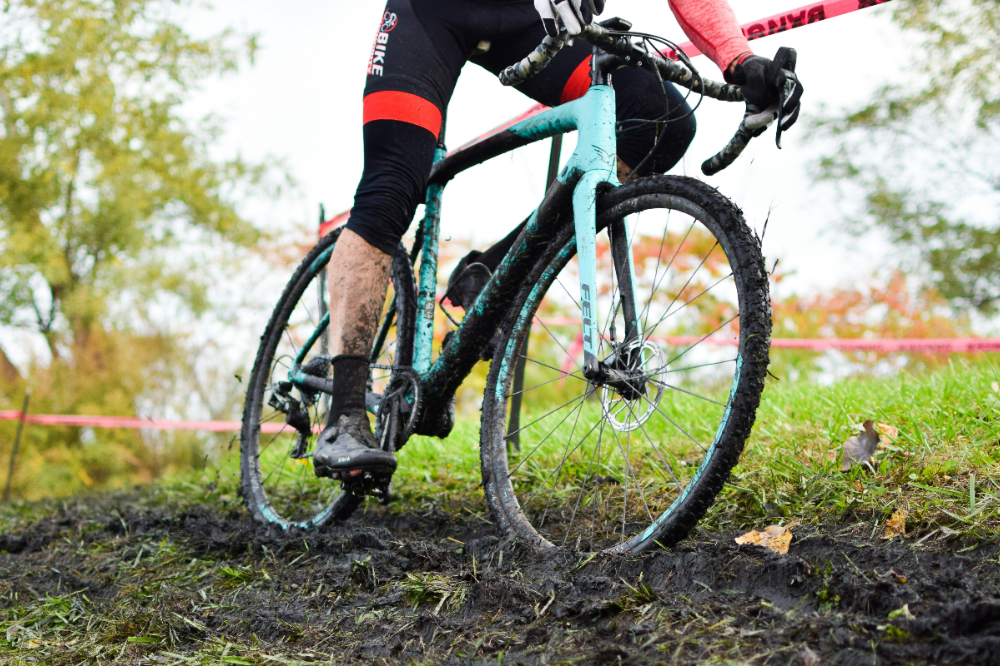
If you’re looking for a fun way to take your cycling to the next level and get a regular competitive fix this winter, look no further than the muddy world of cyclocross, which has major benefits for triathletes. We also include three key workouts to get you ready…
As well as the anaerobic threshold-, power- and strength-boosting fitness benefits that these frenetic 45–60min off-road blasts deliver.
Unlike racing on Zwift on your turbo trainer, they also help hugely when it comes to improving your bike-handling skills.
Poor bike handling is a criticism that’s often levelled at triathletes – with some justification – and, with non-drafting age-group racing emphasising fitness over technique, it’s an area that tends to be neglected in training.
Picture the challenges you might encounter at any race though – that tight 180° turn in the wet, a competitor that cuts you up or an unexpected pot-hole. If you haven’t got the skills to deal with them, your race could be over – even the strongest biker is going nowhere if they’re lying on the tarmac.
Cyclocross is a guaranteed shortcut to those ‘get out of jail free’ handling skills, and being able to nail a fluid flying mount or dismount at transition always saves you a few crucial seconds (and draws admiring glances).
What is cyclocross?

Cyclocross (CX) is probably the most accessible form of bike racing there is. There are races in parks all over the country every weekend during the winter, some of which you can enter on the day.
You don’t even need a dedicated CX bike to take part, as most local races allow mountain bikes and gravel bikes. But be warned: CX is highly addictive and you may find yourself wanting a knobbly-tyred racer after only a few outings.
If you ride through the winter anyway, you won’t need additional clothing and, even on the coldest days, you’ll be warm after a couple of laps.
Mountain bike shoes with treaded soles and recessed cleats, along with multi-sided pedals, are the only real requirements for easy mounts and dismounts (although traditional flat pedals and sturdy running shoes will do if you don’t want to invest straight away).
Races are run over a number of short laps, so you’ll almost always find yourself battling a rider of similar ability, trying to beat your best split time or just trying to ride a tricky section cleanly. So, what are you waiting for?
What is a cyclocross bike?

A cyclocross bike is an off-road, drop-bar race bike. Its geometry is closer to an endurance road bike than relaxed gravel bike for an aggressive riding position and agile handling.
This makes a CX bike more of a handful on tricky terrain but that’s all part of the fun.
Traditionally, tyre clearance on ‘cross bikes was tight because 33mm is the maximum tyre width permitted in UCI races. Beyond that, there’d be extra room at the fork and frame for mud.
Modern models generally have wider clearance because they have converged or merged with race gravel bikes.
Which gears do cyclocross bikes have?
Cyclocross bikes generally have hard gearing because courses long few climbs and the short races are raced flat-out.
Consumer bikes generally have 1x drivetrains consisting of a single chainring, with about 40 teeth.
At the back, you need less range than on a gravel bike. You could get away with a road bike cassette with a 34T or 36T largest sprocket instead of a 40-46T gravel cassette.
The absence of a front derailleur is beneficial because it catches a lot of mud. Pros, however, still sometimes ride double chainrings for even bigger gears.
What are cyclocross tyres?
Cyclocross tyres are usually narrow for off-road bikes. Although wider rubber is allowed in most non-UCI events, 33mm is the most popular width.
At the start of the racing season in North America and Europe, courses are increasingly dry and fast. These conditions favour a slicker tyre.
As courses become wetter, traction gets harder to come by and knobbly tyres, which bite into the mud, come to the fore.
Most modern cyclocross tyres are now tubeless. Using sealant in place of an inner tube, which is vulnerable to pinch and impact punctures, enables you to run lower pressures for better grip.
Tubeless tyres are also easier to install and maintain than the traditional tubular tyres. These are glued to the wheel rim.
Because they roll slightly quicker and can be used safely at even lower pressures, many professional racers still use tubulars.
Do I need a cyclocross bike?

Initially, no.
You can use an endurance road bike for cyclocross, especially if it wide tyre clearance and disc brakes, and you don’t might crashing on it.
In regional leagues, you’ll see plenty of people race on cross-country mountain bikes and gravel bikes.
As you get more serious, you will want a dedicated cyclocross bike. They’re easy to manoeuvre around the courses’ tight turns, lift over your shoulder, bunny hop on and clear obstacles thanks to their high bottom bracket.
Luckily you don’t have to spend much. Second-hand marketplaces are awash with deals on CX bikes.
If you buy new, you certainly don’t need a carbon frame, carbon wheels or a fancy drivetrain. A brand’s low-tier model will be absolutely fine and preferable even, given what a winter’s racing can inflict on components.
Cyclocross bikes may have been eclipsed in popularity by cooler and more versatile gravel bikes. But the latest models are good for much more than racing laps and will open up longer, multi-terrain rides.
Three key cyclocross workouts for triathletes

Follow these three sessions to build your skills and fitness for maximum off-road impact:
Session 1 — skills
- Kit required: CX bike/MTB/gravel bike, cones, bamboo canes and ideally some mates
- Terrain: Your local park, playing fields or waste ground
- Benefits: Builds the skills, handling techniques and stop-go fitness necessary for racing
- Duration: 70–80mins
Warm up
10mins gentle riding on road or flat trails, gradually building intensity. Then jog for 5mins doing a 25sec stride effort every minute. Complete your warm-up with 5mins of mobility drills such as high knees, heel flicks and walking lunges with jogging recoveries.
Course
Lay out a short loop in the area you’re riding on. It needn’t be big, but include plenty of tight corners, 180° turns and forced dismounts (use the bamboo canes and cones to create hurdles). If you can get some climbs and descents into your route (rideable or not), so much the better.
Main set
Perform 3-4 x 10min race efforts around the loop, trying to complete each lap as fast and as smoothly as possible. Work on picking the right lines, balance, gear selection and maximising traction as well as your mounts and dismounts. This is a lot more exciting if you do it with a few friends. Do 5mins light spinning or easy jogging between efforts to recover.
Cool down
5-10mins of easy spinning.
Session 2 — road bike tempo
- Kit required: Road bike
- Terrain: Safe road route, with climbs and corners but no long descents
- Benefits: Develops your ability to recover while riding at threshold level with multiple high-end efforts
- Duration: 75mins
Warm-up
10mins easy spinning, gradually building intensity from 60% to 75% of your HRmax. Follow that with 5mins riding at 75-85% HRmax and finish the warm-up with 5mins alternating between 20sec sprints and 40secs of easy spinning to recover.
Main set
2 x 20mins with 5mins recovery. Ride most of the 20mins at approx. 85% HRmax (tempo/threshold intensity), but exit the corners and ride the climbs hard, with almost-max effort surges.
Keep these fairly short (5-10secs) and include 15-20 surges in each 20min effort, but try to hold tempo/threshold pace as you recover. Vary the surges to include out-of-the-saddle sprints, high-gear seated climbing and fast-spinning bursts.
If you’re training with friends, take turns on the front with the lead rider initiating the surges and everyone else reacting to them.
Cool down
10mins of easy riding.
Session 3 – Off-road long ride

- Kit required: CX bike/MTB/gravel bike
- Terrain: As varied as possible
- Benefits: A long day on the trails is akin to an extended interval session as you tackle the numerous climbs, technical sections and obstacles that force you to increase your effort. You’ll have ample opportunities to test the limits of your bike handling, and it gets you off winter roads when the snow and ice sets in.
- Duration: 2hrs+
Warm up
Ride the first 10-20mins at a steady pace on easy trails or roads.
Main set
Ride for at least 2hrs, predominantly at 65-75% of your HRmax but putting in higher-intensity efforts as the terrain dictates. Use lanes to link up sections of trail and don’t be afraid to explore the by-ways you’d never dare head down on a road bike.
Don’t underestimate what a CX bike can tackle – most red routes at trail centres are fair game.
Use any unrideable sections to practise your dismounts and mounts, as well as getting used to what it feels like to shoulder your bike and run.
Don’t forget to keep yourself fuelled up and carry spares, extra clothing and maps – and always let someone know your plans.
Cool-down
10mins of easy riding.
Now read our guide to wacky off-season races to find a fun winter challenge.


 Nik Cook
Freelance bike writer
Nik Cook
Freelance bike writer