Factor Slick review: we test the brand’s first-ever triathlon bike
A purpose-built multisport machine promising big speed gains, deep adjustability and the pedigree of Beth Potter’s Ostro Vam. But can its performance match the hype?

220 Triathlon Verdict
Frighteningly smooth, fast and comfortable triathlon bike at a premium price. Score: 81%
Pros
- Appreciatively fast
- Comfortable and adjustable
- Superb handling
- Very light
Cons
- Nutrition system could be refined
In a triathlon setting, Factor is renowned for its link-up with Beth Potter, the collaboration beginning in 2021.
Since then, the Scottish athlete has won a brace of Olympic bronze medals, plus the medal cleansweep at the 2023 to 2025 Worlds.
Potter uses the brand’s Ostro Vam aero road bike. It’s clearly served the 34-year-old well.
Now, the cosmopolitan company with a British background that now has links with China and Taiwan has launched what its billing as its first dedicated triathlon bike, the Slick.
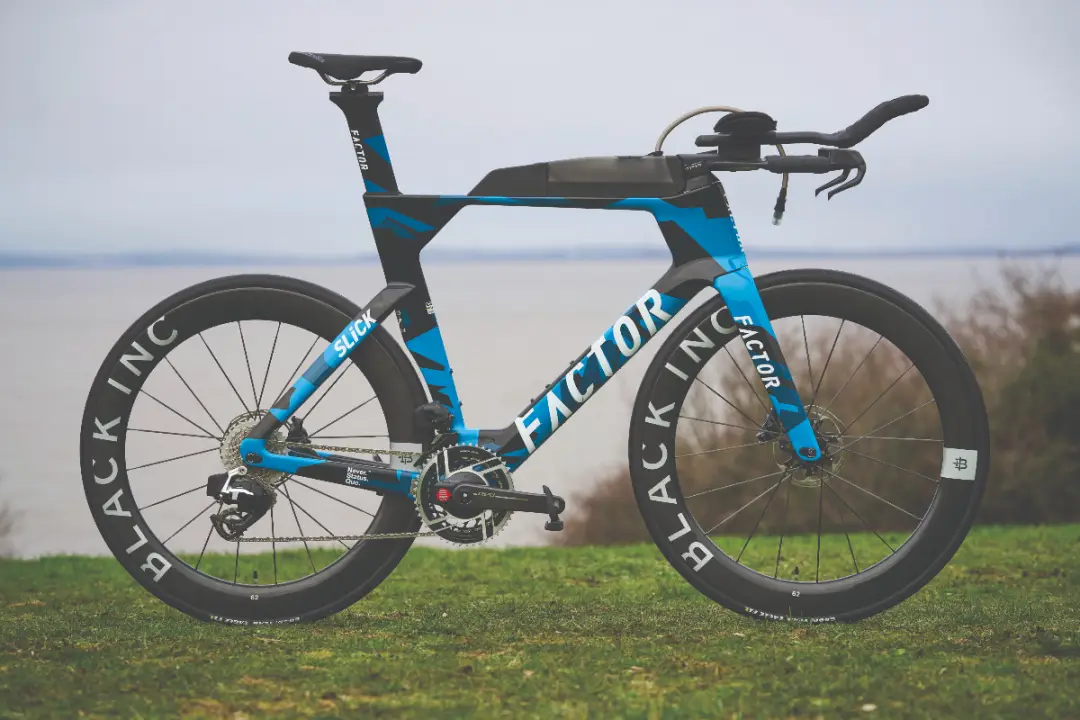
It’s certainly a slick-looking bike that’ll leave your competitors in no doubt as to the thoroughbred you’re riding. But did its ride credentials match the visuals?
How we test triathlon bikes
Every triathlon bike we review is tested on similar roads during rides of different durations and speeds for at least several weeks. We assess the bike’s adjustability, triathlon-specific features, ride feel, handling, comfort and value for money. For more detail, see how we rate and test products.
Technological grounding

To understand where the Slick came from, it’s relevant to look back as Factor’s roots are far from conventional.
The story began in 2007 when Norfolk-based motor sports company BF1 Systems looked to embark on a project that would showcase their expertise in aerodynamics and integration. The only stumbling block was money.
Creating a prototype car is no cheap exercise, so they turned their attention to two wheels instead of four.
The result landed in 2009, the Factor 001 offering a glimpse into the future. Aesthetics were sleek with fully internal cabling and zero clutter.
But it was data and electronics that dropped the jaws of many in the industry with the team taking a cue from Formula One.
The 001 measured everything you could think of, and more, including speed; climbing and lean angles; acceleration; the rider’s heart performance; breathing rate and, of course, power output.
Andy Blow, the brains behind Precision Fuel & Hydration, rode it for 220 in issue 250 and was impressed. At the time, Aston Martin was a customer of BF1, commissioning the steering wheel and electronics for the car manufacturer’s One-77, an ultra-exclusive £1.1-million hypercar. The collaboration led to the One-77 superbike.
The bars and saddles were hand stitched in the same leather as used inside the cars, and the framesets were painted in the same hues as their bodywork.
The outcome was stunning and around a dozen were sold for £25,000 each. Any 220 readers have one? If so, please send in pics. We enjoy a post-Christmas drool! The brand received plaudits galore.
But arguably they were on the firm trajectory to niche. And uber-expensive niche at that.
That changed when bike designer Steve Domahidy came on-board and shifted the brand’s trajectory, resulting not in a true mass-market model, but certainly in a bike with far broader appeal, namely the Vis Vires.
Industry and 220 Triathlon feedback was once again glowing. It was time to upscale production.

That’s when John Bailey, who was managing director of a bike brand as well as a very busy Formula One engineering supplier, met Rob Gitelis.
Gitelis had significant experience as a carbon-fibre manufacturer, running factories in Asia that produced frames and components for many of the world’s leading brands, including Cervélo, Canyon and Zipp. Gitelis duly recommended a factory to increase production.
Things were going well. But things were set to change.
“We made the first 100 bikes, and then I realised just what it was going to take to really build the brand and I still had BF1 to run,” Bailey reflected.
“This is where the hindsight comes in, because I could have gone to Gitelis at that point and suggested he buy into it, but I didn’t. It was a few months later that Rob and [former cycling professional] Baden Cooke came to me with their idea to take over Factor Bikes.”
That was 2015. Two years later they were making their Tour de France debut with French team AG2R La Mondiale and duly helped Romain Bardet to a stage win and third overall.
Since then, they’ve cemented their place at the premium road table with engineering-first approach that has allowed Factor to iterate rapidly: designs can go from idea to prototype to production quickly, a flexibility rarely found among larger manufacturers.
With the Slick, they’re seeking to make more of a mark in multisport…
Multisport focus

Fact: this is Factor’s first Bonafide triathlon bike.
Yes, you may have ridden or seen its predecessor at triathlon and Ironman events, but it was a bike to cater for time-triallists, too.
That meant satisfying the UCI’s rules in cycling regarding tubing and geometry.
As it transpires, the latest Slick is UCI friendly, too, but the remit was solely about satisfying the needs of swim, bike, runners.
To that end, the new Slick jettisons that dual purpose so, say Factor, they can focus on practicality, comfort over long-distance tri and, of course, moving as quickly as possible.

Factor’s dispensed with the split downtube that characterised incarnation one. In come more sizes, greater cockpit adjustability and more storage options.
Focusing on triathlon meant tweaking the geometry, which also enabled Factor to expand the range from four to five (48, 52, 54, 56 and 58cm).
The geometry itself hasn’t radically shifted, but the updates aim for greater stability: slightly longer chainstays, more bottom-bracket drop and reduced fork offset, all contributing to increased trail.
For the unfamiliar, trail is the distance between where the wheel touches the ground and where the steering axis – line through head tube and fork – would hit the ground if extended. In other words, it’s how far the tyre contact patch ‘trails’ behind the steering axis. A high trail = more stability.
Beyond that, the head-tube angle remains unchanged and the seat angle relaxes slightly.
However, an extended 42mm saddle adjustment range allows triathletes to dial in virtually any position.

As you’d expect at this price point, it’s high-grade carbon-fibre throughout. Factor employing the same material used on the Ostro Vam.
It uses similar aero tube shaping as the Vam, too, albeit with a little more depth where lightness isn’t as important.
There’s a beautiful flow from the headtube into the downtube that not only looks the part but goes some way, say Factor, to helping the latest Slick slice off six watts at 48km/hr over version one.
That downtube also features subtle in-frame storage, and less subtle on- frame fluid and food storage options that are reminiscent of that seen in the Cervélo P-Series, and upon Cube’s Aerium and Giant’s Trinity Advanced 1.

A new saddle rail system delivers more greater adjustability than before, with an effective seat-tube angle range of 73 to 79°.
That breadth of range is appreciated by all triathletes, for not only comfort on the bike but to ease yourself into a position that preserves a little something for the run.
Maximum tyre clearance comes in at a healthy 32mm.
Our test model came with SRAM Red, and they also offer a ‘more-affordable’ Force version.
The wheels are from Black Inc, which is the sister brand to Factor Bikes, meaning that like the bikes, they’re manufactured in the company’s own factory for greater agility when creating prototypes and, you’d hope, a finer outcome.
The pair would set you back over $3,000/£2,500 so we’re talking Zipp territory. The spec is impressive.
Riding the Factor Slick

From the get-go this is one fast bike.
That’s not unusual for a road bike, of course. But triathlon bikes can often take a perceptible time to reach max speed, generally because all of the multisport accoutrements like aerobars and nutrition storage results in extra weight.
But the Slick is around 20lbs/9kg for the complete bike and just 2.4lbs/1,100g for the frame. That’s incredibly light for a triathlon bike. Its svelteness pays off handsomely when you accelerate, leaving a smile – or even smirk – plastered over your face.
Chapeau to the carbon-fibre frame that not only delivered little weight but high stiffness, ensuring once you’ve accelerated you just kept going with a perceptible transfer of effort into speed.
Once down on the bars, comfort matched velocity for a truly superb ride. Hats off, too, to the Black Inc wheels as the autumnal test period proved somewhat windy, exacerbated by my test route shadowing the Severn Channel.
Despite the sidewinds, stability proved impressive. That carried over to cornering in an appreciated ‘wherever you point it, the bike goes’ kind of way.
The SRAM wireless blips are a nifty practical addition as you can place them wherever you prefer. Though they don’t feel incredibly robust so ideally you’d have more permanent shifters placed at the end of the extensions with the blips on the base bar.
But the SRAM Red groupset complete with power meter is arguably the best out there..
The hydration storage is middling. The hose didn’t always stick fast to the bar’s holder and if you removed the rubber access, it was somewhat reluctant to return flush.
In an ideal world we’d also have liked a little more than 600ml in our 58cm model with many of its competitors around the 750ml mark.
Then there’s the admittedly crazily expensive Cadex Tri used by Kristen Blummenfelt, which takes up to 1,000ml in size large.
It’s also integrated into the frame rather than, in the case of the Slick, mounted on top. All that said, the energy drink flowed effortlessly through the nozzle.

The bento offering sits behind the hydration storage and cradles five energy gels.
It’s neat albeit again in an ideal world, it’d be further forward atop the top tube for easier access. But that’s nit-picking.
Arguably, the in-frame storage is neater. You clamp your bottle cage to its door, which can be removed via a latch mechanism.
Within, a lightweight bag akin to your school pencil case can carry tools and even a lightweight cycling jacket.
Vision’s Metron aero bars are incredibly comfortable with up to 35% adjustment if you’re a fan of the praying mantis position, while the Selle Italia Superflow triathlon bike saddle is also one comfy number thanks to the cut-out and reasonably wide nose.
Factor Slick bottom line
All of this comes together for a fast ride that, most importantly due to its highly adjustable credentials, ensures your legs feel fresh for the run.
That’s my experience, both for subsequent intervals or longer, lower-intensity runs. Yes, the hydration/nutrition needs a little refining, but that’s certainly not a deal-breaker.
This is one classy bike that, if budget allows, should certainly be on your middle- to long-distance radar.
Factor Slick specs
| Weight | 8.8kg (58cm) |
| Price | $11,399/£10,399 |
| Frame | Toray Nippon graphite pitch-based carbon |
| Fork | Slick wide stance carbon |
| Gears | SRAM Red AXS E1 12-speed with power meter |
| Brakes | SRAM Red AXS hydraulic |
| Wheels | Black Inc Sixty Two |
| Tyres | Goodyear Eagle F1 |
| Aerobars | Vision Metron TFA |
| Seatpost | Factor Slick carbon |
| Saddle | Selle Italia Superflow |
For a little less
Factor Slick Force AXS $7,999/£7,799
The same frameset is dressed by SRAM’s second-tier, but still-impressive, wireless Force, while you roll on the Black Inc 58 wheelset. Vision’s TriMax aerobar takes care of cockpit duties.
For a lot less
Factor Slick Frameset $5,499/£4,999
You can always self-build and simply buy yourself the top-notch carbon-fibre frameset. It comes with the hydration system, plus the carbon-fibre seatpost. Your foundation for fast in 2026.


 James Witts
Freelance sports writer and author
James Witts
Freelance sports writer and author