Free things to do across the UK if you want to improve your health and fitness in 2026
You don’t need a gym membership, a smartwatch or a paid app to get fitter in 2026. The UK is already full of free ways to move, train, and feel better.

Improving your health and fitness in 2026 doesn’t have to equate to spending more money. Across the UK, there’s an abundance of free public resources, training programmes, national trails, and community-led fitness groups to explore.
This guide reveals the no-cost ways to build strength, boost endurance, and support your mental wellbeing, using what’s already on your doorstep.
The NHS is your free personal trainer

Did you know that the NHS actually runs a whole bunch of free courses and activities in your local area, all geared towards getting you healthier and more mobile? I certainly didn’t until I started looking into the best way to boost my fitness this year, without spending a penny.
Forget fancy spin classes and spending a fortune at the popular yoga studio around the corner (which let’s face it, none of us can really afford), instead, why not benefit from the untapped resources already inside the NHS ecosystem?
This includes walking groups, exercise classes in your local community centre, and wellbeing hubs. You can get referred by your GP for exercise schemes under the social prescribing initiative, of which there’s also a green version to get linked up to outdoors walking groups and gardening projects. The best way to find out what groups are in your area is to check with your GP practice or local NHS social prescribing service.
Then, there’s also the NHS’s Better Health platform, which offers a suite of free, guided programmes designed to help you move more, build strength and boost fitness at your own pace, without a gym membership. Within this is the popular, free Couch to 5K running program that guides users on a structured 9-week plan that takes you from novice walker, to running 5km at your own pace.
If you’ve set yourself a step count goal and are keen to get outside more, the NHS also has a free app called the Active 10 Walking Tracker, which records brisk-walking minutes and helps you build daily movement goals. Other free apps from the Department of Health include their: weight loss guide, food scanner, drink free, and quit smoking apps (find out more).
Britain’s outdoor gyms and free running events

If you’ve ever nipped across the Channel for some French sunshine, you’ve likely been struck by the abundance of outdoor gyms in most built-up areas. It’s a brilliant way to get in a workout for free, with robust outdoor equipment designed for a whole-body workout.
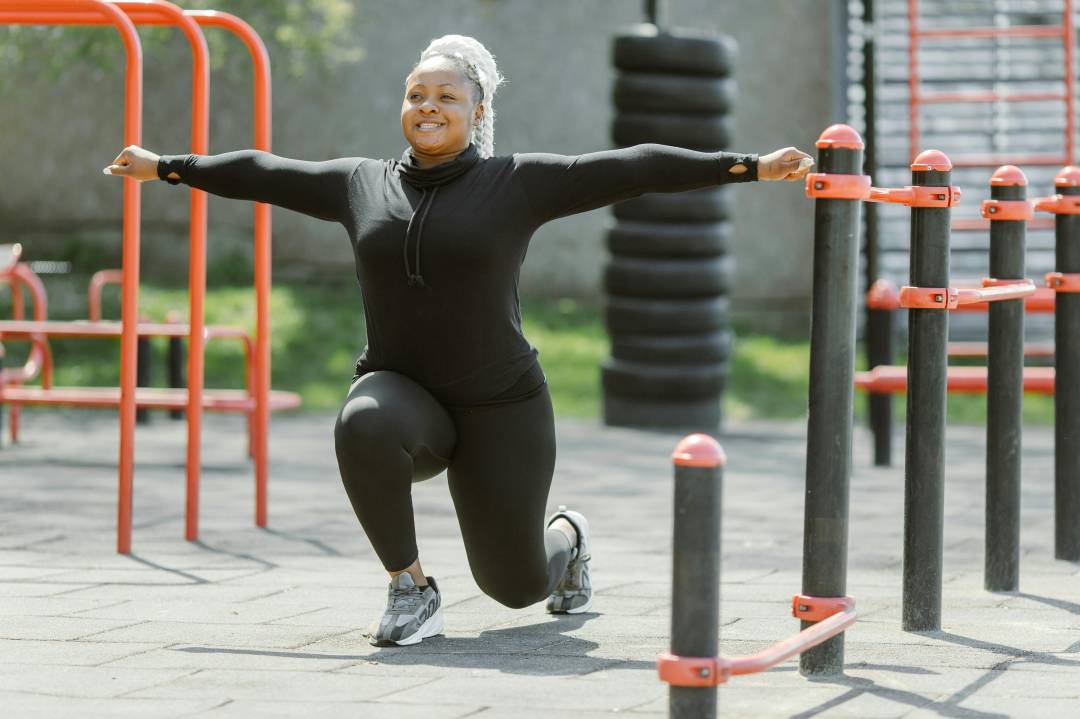
The good news is that these outdoor gyms are being rolled out across the UK, too. Installed by local councils, these free fitness parks make bodyweight strength, cardio, and functional training super accessible. No membership or booking required.
Some of the equipment on offer often include pull-up bars, parallel bars, elliptical (like the one pictured above), leg press, balance beams, and more. It’s pretty easy to find an outdoor gym near you too, just take a look on the Park Gyms UK directory.
I’d be remiss not to mention Park Run. If you’ve not heard of this hugely successful public health initiative, where have you been the past 10 years? Park Run is a series of free 5km non-competitive ‘races’ held on Saturdays at 9 am in most city parks across the UK, and now also in 21 additional countries!
Run by volunteers and frequented by what can only be described as a cult following of eager runners of all abilities, Park Run is a brilliant way to get outdoors, run with others, and track your run progress. You can join any event for free and if you’d like your time recorded, simply sign up to receive your personal barcode that’ll be scanned at the finish line.
Run clubs and fitness sessions

Despite living in an age of connection, it can be easy to feel out of touch with what’s going on in your area and how to get involved. Aside from a Google search, I’ve found that one of the best ways to discover any local clubs and associations is, for all its sins, Facebook.
Personally, this is the sole reason my Facebook page from 2010 is still active; I’ve become adept at sniffing out all and any sporting-adjacent activities going on in my village. Have a go at searching for the name of your sport and of your town/local area. It’s led me to discover local village pilates sessions, language conversation groups, and other keen runners.
Run clubs are pretty common in most areas, even if you can’t find one in your exact neighbourhood, there’s bound to be a group in a nearby town. Running with others is a great way to not only tick off some sessions from your training plan, but also fill up your social cup at the same time.
Workout to nature’s seasonality

Aside from the free organised groups, initiatives, and equipment mentioned above, there are also a whole host of adventurous and type 2 fun activities that you can do right on your doorstep.
One way to categorise these is to think in terms of seasonality. Over the winter, the weather can admittedly be pretty grim. One phenomenon that is increasingly popular is cold water dipping. Not for the faint-hearted, suss out your nearest, safe wild swim spot and get your Wim Hof on with some cold water plunges to get the endorphins spiking.
Springtime could be the perfect moment to dig into some community gardening, while summertime just screams Pilates and Pimms in the park (maybe not at the same time). Meanwhile, trail hiking, arguably, is a winning year-round activity that’s guaranteed to get you exploring new vistas only reachable on human-power.
National hiking paths and cycling routes

That brings me on to the miles and miles of free, organised hiking paths and cycling routes that criss-cross the UK.
From the King Charles III England Coast Path (set to become the longest managed coastal walking route in the world) to the wider National Trails network, the UK has thousands of miles of clearly marked, well-maintained routes designed for walking, hiking, running, and cycling.
Some are scenic strolls suitable for the whole family, while others offer serious physical challenges with sustained climbs and technical off-road terrain. Popular routes include the likes of the South Downs Way, Hadrian’s Wall Path, and Offa’s Dyke.
The beauty of these routes lies in their flexibility. You don’t need to complete them from start to finish. You can dip in for a half-hour lunchtime walk, plan a weekend hike, or gradually build toward longer distances over the year.
For cyclists, the UK has miles of traffic-free canal towpaths, disused railway lines, and long-distance cycleways that make it possible to build aerobic fitness without spending a thing. All you need is a reliable road bike and some knowledge of the brilliant routes within the National Cycling Network.
Build your own 2026 fitness plan

You don’t need a paid app, subscription, or personal trainer to build a solid fitness plan in 2026. Of course, there’s nothing wrong with these things, but with the wealth of free training resources now available, it’s easier than ever to create a fitness regime that suits your lifestyle.
A good place to start is our free triathlon training plans, which also have options for single-sport training and structured strength training. We have plans for all abilities, from beginners to the sport, to exercises for those with more advanced and long-distance goals.
To track progress, a classic sports watch will do the trick nicely, but you can also go back to basics. A notes app, calendar, or even pen and paper also do the job. Start out by logging your distances walked and ran, time spent moving, or how you felt after a session.
In-depth metrics aren’t necessary or motivating for everyone, so find out how you tick and what interests you when it comes to your personal health and fitness progress.
Mental fitness counts too

Health and fitness isn’t just about physical performance. Mental fitness covers how well you manage stress, your daily focus, and recovery. It’s just as important, if not more so, than your physical training.
Free mindfulness and breathwork apps are some great resources to look into if you want to harness your fitness through a holistic lens. Short daily breathing exercises can improve sleep, reduce anxiety, and even enhance physical performance by supporting recovery and nervous system balance.
That being said, if traditional mindfulness just isn’t your thing, that’s ok too. There are plenty of ways to calm our nervous systems without using dedicated apps. One of the most powerful ones is, without a doubt, getting into nature.
Therapeutic, ‘wholesome’ activities that feed the soul are what you’re looking for here, and this is very individual. Some things to try include: setting daily time limits for social media apps, dedicating more time to technology-free hobbies like crafts and reading, trying your hand at baking, or steeping in a long bath as you listen to some calming tunes.
In a world that’s constantly switched on, taking care of your mind is no longer optional. The good news is that, just like physical fitness, some of the most effective tools are completely free.
For more fitness advice, why not take a look at our list of some of the most adventurous and toughest triathlon challenges to conquer in 2026.


 Kate Milsom
Freelance sports journalist
Kate Milsom
Freelance sports journalist