How indoor training can help set you up for your best season ever
With the season over, it’s time to start planning your training through winter and into next year. Here, Tri Training Harder founder Philip Hatzis breaks down what you need to do month-by-month

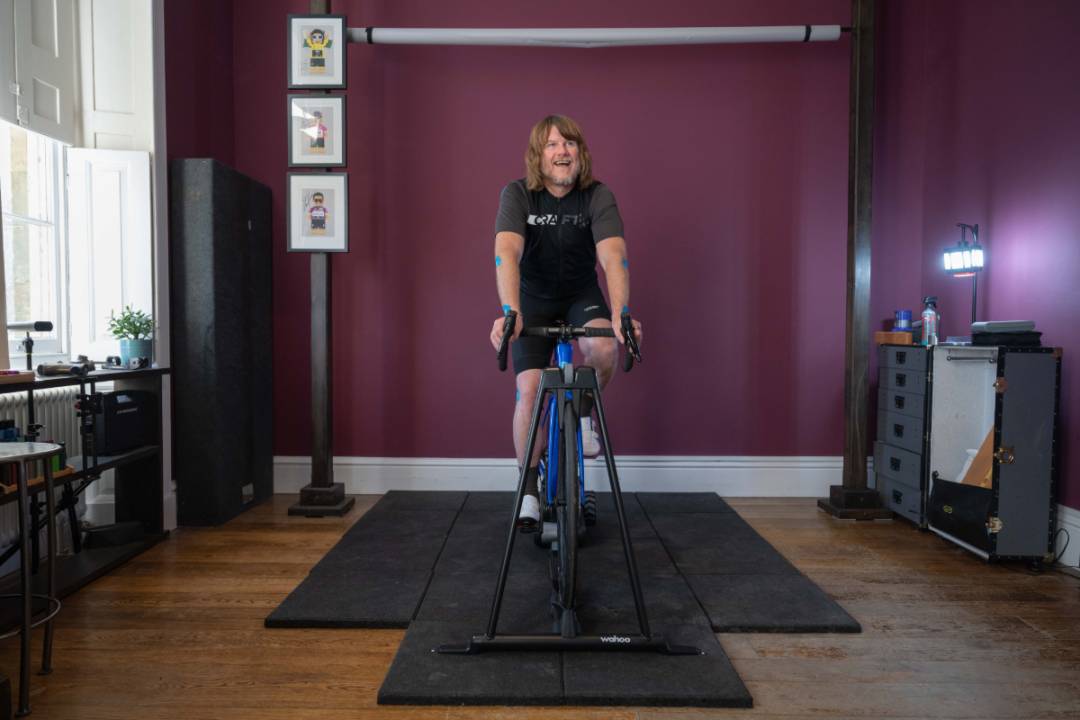
The benefits of indoor cycling on the best turbo trainers mean that triathletes can use the off-season as the launchpad for a successful racing season.
An off-season is when you take a rest from routine training, recharge your mind and body to regain balance after a busy season and reset for the next season.
Your aim is to lay the foundations of a healthy athletic lifestyle and be mentally and physically fresh for the upcoming season.
Naturally, we see more athletes doing extra strength work or focussing more on swimming where the conditions are less likely to interfere with a session’s quality.
The off-season a great time to harness the benefits of indoor cycling to get faster on the bike in a dry, safe and convenient setting.
What are the benefits of indoor cycling?

However, indoor training is a year-round staple of top athletes’ schedules and has several benefits that really come to the fore over autumn, winter and into spring.
Training indoors on a turbo trainer and indoor cycling app has the advantage of being a warmer, drier experience than training outdoors over winter and also removes risks such as poor roads or visibility.
However, it’s also far more efficient, making it a secret weapon for busy athletes to fit in their training.
The other benefit of indoor training is that athletes can clinically execute their workouts or follow precise sessions from coaches.
Athletes no longer need to find the proper route to train on; they have reliable and repeatable ‘lab’ settings at home.
Another beauty of it is that, on Zwift for example, the indoor sessions you tackle can be tailored to your Functional Threshold Power (FTP). This means even if you’re a beginner, the training will be accessible and customised to your fitness level.
Of course, outdoor training shouldn’t be totally neglected through the winter months as it enables a significant variance in training.
What do I need to train indoors?

To ride indoors, you have a few options.
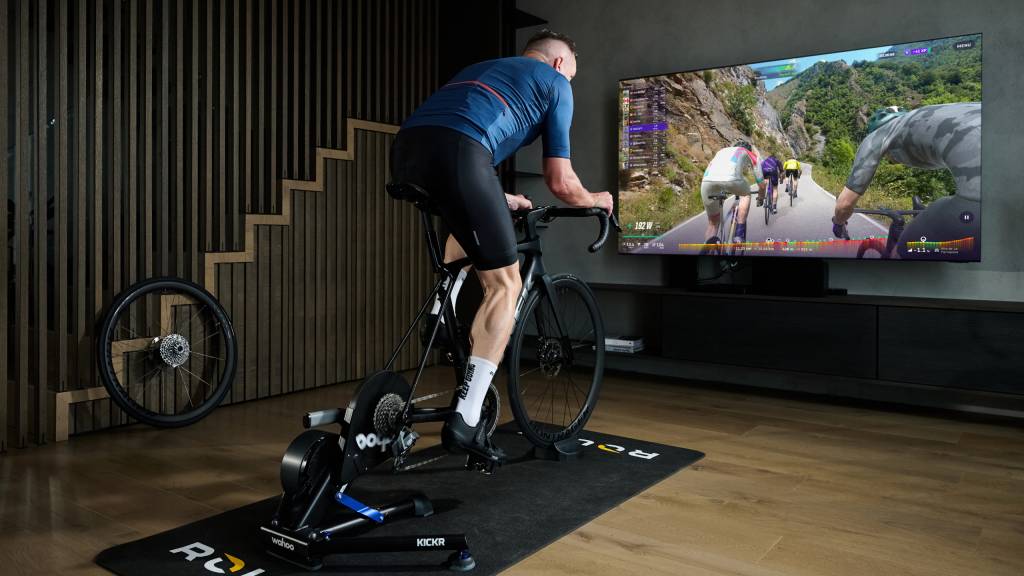
The most popular is to put your best road bike or best triathlon bike on a direct-drive turbo trainer. This involves removing the rear wheel, mounting the drop-outs to the trainer and securely them with a thru-axle for disc brakes or quick-release skewer for rim brakes.
Alternatively, you can ride a smart bike, like the Wattbike Atom, or a smart frame. These customisable frames are compatible with most kinds of smart trainer, often include a training app membership in the price and cost less than smart bikes. They remove the need to ride your outdoor bike indoors and can be made to fit a household of cyclists.
All of these set-ups will have an integrated power meter, buy you could use your bike’s power meter for consistency.
A subscription to a training platform is optional but can be beneficial. It will allow you to follow thousands of workouts, cycle on virtual courses, join group rides or take part in virtual races.
And finally, a fan, to help keep you cool during particularly sweaty sessions, a towel to mop away sweat and a training mat to protect your flooring from both your sweat and kit.
November indoor cycling tip: work on technique
Advice for new triathletes
Now is a great time to invest heavily in your technique such as pedal mechanics on the bike.
Both can be effectively done on the turbo, where you can keep everything consistent and feel, or even see, the changes made.
Coach’s advice
November training should be more technique-focused than anything else, as there is no rush to get something fixed before a race.
On the bike, you could look at everything from positional changes and aerodynamics to pedal mechanics, breathing and cadence.
Low cadence intervals may be worth checking out. They help you focus on your pedalling technique while building strength in your legs, and that’s all without taking too much of a toll on your cardiovascular system.
Training for the sharp end
As you build back into more structured training, a technical focus may be particular for you as you’ll likely have critical areas to work on (this is more apparent from your season reflections).
However, you also want to build back from last season, so ensure you deliberately hold good form after some time off, even if that means slowing down or doing much less than you used to before your break. It will all come back better.
December indoor cycling tip: build consistency

Advice for new triathletes
The aim is to have fun and explore different training styles.
Do an FTP test to gauge where you’re at and then think about doing some racing or following some of the fantastic online training programme specifically tailored to multisport athletes. To name a few, Rouvy, TrainerRoad or Zwift all have triathlon training plans.
Whatever you do, building training into your week will be vital in setting up for a new season (not just starting in January!).
To help you stick to this, you may want to work through some of Zwifts pre-made workouts, achieving reward badges as you go.
Coach’s advice
Traditionally, the winter period is where you may build mileage and an aerobic base (‘winter miles equals summer smiles!’).
ERG mode is useful here, as it locks in a specific resistance to ensure you don’t push harder than you should be.
More generalised advice would be to use this period pre-Christmas to find some consistency (and enjoy the festive period!).
Time spent working out your weekly schedule, fuelling, recovery and building momentum with each session is more effective.
Virtual group rides will really come into their own at this time of year, too.
Motivation can drop at this time of year because of the weather and the solitary nature of indoor training, so being able to train with others is a huge boost. Plus, it adds a slight competitive edge.
Training for the sharp end
At this point in the season, you’ll be starting to implement your season plan, and you’ll know if you need to work on a specific area.
Indoor training can help give measurable and reliable feedback on how those areas are improving. Repeat key sessions to generate clear comparisons of how you’re progressing.
Consider leaning on ERG mode to maintain consistent efforts and avoid soft pedalling.
Doing an FTP test will also give you some vital info to take forward into the new year.
January indoor cycling tip: Build on the platform you’ve constructed
Advice for new triathletes
After your first season, now is the time to begin to see how training consistently can help you progress. Use indoor sessions to build the area you need to work on.
For long-course athletes, this may be increasing training duration. For short-course athletes, it could be working on FTP or threshold building by following a threshold booster plan.
Be sure to do another FTP test after a few weeks to track your progress.
Coach’s advice
Now is a great time to see how effective your aerobic endurance is. After a warm-up, aim to hold a zone 2 effort for a set duration. This could be 30 minutes or up to a few hours.
Your aim is to see how your heart rate trends. It should remain level, and then, as you reach the end of your aerobic fitness, you will start to rise for the same effort, or your power/pace will reduce for the same heart rate.
You can practise fuelling through this as well. This test is best completed indoors (as long as you keep cool) as you can control more of the variables.
Training for the sharp end
You should be making significant gains in the area you wanted to work on from last season.
This should be tested frequently through January to ensure you’re on track. Indoor sessions offer an easy way to test many aspects of your physiology, so test your engine!
February indoor cycling tip: Consolidate your fitness and be more intensive

Advice for new triathletes
With your first proper winter of training under your belt, February is a great time to test yourself and see how you’ve got on.
This may be through indoor tests and races or early-season single-discipline events.
The time trials on Zwift are excellent sessions to settle in and see how you improve week to week.
Coach’s advice
February is often a tough month for athletes; the excitement of a new year is behind you, but racing seems so far away.
However, now is the time to settle into training and put in the hard work, which means increasing intensity as well as volume.
You would want to do some racing to see the progression and keep training interesting and varied.
Alternatively, you could pick a virtual route that matches the terrain you’ll be riding on, be that a hilly course, a flat one or one with lots of turns. You can Ironman bike legs on Rouvy, for example.
Training for the sharp end
Indoor races are a beneficial way to check how your training has gone, especially if those races somewhat reflect the area you need to improve (e.g. TTs, criteriums or 5ks).
If you were working on specific areas, then review those, too. For example, are you actually holding your aero position all the time?
Using indoor testing allows you to record your whole effort and reflect on it objectively more than anything you do outdoors, so set up your camera and look not just at your numbers, but also how you get them.
March indoor cycling tip: Become more specific

Advice for new triathletes
Running off the bike is an odd sensation for many new triathletes. Indoor training can facilitate your adaptation by making it easier to tackle a brick session.
These are most often implemented in the build-up to a race, but it can be useful to introduce them at this point, too.
If you’re also running indoors, brick sessions also give you a chance to consolidate your technique running off the bike by using mirrors to check your form.
General advice
Race season is just around the corner, so think about using some brick sessions to practise your transitions.
If you’re lucky enough to have a treadmill and turbo next to one another, you can work on running off the bike or jumping back on again, like a duathlon, to really adapt to multisport racing.
Alternatively, tackle an endurance session on the bike and have your running shoes waiting so you can pull them on and head out for a short run once you’re off the turbo.
Training for the sharp end
You can continue the specific work for the race distances you’re competing in. However, you can also begin to set targets.
Perhaps you need to build a workout to replicate your A-race, and you can manage the run off the bike at the same intensity.
You can begin to see how your training can be applied to the specific demands of your race.
British pro David McNamee shared his key Zwift sessions with us for long-course racing, which include two race-focused efforts that you might want to try if you’ll be taking on long-distance events.


 Philip Hatzis
Triathlon and ultra running coach
Philip Hatzis
Triathlon and ultra running coach