What is running cadence and how can you improve yours?
Wondering how important run cadence is and how fast your foot turnover should be? Our expert coaches have the answers.


Triathletes will be familiar with cycling cadence and the optimal speed to turn the pedals during training and racing, but what about your running cadence? It’s a metric that has popped up in recent years and you may even find it within the host of data provided by your triathlon watch.
We’ve asked the help of long-time tri coach Andy Bullock to explain the significance of cadence in your training and racing and how to harness the right turnover to your advantage.
If you’re a runner who has done all the drills, strength training, and have perfected your training plan to really optimise your performance, then your next step should be to understand just how fast should your legs should be working for maximum efficiency.
What is running cadence?

Running cadence, and its effect on efficiency, is an interesting area.
With running, the speed you move at is a combination of the distance travelled by each stride and the rate at which you repeat this stride, which is also called turnover or cadence.
Cadence is measured in steps per minute (spm) in reference to how quickly the feet hit the ground while running. Factors that can affect run cadence include leg length, running speed, technique, and terrain/elevation.
What is a good cadence for running?
Generally, the most common number you’ll hear as a target for cadence is 180 strides per minute. Research has shown that around the 180spm mark is the most optimal cadence for running efficiency, this is because quicker steps reduce impact on the joints and minimise the chance of overstriding, which can contribute to injury.
That being said, most recreational runners tend to have a slower turnover than this. Since everyone is different, it might be that 180 isn’t right for you. Chances are though, it’s likely that a higher stride rate would benefit your running.
Individual variation happens because of factors like leg length and strength, and those with longer legs may find themselves taking longer strides with a slower turnover, while those with shorter legs may find they run with shorter strides and a faster turnover.
Why should you increase your run cadence?

One of the most important effects of increasing leg turnover is a shortening of the stride at the front of the action.
This, in turn, means feet hit the floor closer to your centre of mass, reducing the likelihood of a heel strike and, therefore, less lower injury risk. For this benefit alone, it’s worth looking at your cadence.
As for increasing turnover and efficiency, some studies show that increasing run cadence actually results in higher oxygen use during running.
If you’re interested in increasing your leg turnover, you can try running on a slight downhill or counting your strides over a 10sec period, and then simply trying to increase this number by one stride at a time.
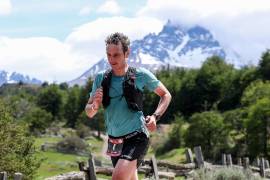
For trail runners traversing technical terrain, a shorter cadence is also useful to remain light and agile on your feet. Navigating over uneven, off-road terrain can be hazardous; quicker footfall means that if the ground shifts below your feet then you’re already onto the next stride and not thrown off-balance or risking a fall. Think: fast feet.
How to improve your running gait and cadence
Studies show that increasing your run cadence is a proven way of becoming a faster runner. Biomechanical run expert Ben Barwick of coaching outfit Full Potential reveals how to develop a swift stride rate.
1. Landing and toe-off
Your foot should strike the surface with the ball of your foot in a dorsiflexed (upwards) position, with your toes pointing forward not downwards. The knee should be at a slight bend to reduce shock of impact.
The landing should be light, not heavy, before gripping and gently scraping the surface underneath you.
2. Focus on the hips
Think of your leg working in a circular motion from the hip joint. This brings the heel of your foot behind your body.
The hamstrings and gluteus maximus (bottom muscles) play a key role in this action. Your hips and waist must remain steady with little side-to-side movement.
Think of your hips as a full bucket of water which must remain centred without side or front tilt.
3. Upper-body position
The shoulders should be relaxed with arms bent at 90°. The motion should be from the shoulder not the forearms.
As the arm moves back, keep the 90° flexion. Hands should be held with the palm facing inwards not down. If you hold your hands in a fist, the thumb should rest on the forefinger.
Coach Ben’s run cadence session

Run cadence should be a function of speed – the faster you want to go, the faster your cadence needs to be – and you should aim to increase the cadence of each run speed by 5-10%.
That’s why during speed sessions, focus on a quicker cadence and pushing off the ground with more power, so that you’re developing both stride rate and cadence to go faster.
Warm-up
- Start with 10mins easy running – Gradually increase your speed throughout so your heart rate increases and you work up a mild sweat
Main Set
- 10mins running at threshold – This is around 80-85% of your maximum HR and is known as the exercise intensity or blood-lactate concentration we can only sustain for a specific period of time. It’s about 25-35secs slower than 5km race pace and 15-20secs per mile slower than 10km race pace
- 90secs jog recovery
- 5 x 2mins at 10km pace with 60secs recovery
- 5 x 1min at 5km pace with 60secs recovery
Cool-down
- 10mins of running, gradually reducing speed
For more run workouts, check out this free 8-week run speed training plan to improve your run times


 Andy Bullock
Triathlon coach
Andy Bullock
Triathlon coach With contributions from