Get ready for Ironman: Tame the Ironman run
It’s where dreams are made or broken, but just how do you complete a marathon after cycling 180km? It’s about consistency, gut training and a decent pair of socks, our experts tell our Tenby entrant.

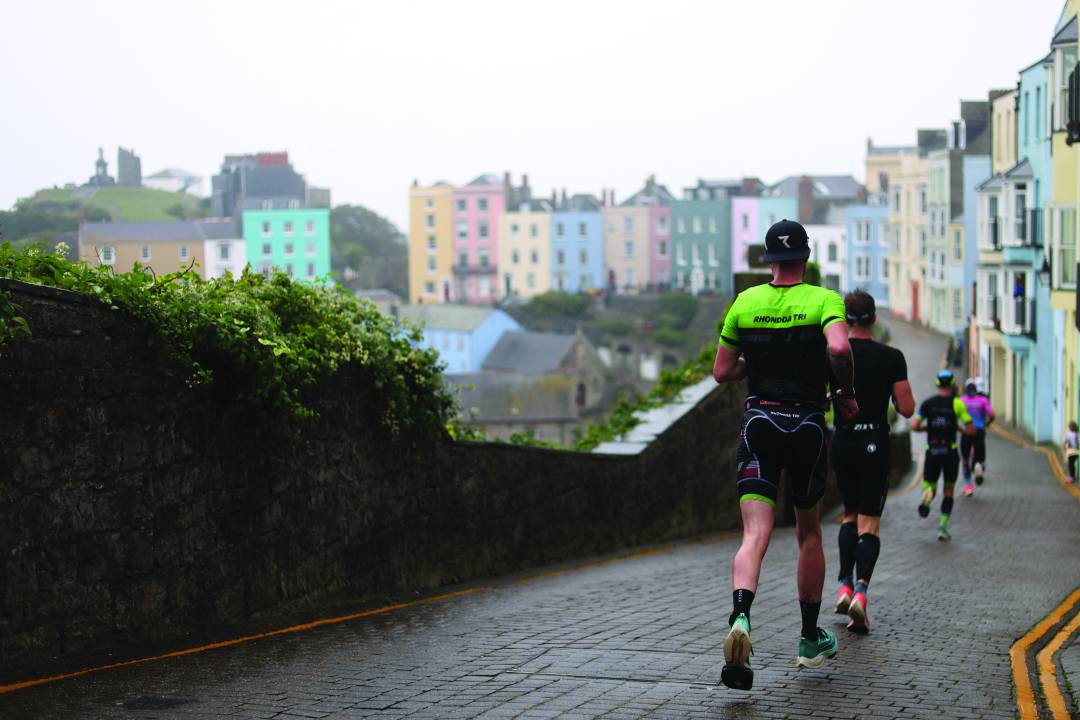
The swim might be the scariest, the bike leg the longest. But it’s during the 42.2km marathon run of an Ironman where the suffering can be turned up to 11 and finish-line dreams are made or broken.
The bad news is the fact you’ve swum 3.8km and cycled 180km before you even get to the marathon run, something that makes jaws drop whenever you try to explain just what craziness you’ve signed yourself up for.
The more welcome news is that, due to the combined swim and bike cut-off being 10:30hrs, you have some six and a half hours to complete the Ironman run course at Ironman Wales in Tenby – and even more time at Ironman races with less onerous swim and bike courses – at an average pace of just 6.5km/h in Tenby.
And, with most Ironman races having multi-lap courses, including four-lap Tenby, that 42.2km distance can be broken down into more psychologically manageable chunks.
Whether you’re aiming to compete or complete, no-one ever said an Ironman run would be easy, however, and you’ll have to manage the mother of all post-bike jelly legs, how to fuel your efforts in both training and on race day, as well as the psychological lows that arise in any marathon, let alone an Ironman, and much more.
For help, I’m calling on multiple Ironman champion and Rouvy pro triathlete Sam Long and top age-grouper and coach Graham Wadsworth to help guide us all to Ironman glory, whether you’re racing for age-group honours or facing a 17-hour-long duel with the clock like me.
Find that consistency

Injury is the biggest worry for any Ironman athlete in training, so big in fact that I can’t mention the ‘i’ word for fear of cursing myself. The chance of injury can be minimised, however, by not panicking or increasing the mileage too swiftly.
“One of the biggest keys to injury prevention in running is consistency,” says Sam Long, who has Ironman wins at Chattanooga and Coeur d’Alene on his racing résumé.
“And not just in the final weeks before a race, but year-round. If you find yourself cramming last-minute miles, especially leading into an Ironman, that’s what I call ‘panic training,’ and it often backfires.
“Instead of trying to squeeze in a massive run close to race day, focus on building sustainable volume over many months – or, ideally, years.”
Understanding there’s only so much you can do at once is imperative, says Long. And is following the 10% rule. “Only increase your weekly run volume by a maximum of 10% at a time. That goes for both total mileage and long runs.
“For example, you can’t jump from a 20km long run to 35km overnight. You’d need to build progressively – 20, 22, 24km, and so on – which takes time and patience.
“After a few weeks of buildup, you should also plan a deload week to allow for recovery and adaptation. Injury prevention comes from respecting those incremental gains.”
Hit the hills

The Tenby bike course garners most of the attention, but the run course, with an elevation gain of 503m over 42.2km, is also a rolling affair.
“Don’t think of traditional marathon run training when it comes to Ironman Wales,” says Wadsworth, who clocked a 3:29:18 marathon at Tenby in 2023 and has coached plenty of athletes to that famous finish line.
“Long hill reps are key, as is learning to run efficiently on gradual downhills. Don’t worry about pace: this will be a slow, slow run. Focus on building your leg strength by adding strength and conditioning sets to your routine; applying them just before a run is a smart and time-efficient method.
Aim to avoid fast running sets as these aren’t needed for Tenby – ditch these to lessen the chance of injury and also save your legs for those bike training efforts.”
Build those bricks

Swim/bike or bike/run bricks are the stuff of tri legend and are probably the first thing I’ll recommend to anyone taking part in their first race. But, as Sam Long states, the key to brick success is variety.
“For Ironman prep, one of my biggest brick sessions might be a 3-4h ride followed by a run of up to 2h at or near race pace. But I don’t do that exact session all the time. Instead, I mix it up.
Some days it might be a shorter but harder ride followed by a longer run. Other days it might be a long aerobic ride with just a 45-60min run off the bike. The goal is to stimulate different adaptations and avoid stagnation – mentally and physically.
Bike/run bricks are easier than ever to perform now due to the improvements in indoor bike and run tech, something elite racers like Long relish.
“Sometimes I incorporate both indoor and outdoor elements. For example, I might ride indoors on indoor cycling app Rouvy and then head out for an outdoor run, and other times it’s ride outside then finish with a treadmill run.
“That combo gives you the best of both worlds: the structure and control of indoor training, plus the real-world variables of outdoor training.
“Running indoors also gives me access to all the hydration and nutrition I need, which is a bonus for those longer or more specific sessions.”
Do the jeff
To misquote Maury Ballstein from Zoolander, jeffing is so hot right now. The run-walk method pioneered by Olympian Jeff Galloway in the 1970s is the talk of running circles, and is basically a more standardised and pedestrian version of fartlek. The benefit is to manage or eliminate pain, exhaustion, burnout and the other negative effects that come from continuous running.
It’s something I’m applying during my training runs and I’ll do so on Ironman race day, using a 3min of running/1min of walking formula for much of my run training, which has largely been on trails and towpaths.
Despite my battered knees, I’ve stayed injury-free thus far (I’ve really jinxed it now). And if you think jeffing makes you slower, a study published in the Journal of Science and Medicine in Sport found that it can nudge you to a marathon finishing time in roughly the same time as continuous running methods.
Think about your feet
My previous Ironman attempt saw me grow the biggest pair of toe blisters since Lawrence of Arabia went for a 1,000-mile stroll in 1909, not helped by wearing cycling socks on the run and not adding lube or blister plasters in T2. It was great for the post-race photos, but easily could’ve ended my race. It’s a mistake hardened pros like Sam Long don’t make.
“First and foremost, find your go-to pair of socks – the ones you trust on race day,” says the American pro. “And don’t just throw on elastic laces without testing them.
“Make sure your shoes fit exactly how you want with those laces – not too tight, not too loose. It’s one of those little things that can make a big difference late in the race.”
Embrace the atmosphere
When training worries/nerves/sheer panic set in, it’s worth remembering the why when you’re training for that A-race. Watch race videos of Ironmans past, draw on your favourite racing experiences or picture those crowds on race day.
“If you practice Tenby’s run course outside of race day, it might seem quite unspectacular. But it’s transformed come race day,” says Bristol-based coach Graham Wadsworth, who finished 25th overall at Tenby with a 10:25hr time in 2023.
“The four out-and-back loops give plenty of opportunities for spectators to offer vocal support, with the twists and turns back in Tenby’s old town making it easy for spectators to cut through the alleyways to see their athletes. Supporters can easily see their runners eight or 10 times in the race without walking any distance at all.
“The massive local participation also means that there are loads of local spectators, while the Welsh triathlon clubs all set up their own areas and come to cheer in their thousands.”
Train your gut
My one and only previous Iron-distance run at the UK Ultimate Triathlon in Shropshire took some 15h on a pancake-flat course. So long in fact that I made some good friends on the way and had time to be sick in a hedge twice on the run.
Let’s just say, I should’ve packed some Rennies and trained my gut beforehand to consume the carbs needed to fuel a body for a full day of endurance sport (read more on this next issue). It’s a stone that pros never leave unturned.
“When it comes to the Ironman run, fuelling is all about gut training,” advises Long. “As a pro, there really isn’t room for ‘treats’ on race day – it’s all gels and liquids, and often whatever’s available at the aid stations.
“I focus on practicing with the same products I’ll use on race day and getting my gut used to absorbing large amounts of carbs, especially late into long runs.
“I don’t always practice this in every session, but I make sure to include a few key runs or bricks where I replicate race-day nutrition closely. You’ve got to be able to keep taking in fuel when your body wants anything but that.”
Check what nutrition is available at the race’s aid stations (Rouvy has a feature that specifies exactly where the feed stations are on Ironman courses) and use it well before race day, with the Maurten gels and bars that will be supplied at Ironman races worldwide for the 2025 and 2026 season and Precision Fuel & Hydration PH 1000 tabs available at European races.
Plan those B-races

Brick sessions and Rouvy’s Ironman course-specific sets on the turbo trainer are proven ways to help tame an Ironman, but building races into your training are an invaluable way to gauge race fitness (as long as you don’t push it too hard!).
Which is why I raced the Croyde Ocean Triathlon in early July (race report coming soon) to gauge my race fitness and experience some choppy Bristol Channel swell before September’s Tenby.
With my breakfast left on Putsborough Beach and a finish time 45-minutes slower than my Croyde PB, let’s just say it didn’t go well.
As a wake-up call for Tenby, however, it did the job, and I know exactly what I need to focus my training and prep on before September.
Including not eating my breakfast in transition just half an hour before the race…. Croyde’s fantastic atmosphere and epic course have also whetted the racing appetite, something I’ll remember when motivation dips and that family bag of Wotsits calls.
As for psych-boosts on race weekend, Long has a ritual that we can all perform. “One thing I always do is visit the finish line the day before. I take a moment to visualise myself running down that chute, crossing that line.
“But I don’t imagine it being easy. I imagine it being real – tough, gritty, painful. Sometimes I’ll imagine myself winning, but even in that moment, I picture the suffering it takes to get there.
“That way, when race day comes, I’ve already made a pact with myself: I will get to that finish line – no matter what it takes.”
Matt’s Ironman training stats
Here’s how our writer has fared in this month:
- Swim: 4.2km (6km in May)
- Outdoor bike: 142km (90km)
- Indoor bike: 7:30hrs (9hrs)
- Run: 52km (45km)
- Vo2 Max: 50 (50)
- BMI: 23.7 (23.9)
Next month, we’ll be focusing on Ironman nutrition, including how many carbs you need, how to counter sweat losses and perfect your pre-race hydration ahead of Ironman race day.
For more from Matt, check out our preparing for the swim and bike course sections of this series.


 Matt Baird
Editor of Cycling Plus magazine
Matt Baird
Editor of Cycling Plus magazine