I won a brutal triathlon on Mount Etna and it took 15 gruelling hours in darkness and heat
Sean McFarlane reports back from winning the Water Fire Triathlon Extreme Etna, one of Europe's toughest swim-bike-runs.

I’ve been thinking about this climb for months. If I can just get up it, I’ll feel I’ve broken the back of this brutal bike leg.
But talking of broken backs, mine is straining. Like fudge doughnuts, sustained climbing on a bike is a weakness of mine. I can feel the calories burning at an alarmingly rate and thinking of chocolate-filled pastries is not helping.
My mind is all over the place, grasping at a wide range of topics in an attempt to get up this huge stretch of rising tarmac.
The occasional tourist bus passes, its occupants straining their necks to give me looks of either bewilderment or awe – it’s hard to tell.
They look ever so comfortable in their air-conditioned vehicle. I am not.
Sean McFarlane
Sean McFarlane was runner-up in the inaugural Celtman, City to Summit and Brutal extreme triathlons. He is Head of Triathlon at leading Scottish independent school Dollar Academy. He’s also written race reports for us on the Saharaman and the Hebrides Triathlon.

The landscape is changing – the tree cover easing to expose the impressive fields of lava. Up ahead, Europe’s most active volcano smoulders, seeming to say “come and get me”. It last erupted just a few months ago but we’re all hoping it fancies a quieter day on this occasion.
The turns on the road become tighter and I look up to see the roadside barriers signalling hairpins. I also spot a couple of other riders who, just like me, are making slow progress. It’s a welcome reminder this is tough for everyone and seeing them gives me the boost I need.
A bit of mutual encouragement with both and I pass them to make the top of the climb. The volcano seems tantalising close.
My bike computer tells me I’m at 1900 metres. T2 is at 1750, but to get there involves a big descent and yet another climb. Jacket on, I now plummet down towards the coast.
Rapidly losing all those hard gained metres is mentally tough to take, especially with the prospect of that final ascent.
Mount Etna in sight

This is the bike leg of the Water Fire Triathlon in Sicily and I’m riding a course that spirals around Europe’s most active volcano, Mount Etna. That mighty impressive piece of natural high rise on the Mediterranean’s largest island is also our run route.
I’m not sure triathlon courses can get any more spectacular, but this race’s beauty belies its toughness. I first came to Sicily over 30 years ago on a university exchange called Erasmus and have been coming back ever since for a variety of experiences, usually with a heavy emphasis on friends, good weather and food.
I’d long expected that one day I’d be back to do a swim, bike, run adventure but even in my wildest dreams I never envisaged something quite on this scale.
I’m in decent shape, especially for my advancing years, but completion of this monster is my sole aim today.
Race day dawns

Arriving with my family at the race venue Giardini Naxos on Sicily’s east coast on Monday for a Saturday race felt a bit early, but my daughter Holly is effectively a crustacean and could live in the sea.
So she and her mum Becs were happy with multiple beach days as I went about the business of preparing. I met up with my supporter Alan who in very cool fashion had left his village in Scotland in August with his partner Mhairi in their campervan and been on the road ever since.
Everything was coming together nicely. Bike check done, some easy riding and all too soon I just wanted to race. A dilemma for organisers of long-distance races in Southern Europe is heat versus hours of daylight.
Summer temperatures (especially for us Brits) can be too much. I was particularly aware of this as my last full distance race was in Italy last July, where the heat played a big role in my one and only DNF. I was comfortable that in late October the heat wouldn’t be an issue, but I was still more nervous than usual given my failure to reach the finish line last time round.
Autumn meant less daylight, with the swim and most of the run likely in darkness.
With a half distance race also taking place, we assemble on the shoreline for the 5:30am start for our 4km swim.
There’s a lot of pointing at various flashing buoys and boats, and we enter the warm water in darkness. We all have tow floats with glow sticks.
Through a combination of following others, keeping the lights of Giardini Naxos to my right and the safety boats to my left, I make steady progress in the right direction.
On to the bike

The race hotel is behind T1 and with its unusual structure and blue and white façade, it’s a welcome target. As I exit up the sand my watch says 4.25km which, given the conditions, I’ll take.
My somewhat novel approach to the bike leg is to take actual breaks. The theory being, if I want to get round this course, I’m best conditioned to replicate what I do in training (back to the fudge doughnuts).
There are four clear climbs on the bike leg, and the first is gradual, over about 40 kilometres with a café at the top.
As I pull in, other riders pass, but I have my game plan. Cappuccino and small pastry, a few photos, and I’m on my way, feeling good.
I’ve never done this before on a race, but it gets my head into the right space. Gradually descending now, Etna looks phenomenal with a mushroom smoke cloud sitting over it.
Bogdan Ionita from Romania comes by then I pass him as he stops to get fuel from his supporter. Then the big climbing starts. “Spin baby, spin,” I think. The course meanders through villages and farmers’ fields.
As I get higher there’s a distinct autumnal feel, with fallen leaves on the road. Breaking up the climbs into 5km sections, I stop each time with Alan to refuel and stretch.
I come alongside fellow Brit Dave Chapman – incredibly, this is his 50th extreme triathlon. It’s safe to see he’s seen it all before, but his face tells me, like all of us, he’s finding this tough.
Craving plates of chips

I’ve not had a café stop since the first one, but Alan casually drops in that I’m now in third place.
My competitive juices at least partially kick in, and I’m happy to continue with roadside stops rather than proper sit downs.
It’s late in the afternoon and as I pass through villages, I can hear the clinking of glasses as residents assemble for an aperitif.
I do fancy a plate of chips. Alan’s Italian is pretty much non-existent but surely he could manage “patatine per favore?”
With the gradient now steepening, the last 2km of the bike leg will live long in the memory.
The auto pause on my computer kicks in, which I’m sure I set to 0km/h.
The changing room at T2 has a strong whiff of reluctance. Nobody seems in a hurry to leave. My friend Guilio Dubusio is there – he supported me in my DNF last year.

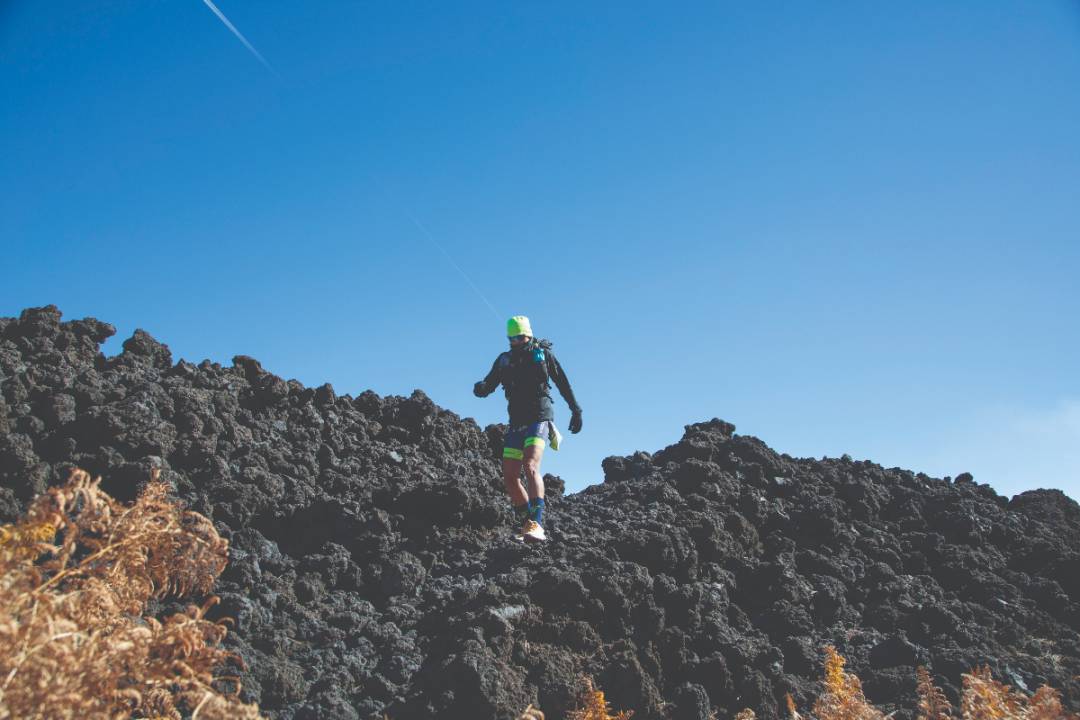
Heading out, my legs feel ok but I’m descending for now, off road through the forest and then through surprisingly technical lava fields that require focus.
My headtorch is soon on. I struggle as the inclines come and I walk plenty of them.
I meet Alan at 13 kilometres who tells me first place is just in front. I soon come alongside Mauro Ciarrochi, a multiple ironman competitor with ten Kona finishes.
I head past him, uphill through the forest to then descend through another lava field. Now in lead, I’m still focusing on finishing rather than winning.
I can’t see any lights behind me and given how much I’m walking, it’s clear everyone is exhausted.
It’s getting late and the wind is whipping up. I wonder if Etna will still be open to us?
I take a deep breath as I reach the 23km mark to pick up Alan for the final 19km ascent of Etna.
Organiser Luca Mancuso and his team emerge from the darkness with news – for safety, they’re cutting the race short. Suddenly, unexpectedly, joyfully – I’m declared the winner!
A sensible curtailment

I finish in 15 hours and 41 minutes to take first place. I think I could just about have continued with Alan’s support and my trusty walking poles, but it would have taken a long time.
Without doubt, it was the right call to cut the run course short with the safety of competitors paramount. It was already close to 10pm and sending exhausted people up a 1000 metre climb followed by a 5-kilometre technical descent to the finish in gale force winds was not a good idea.
I definitely need to improve my nutrition for longer races. My stomach wasn’t great and for the entire run I only had a very small amount of water.
But it’s not rocket science. It’s no wonder my stomach struggled when you look at what I put in it – a vast assortment of coffee, chocolate, crisps, peanuts, rice cakes and different sport products.
I need to work out a nutrition plan that’s sustainable over that length of time and practise taking that nutrition more in training.
As an experience, the race was like nothing I’ve done before. Landscape, culture, course, format, spirit, weather; it had the lot.
Not to mention a very active volcano.
Whilst Luca may need to tweak things to have more of the race in daylight, he undoubtedly has something very special to take forward.
Somewhat unusually for me, I was emotional at the end. Sicily is very much my second home and coming first in the island’s inaugural extreme triathlon felt incredibly special.
Guilio finished second. Last year’s DNF had played on my mind in the build-up and he had supported me brilliantly on that occasion.
As we hugged at the finish line, he said to me “Good to get to the finish line this time”. It certainly was.
Water Fire Triathlon Extreme Etna logistics
The Water Fire Triathlon takes place on 24 October 2026, with the full Iron and half Iron distances on the first day.
How to get there
I flew direct from Edinburgh to Catania with Easyjet. Several airlines fly direct to Catania from the UK. There is a decent bus service from the airport to Giardini Naxos.
You can also get a train to Taormina Giardini which is a 20-minute walk from Giardini Naxos.
The race has a deal on car rental from Catania airport – more information on the race website.
Where to stay
The race hotel is Sporting Baia Hotel in Giardini Naxos. Competitors get a discount and it’s at T1. It was 45 Eurosppn and 60 Euros for a single on a BnB basis this year.
There are several other hotels as well as apartments via the usual websites.
How to make a week of it
The race organises excursions including a swim across the Straits of Messina and a tour of Mount Etna. More information is on the race website.
Taormina is just a couple of miles away and with a good bus service is well worth a visit. It is widely regarded as the most popular tourist destination in Sicily, and for good reason.
Giardini Naxos is the perfect base and a great place to have a holiday and relax. It’s on the beach with plenty of cafés and restaurants and is less busy and cheaper than Taormina. It also has a rich history itself.
Bike hire and mechanic enjoycyclingsicily.com provide a superb service for bike rental and repair. Several half distances competitors hired bikes from Simone here and he fixed an issue with my pedals.
For more extreme race inspiration, read our guide to the world’s hardest triathlons.
Images credits: Carlo Strippoli, Emanuele Spagnolo and Nicola Mari


 Sean McFarlane
Journalist, triathlete, film producer and sports manager
Sean McFarlane
Journalist, triathlete, film producer and sports manager