“I knew I just needed to get as fat as possible and as fit as possible!” Ross Edgley on the extreme ways he had to change his body to swim around Iceland

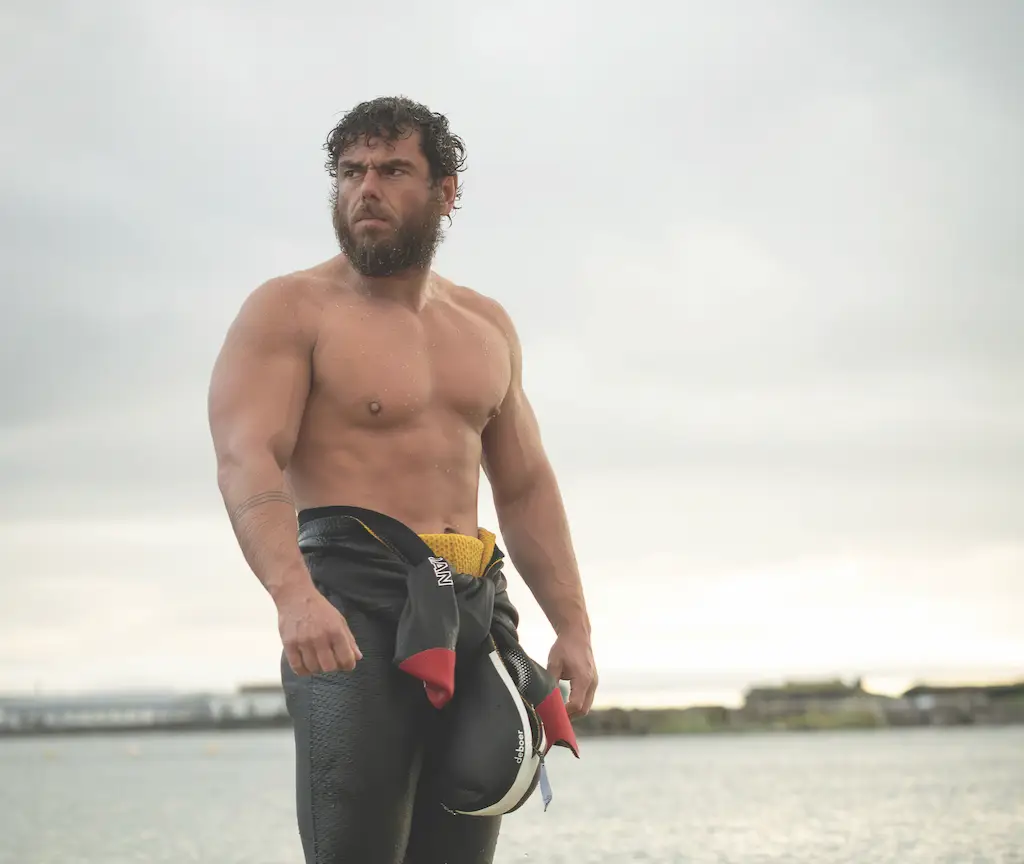
Pulling on his wetsuit each day and braving the freezing waters around Iceland, Ross Edgley made history last year after swimming 1,610km to circumnavigate the country. While the headlines were of epic swimming, the harsh toll of nature on his body and the ecological research he enabled though, there was a much more personal reason for Edgley to swim as fast as possible and get the job done.
Ahead of his new Channel 4 documentary series launching, I was lucky enough to grab half an hour with the man himself. Full of energy and enthusiasm (as you’d expect from a man who can laugh through his tongue falling apart and sees a banana covered in Nutella and coffee as a good mid-swim snack), Edgley is on form, full of stories from his most recent extreme adventure.
In the interview below he reveals what keeps him going, coping with the pain of that infamous ‘salt tongue’ and the very special news he shared with his long-term girlfriend, Hester Sabery, that kept him going despite freezing water, extreme weather and erupting volcanoes…
220: Congratulations on your latest massive swim! Great Britain and then Iceland, via Loch Ness, Italy and the Yukon…
Ross Edgley: Thank you! This was very different to the Great British Swim, in that it was a race against time. I had to be back as Hester was four months pregnant when I started the swim! We’d decided to try for a baby, but we didn’t realise we were going to get pregnant so quickly. Hester was just like, “look, you have to go, the boat’s booked, the University of Iceland, the scientists, everybody’s on board…” So I had exactly four months to finish it. I made it back by five days! I literally landed and our little boy arrived into the world. We named him Raife, which means ‘wise wolf’ in Nordic.
220: Nothing like a bit of pressure to get you through! Were you worried about making it back?
RE: Towards the end a volcano went off in Grindavik. They actually evacuated an entire town, molten lava just literally crushed houses. It was crazy. We couldn’t get too close because of the poisonous gas. Then to the east, Hurricane Erin came through the Atlantic. Then to the north Europe’s biggest glacier was throwing down huge shards of ice the size of cars.
At that point the crew were like, “Ross, I’m so sorry. We’re going to have to sit here in the harbour for two weeks, it’s just not safe”. And I was like, “no, no, I’m so sorry. We’re going out. I have to be back for the baby”. Then the crew were just heroes. We went out people were chundering everywhere! Pots and pans everywhere, everything just going nuts… And I’m like, “no, no, no, it’s fine. Keep going”.

220: You’ve found a real niche with these huge swims. Why Iceland?
RE: The idea of swimming round Iceland came up a few times. When I was on the set of Thor, Love and Thunder with Chris Hemsworth he was teaching me about Nordic folklore and we joked that swimming around Iceland would be the closest thing to swimming around Asgard, the magical realm of the Gods. Then the University of Iceland basically said if they had someone stupid enough to want to swim around Iceland, it would be amazing, because they could track the biodiversity of Iceland in a level of detail we’ve never seen before. And I was like, well, I know a guy…!
220: You have an amazing ability to morph your body for the challenge in front of you. Is that how you see it?
RE: I call it ‘physiological puppetry’, where you’ve just kind of got to jump between whatever you need. It’s knowing that form follows function. So whatever I am training for, it’s just knowing that you have to adapt to that. I went to Scotland for a training camp for months before with Tom Stoltman, the World’s Strongest Man. I knew just need to get as fat as possible and as fit as possible, which sounds like such a weird concept. And he just said “right, no worries, come live with me and just eat what I eat”. He’s massive, 190 kilos, that’s like two large men stuck together! I joked, he was my head nutritionist. I was swimming for hours in Scotland too, just getting as fat and as fit as possible.
You need to look to the cues in nature too. That idea of biomimicry. If you look at what survives in the water in Iceland, it’s fat, it’s blubber, it’s whales, it’s seals! So I just had to become more whale-like, knowing that a nice sleek physique – like for example Alex Yee, or the Brownlees – that’s not going to work for this.

220: I‘ve always loved your ‘instrument not ornament’ motto – it’s so refreshing
RE: When I was going around Iceland, we met old Icelandic chieftain who blessed the swim. I was getting into a wetsuit and they’re literally just pushing rolls of fat in here and there… He looked at me deadly seriously and he just said “that is an amazing physique for Nordic folklore mythology”. And I sort of like laughed. And he goes, “no I’m being serious”.
When you look at the old statues in ancient Greece they were ripped you know, throwing discuses, wrestling… But if you look at mythology Thor for example was a massive man with loads of fat. He was big, fat and ginger – obviously not in the Chris Hemsworth portrayal – but I thought that was really interesting.
220: Would you say swimming is your superpower?
RE: it’s so sweet when some people say I’m a really good swimmer, but I always correct them! Adam Peaty’s an amazing swimmer. Keri-anne Payne’s an amazing swimmer… I’m just stubborn and stupid. There’s a difference. And I like to make that distinction.
I think everyone has a swimming superpower. Mine is just to just be really stubborn and float far and eat lots. But don’t look at me for poetic technique. Especially towards the end, because rhabdomyolysis sets in, where your muscles are liquefying, also as well I’ll be dealing with cellulitis, my chafing wounds were so bad… So when you look, it’s just this ugly technique where you’re just nursing wounds and stuff, but it’s just knowing that’s what’s necessary to make it round.

Towards grit not quit
220: The physical hardship and gruesome injuries capture people’s attention – how do you push through those?
RE: I really love the neuroscience of it. Everyone will be able to take something from this hopefully. We all have those day you don’t want to train and you’re thinking “this is a terrible, go back to bed. This is horrible”, and so that part of the brain is always running a calculation going, “is it worth it?” It’s basically like quit and grit.
What’s really interesting is before you start on any training schedule, event, whatever it is – if your ‘why’ is big enough, then your anterior mid-cingulate cortex will go more towards grit than it does towards quit. It will go, ‘do you know what, this is worth it. “Remember, you said you were going to do this event to raise money for charity. Remember you said you were going to do this event and you posted it on social media, so you can’t let anyone down”. All of those are really, really powerful reasons. So your anterior mid-cingulate cortex calculates it and goes, ‘yes, get out of bed and go and do it’.
So every single tide in Iceland, it was pitch black, it was freezing outside, there could be orcas circling the the boat! My why was “we’re making a documentary. We are trying to track eDNA samples around the entire coast of Iceland. If you don’t finish that, Ross, there’s going to be a huge gap. And also you said you were going to do it and be back for the birth of your child”. So all of those things made me put my wetsuit on and get in.
As for my tongue falling off and the chafing wounds aha… They work as a Trojan horse to deliver the actual ocean conservation to a wider audience! So when people go, “urghhh“ and they’re tagging their friends, going, “this is disgusting!” that brings our message to a new audience as well. The scientists we worked with were incredible.

220: We can start to think you’re invincible, but you had to submit to the elements in Lock Ness and Italy, where hypothermia and then heatstroke ended your swims?
RE: I sound so weird, but I love the experiences. In Loch Ness I had an amazing time… Aside from hallucinating and stuff in the middle of Loch Ness, it was brilliant! It sounds so cheesy but you learn more from your failures than you do from your wins. I learned so much about cellulitis, rhabdomyolysis, kidney failure, hypothermia, all of them… And then in Lake Trasimeno, heat stroke, and rhabdo again. All of those learnings allowed me to go to the Yukon and break the record for the world’s longest non-stop river swim, plus I then knew enough to attempt Iceland. I really don’t think I could have done Iceland had I not failed in Loch Ness and Trasimeno. If I’d have just gone straight from the GB swim to Iceland I wouldn’t have made it, I don’t think, because I wouldn’t have known enough about hypothermia and everything.
220: I’m guessing everyone keeps asking you what’s next?
RE: Yeah! I think at the moment, I’m sort of waiting to see where somebody wants me to swim… But other than that, I’m just focusing on absolutely dominating the Father’s Day race. That’s my only goal!
220: Imagine those poor dads that turn up at the start line with their little egg and spoon and Ross Edgley’s there…
RE: Aha! Exactly! Exactly, that is what I’m going for. I’m turning up in Lycra and spikes with my egg and spoon!
Ross Edgley’s new book How to Hero, Philosophy Forged Through Endurance is due to go on sale in October and is available to pre-order now. The documentary series The Great Icelandic Swim premieres on Channel 4 on Saturday 7th February at 7:30pm.
All images courtesy of Ross Edgley and The Great Icelandic Swim/ Olly Jelley


 Helen Webster
Editor, 220 Triathlon
Helen Webster
Editor, 220 Triathlon