How likely was Sabastian Sawe’s world record at the London Marathon and how low can the benchmark fall?
Data scientist Simon Angus considered a sub-two-hour marathon pretty likely on the day and expects records to fall further

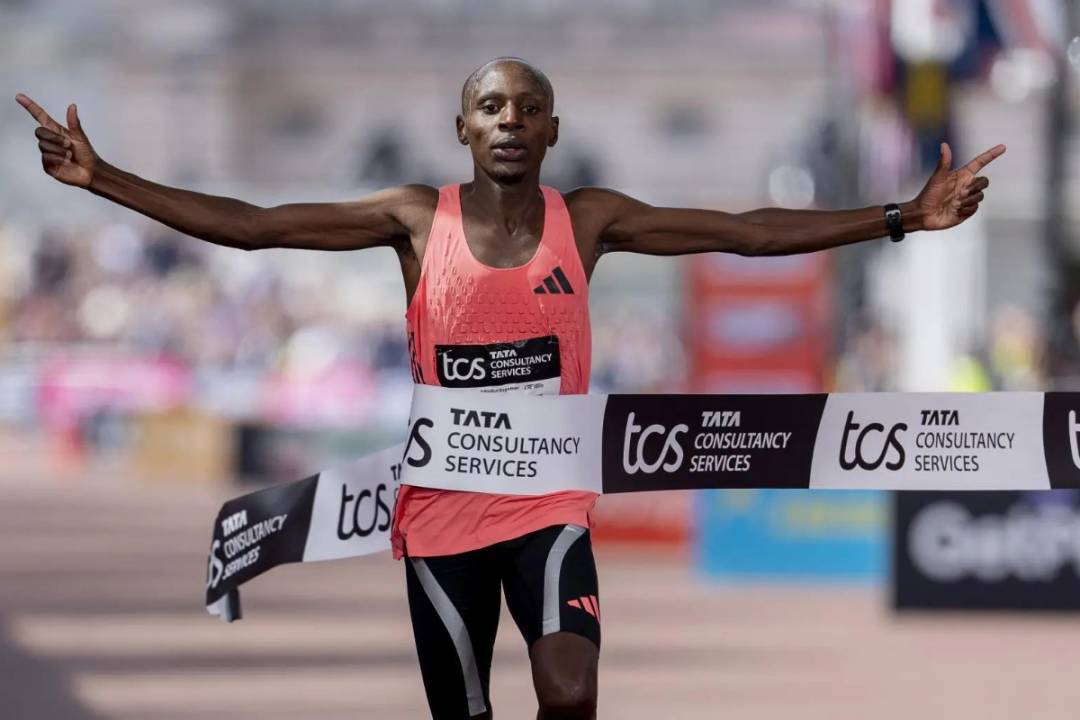
Two world records were set at the 2026 London Marathon on Sunday as Sabastian Sawe went sub-two in the men’s race and Tigst Assefa won in the world’s fastest women’s-only time of 2:15:41.
Sawe’s astonishing mark of one hour, 59 minutes and 30 seconds was nearly one minute faster than Kelvin Kiptum’s previous 2:00:35 benchmark, the most the record has fallen since 2018. He was also 10 seconds quicker than Eliud Kipchoge’s unofficial 1:59:40, run as part of the Ineos 1:59 challenge with a lead vehicle and rotating cast of pacemakers/drafters. Meanwhile Assefa broke her own record in a race without male racers or pacemakers – Ruth Chegngetich’s outright record is five minutes faster.
As impressive as these marathon times were, they didn’t come out of the blue, according to a data scientist and economist, who has also predicted how fast both genders can go in future.
How likely was Sawe’s record?
In 2019, Simon Angus from the department of economics at Monash University in Australia published a paper giving a “statistical timetable for the sub-2-hour marathon”. He expected the sub-two-hour threshold to be broken in May 2032 at his benchmark odds of 1 in 10, i.e. quite rare but possible. He gave this a 5% chance in 2024, so 2026 is somewhere between the two. As marathons got faster, in 2023 he updated his prediction for a sub-two to March 2027 with 1 in 10 likelihood. As he explains in a recent article in The Conversation, in the context of 60 years of data, that’s only slightly late.
On the day of the London Marathon, the likelihood of a sub-2 was fairly high: about 1 in 4, according to Angus’ original modelling including data from up to Kiptum’s Chicago win in 2023. As you’d expect, beating the two-hour mark by thirty seconds as Sawe did was less likely. There was a 1 in 7.4 chance, according to the same methodology, making it a low-probability event that would only happen 14% of the time.
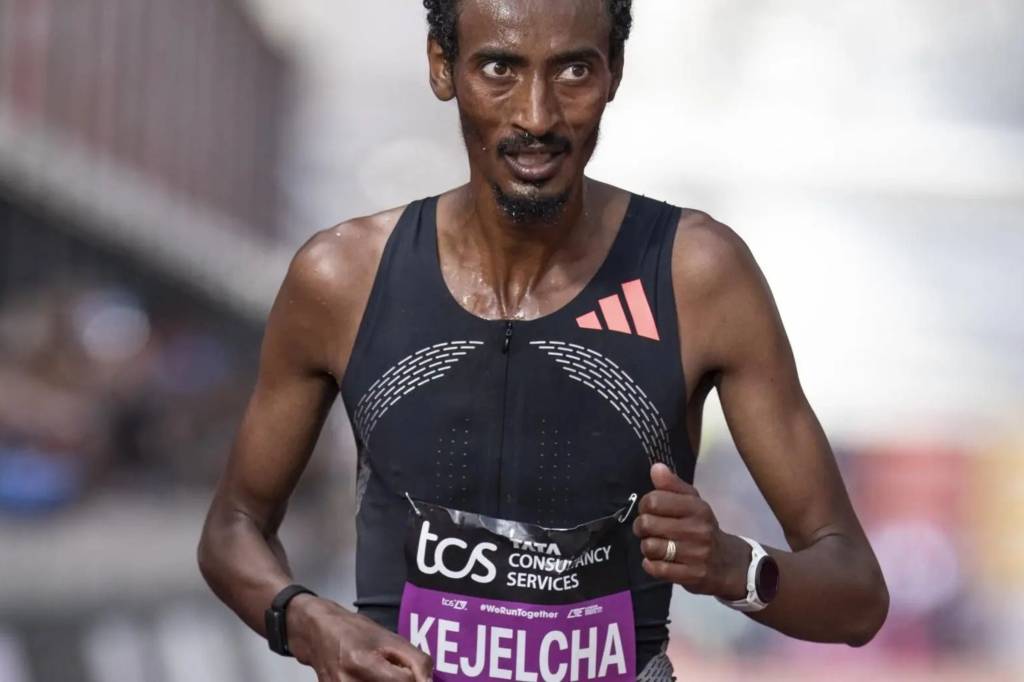
Angus identifies several contributing factors to this “pretty rare” event: ideal preparation, execution and conditions added to the fact that runner up Yomif Kejelcha also went sub-two, pushing Sawe all the way.
How low could the records go?
Angus has also predicted the limits of human performance in the marathon. He assumes that innovations, such as carbon-plate running shoes, will continue but at a slower rate than previously.
In his original 2019 paper, he calculated with his benchmark likelihood of 1 in 10 the limiting times are 1:58:05 for men and 2:05:31 for women. For men, this corresponds with the prediction of 1:57:58 as a physiological limit (in terms of VO2 max and running economy) made by physiologist Michael J Joyner in 2010.
Angus updated this forecast in 2023 to take account of Kipchoge’s official 2022 world record and Kiptum’s 2:00:35 in 2023. This lowered the limiting time to 1:55:40. Including Sawe’s London time, the limit goes down slightly to one hour 54 minutes.
That sounds staggeringly rapid, but as Angus notes in his Conversation piece, courses like Chicago and Berlin have historically been faster than London.
What represents the two-hour barrier for women?

To calculate the equivalent of the two-hour threshold for women, Angus worked out the difference between the two-hour mark and the male limit (1:58:05) to be 1.62%. He added this to the female limit (2:05:31), producing 2:07:33. Rounded up, this could make 2:10 the two-hour equivalent for women. Ruth Chegngetich has already surpassed this, by running 2:09:56 at the 2024 Chicago Marathon, a mixed gender race. However, her three-year ban backdated to April 2025 for a positive test for hydrochlorothiazide, a diuretic, has clouded this effort.
The validity of her time notwithstanding a sub-2:10 female marathon was overdue, according to Angus’ modelling. It became likelier than 1 in 10 back in January 1996. He attributes this delay to “asymmetric opportunities … for females to compete at the highest level in athletic competition.” For example, African men run about 2.5% quicker than Europeans. But top African and European women run at the same speed. This suggests to Angus that the talent pool of female African runners is not being tapped to its full potential. Logically, increased grass roots participation could rectify this and see the women’s record drop further, faster.
For most of us, a tilt at one of the weirdest marathon world records is a more realistic way to get into the history books.


 Jack Evans