H20 Audio Sonar 2 Pro vs Suunto Aqua: which style of waterproof swim headphones is best?
The Sonar 2 Pro promises long-distance comfort while the Suunto Aqua has superior spec and tech. Helen Websters puts them head-to-head.

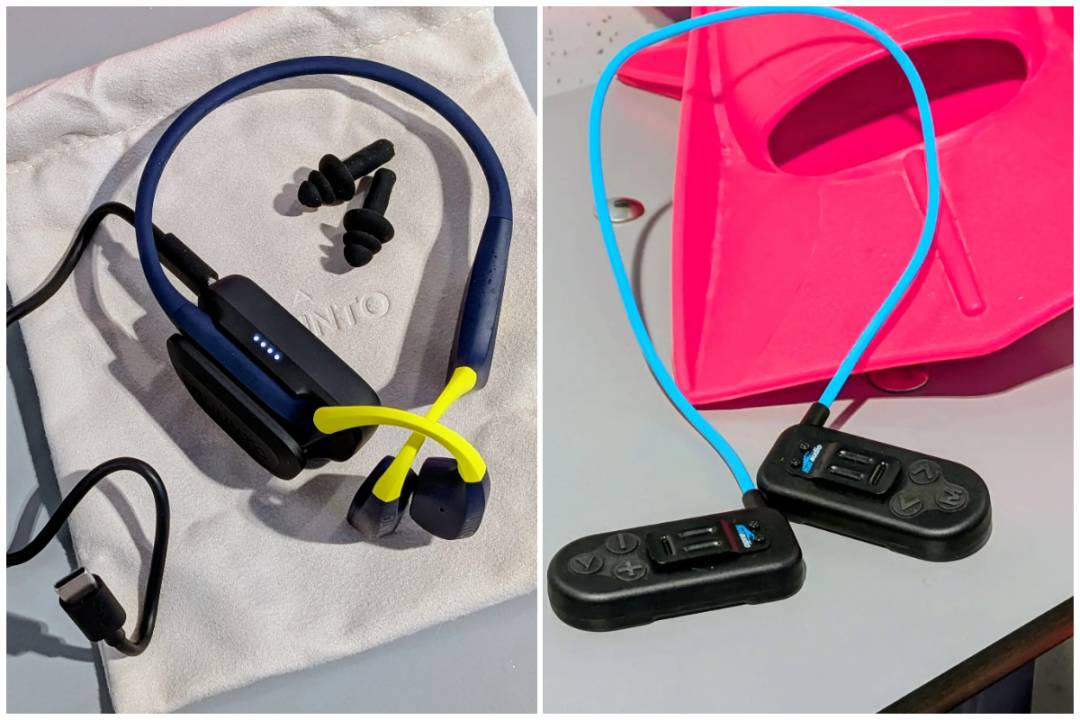
Waterproof swim headphones can help you stay motivated and focused during pool and open-water sessions, enabling you to build up volume.
The $149.99/£113 H20 Audio Sonar 2 Pro and $179/£159 Suunto Aqua are two top-quality models which fit very differently, making each better for distinct purposes.
220 Triathlon editor and qualified swim coach Helen Webster has set them against each other to see which is best for swimming.
Design and features

The primary difference lies in how they are worn.
The H20 Audio Sonar 2 Pro features a hookless design that clips onto goggle straps or tucks under a swim cap.
Not having to wear a band over your head reduces ear pressure, making them the superior choice for long, multi-hour swims. However, you’ll struggle to wear them on dry land without swimming goggles.
The Suunto Aqua has a traditional wrap-around design with over-ear hooks.

While stable and premium-feeling, the hooks can cause discomfort after an hour of use. Their benefit is versatility. They work well for running or daily use.
Both units use bone conduction and include earplugs to block water noise, but they handle music differently.
The H20 Audio Sonar 2 Pro uses Playlist+ to record streaming audio (like Spotify) directly to the device in real-time via an app. You don’t need to upload MP3 files. A negative is that you need to remember to record the music pre-swim.
On the other hand, Suunto Aqua uses the traditional drag-and-drop method (32GB storage).
This is fine if you have MP3 files to hand. For example, I added CDs to Apple Music and made playlists from these. But if you no longer own music physically or digitally, this aspect of the Aqua could be inconvenient.
It has three distinct audio modes (Underwater, Outdoor, General) to sharpen sound depending on your environment.
H20 Audio Sonar 2 Pro vs Suunto Aqua specs
In terms of waterproofing and ease of music upload, the Sonar 2 Pro is the winner.
There’s nothing between them on the scales.
But the Suunto Aqua’s run time, storage capacity and smart tech are better.
| H2O Audio Sonar 2 Pro | Suunto Aqua | |
| Style | Goggle strap clip / under cap, bone-conduction | Over-ear hook, bone-conduction |
| Weight | ~29g – 35g (40% lighter than v1) | 35g |
| Waterproof rating | IPX8 (Unlimited time at 3.6m/12ft) | IP68 (2 hours at 5m/16ft) |
| Storage capacity | 8GB (approx. 2,000 songs) | 32GB (approx. 8,000 songs) |
| Battery (playback) | 10 Hours (Bluetooth) / 6 Hours (MP3) | 10 Hours |
| Charging Case | Protective Hard Case | Charging Pod / Powerbank (+20 hrs) |
| Connectivity | Bluetooth 5.3 + MP3 Player | Bluetooth 5.3 + MP3 Player |
| Streaming recording | Playlist+ (Record from Spotify/app) | Traditional File Transfer (via App/PC) |
| Audio modes | Swimming-optimised (single mode) | 3 Modes (Underwater, Outdoor, General) |
| Smart features | None | Swim Tracking (SWOLF, Stroke, Pace) |
| Controls | Tactile buttons (Volume/Track/Mode) | Customisable buttons + Head Gestures |
Performance and fit

The H20 Audio Sonar 2 Pro gives six hours of memory playback (nine hours via Bluetooth). It recharges via a magnetic cable.
The Suunto Aqua has better battery life. The unit alone provides 10 hours of playback, and the included charging pod acts as a power bank, providing an additional 20 hours of charge.
Waterproofing is the Sonar 2 Pro’s stronger suit. Its IPX8 rating means its submersion time is unlimited.
Rated to IP68, the Aqua’s waterproofing is ratified for two hours at up to 5m deep. In my testing it survived longer than that, but wearing them for more than two hours could void your warranty.
The Sonar 2 Pro’s sound quality, which H20 says is optimised for underwater use, is as good for music as it is for podcasts. The audio from the Aqua was similarly good in the crisp underwater setting.
The design of the Sonar 2 Pro makes them extremely comfortable for hours on end. They attach to your goggles instead of resting on top of your ears, taking weight off them.
Like other bone conduction headphones, the Aqua’s hooks sit on top of your ear as you swim. They were comfortable for up to an hour, but no longer.
Swim data is an area where the Aqua has the edge. These headphones break down the stats of your swimming session and even give you a SWOLF score.
These data seemed fairly accurate, but for me the Aqua’s analytics won’t replace the best multisport watches.
Price and value
At $149.99/£113, the H20 Audio Sonar 2 Pro is the cheaper and better value option if you just want swimming headphones.
But if you’d like something to use as running headphones as well, the $179/£159 Suunto Aqua could be worth the extra investment.
Verdict

Choose the H2O Audio Sonar 2 Pro if you are a long-distance swimmer who prioritises extended comfort and needs an easy way to download music from streaming apps without a computer.
If you want a more analytical, multi-sport device, pick the Suunto Aqua. Its swim tracking provides more data than the Sonar 2 Pro can and you can wear these versatile headphones while running too.
How we test swimming headphones
Each set of headphones is put through the same testing process. First they are assessed for ease of set-up. I’ll then consider their usability, comfort and sound quality.
At a minimum I will do several swims in each set of headphones in the pool of one to two hours. In summer when the water is warmer I’ll also test waterproof headphones on longer lake swims as part of my training. You can find out more about how we test and rate products here.


 Helen Webster
Editor, 220 Triathlon
Helen Webster
Editor, 220 Triathlon