Emma Pallant-Browne on the rise of the pro-triathlete mum, gut and heat troubles, and her Ironman 70.3 world title goal
She’s known for her punishing race schedule and a can’t-sit-still mentality, but just before Emma Pallant-Browne started a new career as an athlete/mum we caught up with the 70.3 champ to talk multitasking, maternity cover and more

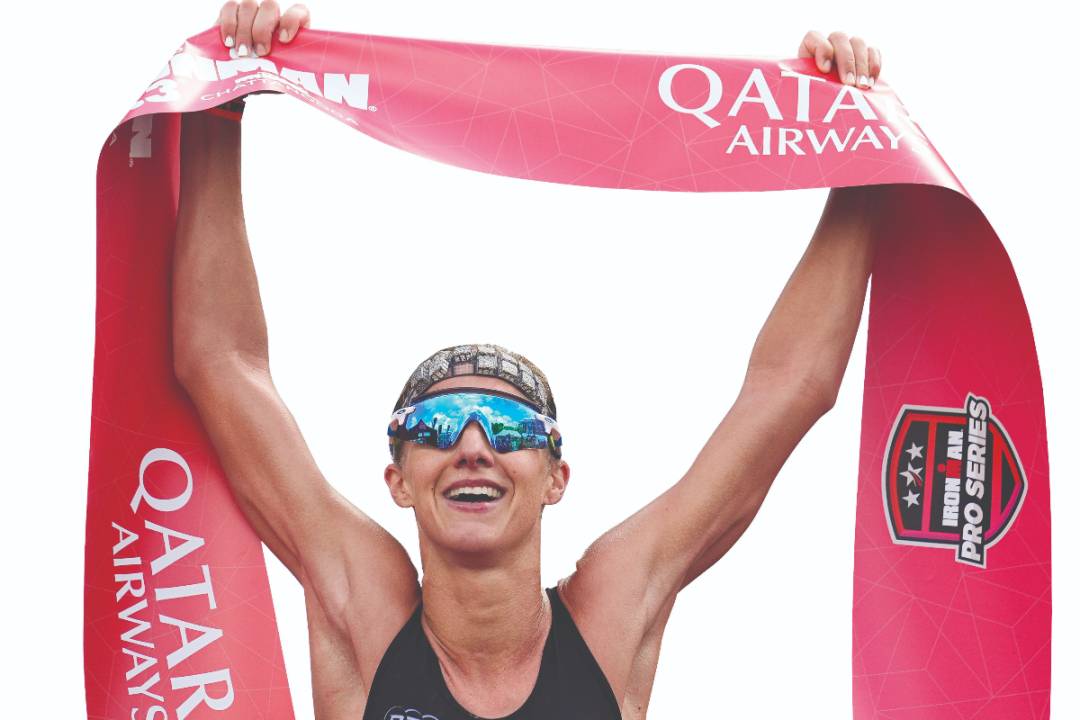
The day after we filed this feature, British long-distance pro Emma Pallant-Browne and her husband Jaryd Browne welcomed their first child to the world, the sport’s power couple having announced the pregnancy back in March.
The happy news followed a particularly rough patch in Pallant-Browne’s otherwise supremely consistent career, when gut and heat issues derailed her run of good form and saw her benchlined at the end of the 2024 season – the worst place possible for someone who finds it difficult to sit still (“at school, I guess they called it hyperactive!”).
Yet, every cloud… “I thought I had a healthy body, but I was pushing through a lot last year and we were never getting pregnant, even though we weren’t specifically trying.
“And then with the T100, I pushed it too far, I raced through it and got to a really unhealthy point. I had to have two weeks of fully nothing, then two weeks just real easy.
“I think that [rest] kickstarted my body and I fell pregnant the following month. I think that total downtime not only reset my body, but I’ve had no gut issues since, so we kind of assume the tear has sealed [in November 2024, a scope discovered a tear and bleeding in her gut, and she was forced to pull out before the T100 final in Dubai].”
We first spoke to the multiple 70.3 winner for this piece back in May, when she was enjoying her second trimester after a particularly challenging first, involving a lot of sickness and lethargy – “I felt so lazy, I could just put my head down and then be gone for two hours.
Training through pregnancy

By the second trimester, I was like, ‘oh, this feels better!’”
We then briefly caught up with her two days before she would give birth, again talking to her at her home in Johannesburg where she was enjoying her third trimester and detailing her training: “I’ve just been doing strength, lots of stretching to give him a bit more space, and running each morning.
“With swimming I felt like I was sinking, and the riding I was super squashed – he likes to be upright – so running just feels by far the most comfortable for me.
“I was on 10km each morning until week 34 when I went down to 9km, then week 35 it was 8km, week 36 7km, and now week 37 I’m on 6km.”
Everyone’s chief supporter

For an athlete who averages about eight races a season, not being able to race triathlon competitively during her pregnancy proved, unsurprisingly, “super tough”.
“I’ve still been involved, though,” she adds. “So I’ll go and support my clients at a gravel race, for example.
“I feel like I’ve had such a selfish career where everyone’s supported me, and I haven’t been able to give much back. So now this is my time to go and be everyone’s chief supporter. And, it feels good.”
The ‘clients’ are her coached athletes, who she advises mostly remotely for PEaK Team Coaching, a now global company set up by Jaryd in 2015.
“Yeah, I always want to do things,” she says laughing when I ask how she manages to fit it all in.
“I was never good at getting in that good kind of recovery. So for me to sit there, I have to be engaged and locked into something. [With coaching] I can literally put on my [recovery] boots, sit, and work three hours in the evening.
“And I’m so passionate about it. You can spend all day focusing on you, you, you.
“But then you check in with this person, see how they’re doing, and put everything that you’ve learned into something.”
Coach Emma
So what’s her coaching style?
“If I have to compare it to Jaryd, I’d say he’s very data- driven, black and white, not very emotional.
“I’m very, like, ‘okay, cool, that looks good. I can see you and your data here, but, like, tell me how you felt’.
“I like sussing out their moods – my thing is always a happy athlete is a faster athlete.
“I like tapping into that – how do we get people in that happy place and how do they get them wanting to race and seeing that race as the treat?
“Race day should always be that – the buzz at the end of the hard work.”
Pallant-Browne’s gold-starred multitasking skills will come in handy as a parent, I tell her.
But, thanks to vast improvements in maternity cover, she also now has a large number of pro triathlete mums to call on for advice.
“Before [the cover was introduced], you needed to achieve everything you wanted to because you might not come back,” she says.
“Now I can come out the other side and I know I will be supported.
“And there are so many incredible women who have come back and had phenomenal careers – like Jackie Herring, who, if her kids weren’t there at the races, I’d forget she was a parent because she’s mixing it at the top of the Ironman series.
“Just seeing how she juggles everything and talking about, ‘so I do this before I drop them off at school, then I go off and do this and this, and then I pick them up, I have this time’ – and it just seems so realistic.
“You just naturally end up thinking, ‘oh, yeah, I could do that’.”
Returning to racing

Emma en route to fifth place at T100 San Francisco in 2024 – the result would be her best from her three T100 finishes. (Credit: T100/Polizzi Studio)
It will come as no surprise then that Pallant-Browne has already planned her race schedule post-baby.
“He’s definitely, from a young age, going to be totally involved in the action, which is the exciting part.
“And yeah, we’ve already made big plans. So we’ve set one big goal in that first six months – the London Marathon.
“And here there are so many high-quality local run races.
“We can find out what kind of form I’m in without having to go abroad.
“But I’ll probably do the Paris half-marathon, which hopefully will be a confidence booster to know that I’m back into it.”
And the next triathlon?
“I’ll probably aim for an April race, maybe one of the Spain Challenge races or an Ironman 70.3.
“But I’ll definitely start with a half distance and then work my way back from there.”
Feeling the heat
When we first talk to Emma in May, the news has just broken that the Ironman World Champs will return to a one-day format in Kona from 2026.
But for someone who also seriously suffers in the heat (she was hospitalised after collapsing during T100 Miami in March 2024), the announcement was met with mixed emotions.
“I’ve got a low blood volume, low heart rate, and low blood pressure.
“So for some reason, I don’t sweat as much in the dry heat of Johannesburg.
“I can train in the middle of the day, in 40 degrees, and be okay. But take me down to the Durban humidity and I’m drenched.
“We’ve gone through so many tests, especially when I was with BMC. They were kind of like ‘it’s your genetics and perhaps you shouldn’t be pushing your body to the max in the humidity’.
“So I need to avoid the humid ones, which is easier to do now as there are so many other races. But Kona is never going to be an option now.”
Nice, however, will host the 2026 Ironman 70.3 World Champs…
“Yeah, that definitely could be an option,” beams Pallant-Browne.
“I want to start off with that kind of good running base, and then see where we go from there.
“But I’ve always wanted to win a 70.3 Worlds. I’ve got a second, a third, a fourth and a fifth place. So yeah, that’s the ultimate goal.”
Opposites attract
Helping her reach that goal will be her own coach, the tri legend that is Tim Don.
The two first started working together at the start of 2021, after Jaryd, who’d also been coached by the Don, couldn’t speak more highly about the four-time world champion and three-time Olympian.
“Tim is very much the opposite of me,” admits Emma. “He really thinks things through. He’s very cautious.
“He’s very, like, ‘more is not more, your easy needs to be easier’.
“I don’t need someone to kick me out the door or to tell me to push harder, but he’s very good at the other stuff – the recovery, his positivity, he’s very chilled – it’s a good coaching relationship.”
And it’s this relationship, plus the one with her no.1 cheerleader, Jaryd, that will help Emma return to the race course in possibly the best shape of her life; the next chapter in an already super successful career that she can’t wait to share with her son.
“I get such a high from pushing my body, like when you’ve run faster than you’ve ever run before or you’ve hit that deep, dark place where your lungs are burning, everything is just screaming and you hold on that little bit longer than before.
“And I think it’s just that continuous personal growth and development and just being able to – it sounds silly – withstand pain to a point where it doesn’t get more painful. All you have to do is hold on.”
Power to the period

In May 2022, an image of Emma racing while visibly on her period went viral, and it continues to stir debate.
At the PTO European Cup, in Ibiza, pictures were taken of Emma racing with blood visible on her swimsuit during the final run leg.
When it was posted by the PTO, someone commented, ‘not the most flattering pic – surely you can crop it a bit better’.
In her initial reply, Emma said: “Thanks for caring but definitely something I’m not shy to talk about because it’s the reality of females in sport.”
Celebrating women in sport
She keeps the image pinned in the top-left slot of her Instagram feed, with a caption that further explains her position on the matter: ‘Celebrating the amazing women in sport and the equally amazing men who champion them… If you wrote to me saying 99% of the women you know would be mortified at this then that is exactly why I am sharing this, because there really is nothing wrong. Its [sic] natural and coming from eating issues as an endurance runner when I was growing up where I didn’t have my period, I now see it as beautiful.’
Two years on she still receives comments, which she says have taught her a lot.
“I love getting those messages, especially from guys saying, ‘oh, that’s disgusting. You shouldn’t talk about that’.
“I’m like, cool, but you’re messaging me to talk about it. And it is something we should talk about because why do you think it’s disgusting?
“It’s so fascinating to also hear their side.
“I mean some comments are just stupid and you ignore them, but then with some you hold a really decent conversation about it, and you’ve learned a bit from them and they learn from your side, and you think, ‘okay, it’s just because you’ve been taught this, and actually women feel like this and this is what happens every month’, and they’ve just never been exposed to it.
“It’s talking about things so they’re no longer something scary and hidden and gross.
“It’s creating that safe place where people can talk to each other, start those conversations so that there’s less shame or embarrassment attached to them.”


 Liz Barrett
Freelance sports journalist, copywriter and editor
Liz Barrett
Freelance sports journalist, copywriter and editor