Croyde Ocean Triathlon: Hills, thrills, and bellyaches
Big swell, big sky and big climbs. The Croyde Ocean Triathlon has become an essential fixture on the triathlon race calendar. Matt Baird gets reacquainted with arguably the UK’s toughest Olympic-distance event.

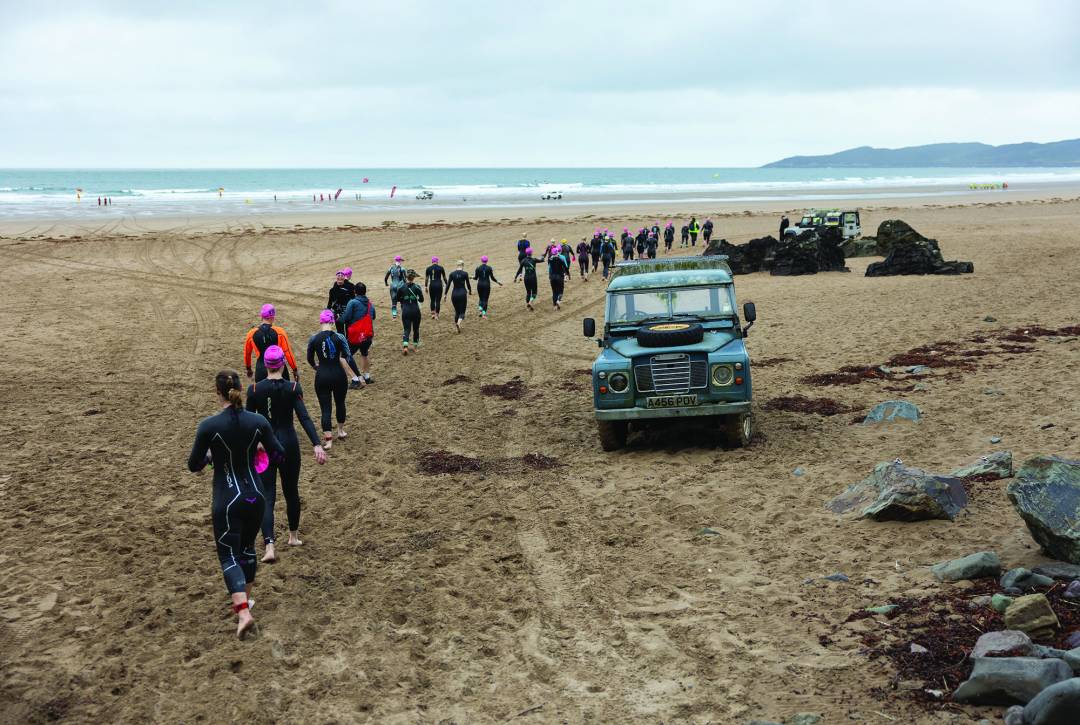
“Reckon we’re actually going out in that?” The pre-race chat in the car park above Putsborough beach in North Devon has almost exclusively focussed on the behaviour of the Atlantic Ocean’s swell and surf. After weeks of tepid conditions, the sea is restless this weekend. It’s had enough of the heatwave and wants to blow away some cobwebs. Or at least some triathletes.
The murmur of pre-swim concern filters down into the Croyde Ocean Triathlon’s expo area – the lofty position over Putsborough beach and proximity to the South West Coast Path making it one of the most scenic transition areas in all of triathlon. Today that coastline is covered by a thick duvet of dark clouds and sporadic rainfall.
News filters through that the 1.5km swim is still going ahead, but with the 1,500m distance reduced by 300 metres. A gentle loosening of the nerves but no more – we swiftly become aware of what foaming menace awaits us on the long walk from transition to the race start.

The starting horn goes and my Olympic-distance field shuffles into the sea, cautious of the potholes beneath the water and the breakers above. Clean waves are few and far between – it’s choppy, agitated and more unpredictable than a Donald Trump trade tariff announcement.
It takes me seven minutes to make it to the first 200m buoy, and from there it’s a swim that’s parallel to the shoreline for a kilometre of being buffeted by swell.
I take an early morning glug of the Atlantic and it instantly makes me wretch. It triggers a 30-minute barf-o-rama that sees my breakfast of pancakes, a banana and an energy gel-chaser gifted to the ocean. Luckily, there’s no-one in my slipstream as I’ve long since been left behind by my Vet 40-49 wave.

I finally make it to the final buoy and turn inland, at last propelled in beneficial fashion by the swell. For once I swim close to the stated race distance, returning to dry-ish land after 1,325m of toil both dishevelled and disorientated. And exhilarated.
What other sport can offer this level of drama before much of the population have sunk their morning espressos? There’s no escaping the fast that I have, however, taken nearly 50-minutes to complete a 1.2km swim course.
Just six bikes remain out of the Olympic-distance field of 294 when I finally retrieve my Ribble after the 500m run back to transition.
Hill communication

The Croyde Ocean Triathlon has proven an instant hit since 2015 and, for me, stands as one of the UK’s essential triathlon experiences. Along with the Slateman, it’s a race I’ll happily do again and again due to its hugely welcoming atmosphere, slick yet personal organisation and jaw-troubling scenery.
The organisers’ efforts have been rewarded in 2025 with the Triathlon England ‘Large Race of the Year’ accolade for the South West.
Part of the race’s acclaim stems from the environmental measures the organisers have put in place, with Surfers Against Sewage crowning Croyde as the UK’s first ‘Plastic Free Event’ back in 2018.
The race is now under the new ownership of local environmental charity Earth Action North Devon, ensuring that 100% of profits from the Croyde Ocean Triathlon (and its sister Exmoor Open Water Swim event) now go to charity.
That Plastic Free North Devon link-up ensures there are no single use plastics on the course, with athletes drinking from reusable beakers at the aid stations and scooping loose Jelly Babies from big tubs.
And that ‘leave no trace’ ethos flows into the triathletes – I barely see an empty energy gel packet on the course. Which makes me feel even worse about what I did to the ocean on the swim….

This is my third time racing here but my first riding the race’s latest 38km bike course (with 668m of elevation gain), and, while it can’t compete with the scenic heights and drama of the swim and run, it’s more varied than what came before.
For the most part, the route is a quiet country-lane out-and-back ride on closed or low-traffic roads. Somehow, it exclusively feels like it’s uphill, beginning with a 5km climb from Putsborough village to Pickwell Down before another 5km slog from West Down takes us to a widescreen viewpoint down to Combe Martin at the halfway stage.
A spectacular winding descent takes us through the cliff-hugging village of Mortehoe into the surfing honeypot of Woolacombe. I have flashbacks to the many messy teenage camping trips and post-pub ventures to Marisco disco here in the nineties, only this time I’m doffing hydration tabs and not Hooch. The Sunday morning sickness remains, however.
I pick up a couple of places on the (you guessed it) 5km ascent out of Woolacombe, but I’m still stubbornly stuck near the rear of the field. Thankfully, that’s the bike climbing done at least and I can prepare to unleash my strongest discipline with the run.
I breeze through T2 in 2:41mins and prepare to turn on the style… but nothing happens. I’m out of gas having expended my fuel in the sea and failed to top-up my supplies on the bike. And standing before me is arguably short-course triathlon’s toughest run course.
Years and mileage

Edging the swim leg, the multi-terrain 12km run (with an elevation of 335m) is the Croyde Ocean Tri’s real showstopper. It commences with a welcome kilometre descent into Croyde village, where I shun the bakery to begin a lengthy, steady ascent to Saunton Down that reduces me to walking speed.
My stride length is 25cm less than usual as I labour up a tree-lined pathway, the canopy shielding me from the sun’s belated attempt to shine.
After the 3km mark, a steward at a gate signifies the race’s highpoint, namely the gob-smacking view over the vast shoreline of Saunton Sands and the Taw Estuary. I could spend all day here, but the chap in 285th place is creeping up behind me.
A long staircase descent takes us back to the glorious South West Coast Path, the 630-mile National Trail that’s now intrinsically tied with Raynor Winn’s The Salt Path book (The Observer’s expose of which made for gripping if unusual race-morning reading).
Also now infamous is the Grand Designs Lighthouse that dominates the coastline between Saunton and Croyde, a hubristic tale that’s become arguably the long-running series’ most famous episode.

The South West Coast Path takes racers to the wide sands of Croyde Bay, a further devious measure that saps my leg strength further. It’s great fun attempting to plot the most compliant route through the sands and small sea pools, though, and we receive some hearty cheers from the surfers and holidaymakers on a beach I have more happy memories on than any other.
The devious course continues after the final aid station on the northern fringes of Croyde, where the unique ecology and jagged shoreline dates back some 370-million years to the Late Devonian Period.
We’re forced to head skyward again on rocky trails and I return to shuffle mode. My inner-race chatter amplifies; encouragement mixed with admonishment at my faltering fitness.
Herring gulls hover as the route reaches the Baggy Point headland, where distant views of Lundy Island’s granite outcrop stand before us (well worth a boat trip if you’re racing next year).
The finish line is also now in sight, albeit from a distance with a lumpy 2km coastline trail run to come. I increase my pace (all things are relative) in a bid to move up the placings, crossing the line in 4:21:09, some 270th out of 294 Olympic-distance finishers.
And 35-minutes slower than when I last raced here in 2021, despite racing that on a rented mountain bike because I couldn’t get my road bike on the mainline train in Bristol.
Both the years and the mileage have caught up with me somewhat since then, and I know I can’t get away with racing toughies like the Croyde Ocean Triathlon without course-specific training again.
The mid-race enjoyment and finish-line satisfaction remains, however, especially when it’s followed by a post-race pasty and can of pop on the South West Coast Path. And a handful of Rennies, of course….
Matt’s Croyde Ocean Triathlon essentials

Where to eat, sleep and have fun in North Devon:
Where to sleep
Croyde is full of decent campsites (which fill up quickly on summer weekends). The low-key Ocean Pitch and Freshwell are the most scenic; Ruda is vast and has plenty of facilities.
Food and drink
On Croyde’s main street, The Thatch and Billy Budds are the village’s two long-standing pubs with plenty of outdoor space, while the Croyde Village Shop has fresh bread and barbecue supplies, and The Hub does delicious pasties.
What to do
Away from the triathlon, if you’re in North Devon for the weekend then North Devon Coasteering put on great sessions in the cliffs, pools and caves of Croyde’s rugged coastline, while there are multiple surf schools on both Croyde and Saunton’s beaches.
The 2026 event
Next year’s Croyde Ocean Triathlon takes place on 12 July 2026, with both sprint and Olympic-distance-ish events on offer.


 Matt Baird
Editor of Cycling Plus magazine
Matt Baird
Editor of Cycling Plus magazine