Kat Matthews: ‘Sub-8 is possible this year’
As the British long-distance star builds towards a defining season, she tells 220 why discipline, curiosity and a willingness to edge closer to the limit may unlock the performance she – and the world of triathlon – has been waiting for.

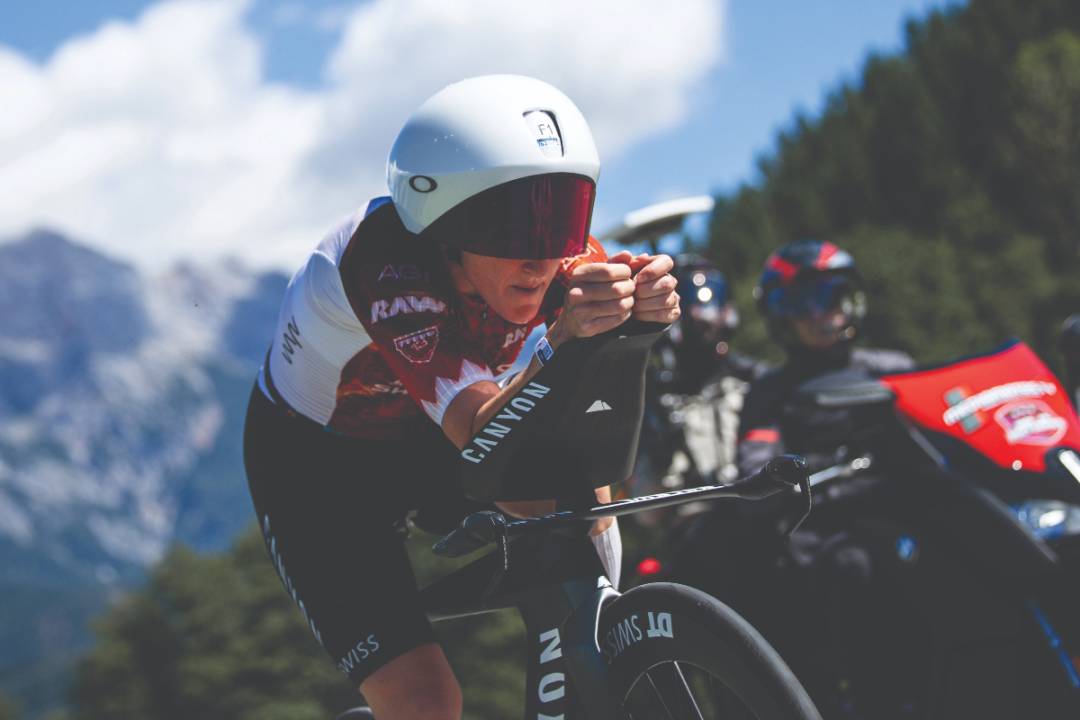
At first glance, it would be easy to assume that everything comes naturally to Kat Matthews. Watch the British triathlete glide through an Ironman marathon or dismantle a field on the bike and the effort can appear almost casual. Needless to say, it isn’t.
“I think that’s something people often misunderstand,” she says. “When you say I made it [Ironman New Zealand, which she won in March] look easy, it still hurts. It’s still really hard.” Matthews’ understated toughness – equal parts composure and quiet resilience – has become one of the defining characteristics of her racing style.
Since taking part in her first full Ironman as a pro at the end of 2019, the former British Army physiotherapist has risen rapidly to become one of the most formidable athletes in the sport. She has stood on the podium at the Ironman World Championship three times and produced the fastest women’s marathon split on the sport’s biggest stage.
Yet in Matthews’ mind, the story of her career so far is less about results and more about potential.
“What motivates me is basically a personal case study,” she says with a smile. “How good can I get?” That question is driving a 2026 season that could redefine both her career and the limits of women’s Ironman racing.
An honest start

Matthews’ year began on the rugged roads of Taupō, New Zealand at the start of March, on a course renowned in triathlon circles for its honesty – aka, a toughie.
“I think it gets that reputation because the climate can be inconsistent and the road surface is rough,” says Kat, who we catch up with before Ironman 70.3 Geelong, which she also won.
“But honestly, compared to America’s [roads] it’s not that bad. I think my natural British… I don’t know the right word. Maybe gritty? That kind of racing just feels normal to me.”
The defining moment came around 40km into the bike. Matthews had begun the race expecting to chase. Her husband and coach Mark predicted she would exit the water roughly 90 seconds down. Matthews, more pessimistic, estimated closer to five minutes.
The reality landed somewhere in between – “I think it was about two and a half or three minutes,” she says. “So I was already in a decent position.” Mark’s race plan was simple: ride a controlled but relentless effort until she reached the front. Matthews wasn’t entirely convinced.
“My instinct was that it might take most of the bike to get there. But when I caught the front at around 40k I realised I hadn’t actually put in that much effort,” she recalls. “And that was the moment where I thought: ‘okay, if I can catch them this easily, the rest of the bike will be fine’.”
From there the race unfolded smoothly. Matthews settled into rhythm, conserving energy for the run and reinforcing a quiet confidence about her form. The takeaway from the race? “My fitness is adequate,” said with characteristic understatement.
Reset and rebuild

That subtle confidence stems from a winter that focused on something less glamorous than watts or pace: durability. Matthews’ previous season had ended with a small but persistent problem – a calf injury flared after Kona and then again during the 70.3 World Champs in Marbella, where Matthews was forced to DNF.
“It meant the off-season focus was basically getting healthy enough to run properly,” she explains. The solution included strength work, new footwear choices [see box] and a recalibration of training load. Matthews and Mark decided to dial back the overall volume that had dominated the previous year.
“Maybe I overdid it a bit last year,” she admits. “This winter was about reining that back in and focusing on really good quality, consistent bike and run training.” But before the rebuild began, there was time for something far removed from professional sport. Two weeks completely off. A trip to Paris with friends. A spa day with family. And, by Matthews’ own admission, a fair amount of drinking.
“I said ‘afternoon drinking’ earlier,” she laughs. “But all-day drinking is probably more accurate.” Just as importantly, she disconnects from the metrics that dominate elite sport. “I take off all the performance tracking. If I get sick, I get sick. It’s just normal life.” For an athlete whose daily routine revolves around discipline and data, the reset is essential.
The Sub-8 obsession

For someone who insists she isn’t driven by records, Matthews has developed an unusually strong attachment to one – breaking the hallowed eight hours for a long-distance tri: “I have a bit of an unhealthy obsession with it,” she admits. [Kat took part in the Sub8 Project in 2022, clocking a 7:31:54 as part of a controlled, single-race format alongside a team of pacers.]
Several of the world’s best athletes – Matthews among them, with an 8:05:13 at Hamburg last year – have clocked tantalisingly close finishing times over the last few years, which has led many media outlets, this one included, to declare 2026 the ‘Sub-8hr Year’. For Matthews, the idea carries symbolic weight. “It just feels like this big barrier in women’s sport,” she says. “I don’t know why it stuck with me, but it did. With the right day and the right conditions, even with last year’s fitness, I think it’s possible.”
Kat Matthews’ race-day weapon
The British star relies on cutting-edge footwear from ON to deliver race-winning speed, but for Kat the biggest gains happen long before race day. For racing, Matthews currently opts for the Cloudboom Strike LightSpray, ON’s lightweight, laceless super running shoe. She’s experimented with the standard laced version too, but prefers the laceless for one simple reason – “They just give me a little more confidence”.
The shoe’s upper and aggressive rocker geometry create what Matthews describes as extra “pop” in her stride, crucial for maximising power transfer throughout the marathon.
But she believes the biggest advantage isn’t the race-day shoe itself. Instead, it’s the ecosystem of training footwear that supports the work behind the scenes.
“The psychology of knowing you’ve got the best shoe helps,” she says. “But more important is being able to train consistently in their training shoes. That’s where the real performance gains happen.”
This year, she expects more opportunities. Challenge Roth – widely regarded as the fastest long-distance course in the world – looms large on the calendar (5 July, to be exact). The current fastest women’s time sits at 8:02:38, set in Roth by Germany’s Anne Haug in 2024. But Matthews suspects the breakthrough might come earlier.
“It could happen before Roth,” she says. “Maybe in Texas or even Hamburg. I definitely don’t think I’m the only athlete who could do it, though. There are a few women who are close.”
Another German powerhouse, Laura Philipp, currently holds the official Ironman women’s record with an 8:03:13, which she set at Hamburg last year ahead of Matthews. For Matthews, though, the clock itself isn’t the real prize. “It’s not about the number,” she insists. “It’s about seeing how fast I can go.”
Finding the limit
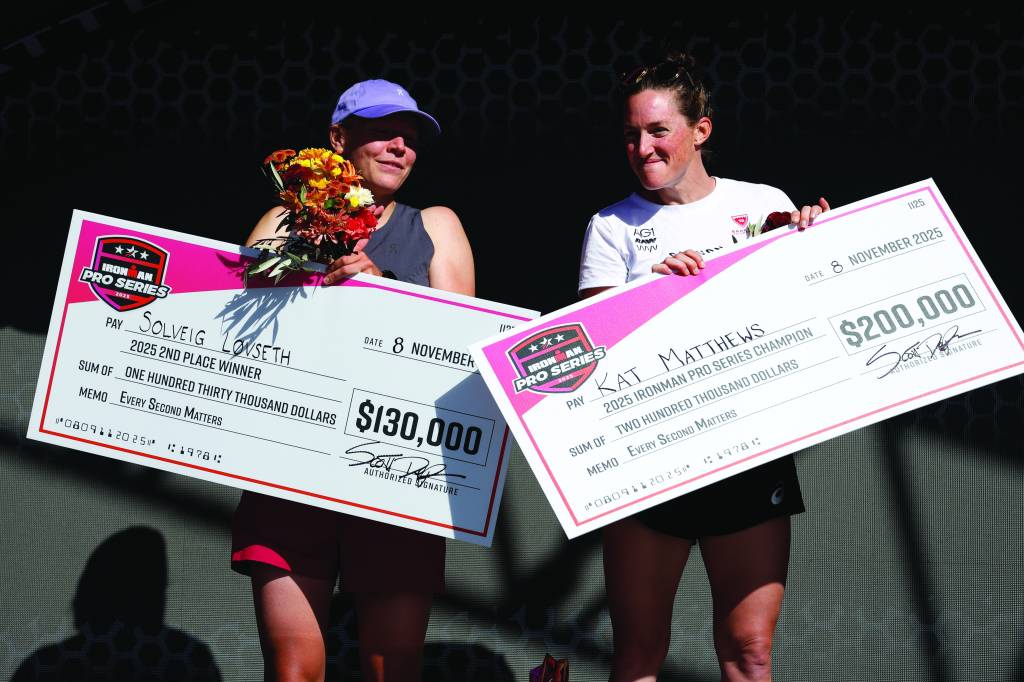
The sub-eight possibility is only one piece of an ambitious race schedule. While not packed with races – four full Ironmans and two 70.3 races, including both world champs – Kat’s 2026 calendar is designed to keep her firmly in the hunt for what could be her third Ironman Pro Series title on the trot, while building toward two of the sport’s biggest titles. New Zealand kicked things off. Next was 70.3 Geelong – which she won – then Ironman Texas, which she withdrew from after puncturing on the bike, before the European summer and the pilgrimage to Roth.
“I’ve never actually raced there [in Roth],” she says. “But everyone who has just goes on about how incredible it is. It feels like a race where the community really matters. You’ve got the professionals and the age-groupers all part of the same event. It’s not just about elite sport, it’s about the whole experience.”
After Roth, attention will shift to the world championship double-header: the Ironman 70.3 Worlds on 12 September and, most importantly, Kona, on 10 October. The Hawaiian race remains the defining target of her career. And if there’s one simple metric by which she’ll judge her season, it’s brutally clear – “I need to win Kona”.
Matthews has finished second at the Ironman World Championship three times, in three different locations – St George, Utah in 2022, Nice in 2024 and Kona in 2025. Last year’s performance included a record-breaking marathon split of 2:47:23, with a remarkable 6:22/mile pace, yet Matthews still believes she raced conservatively.
“My bike was actually quite a lot slower than what I know I can do,” she admits. “And the run was very controlled. I should have been more brave.”
That willingness to take greater risks is something she’s actively trying to develop. Matthews’ natural instinct, she admits, is caution.
“I think maybe why I’m able to perform so consistently is that I’m not as brave as I want to be,” she admits. “I don’t take massive risks. I want to get better at pushing myself to then maybe make mistakes.”
Discovering that sweet spot – and embracing it without tipping into DNF territory – may ultimately decide whether she converts those silver medals into gold. But Matthews still wrestles with this deeper question about elite sport: how close is she willing to go to find her performance limit?
Kat’s career highlights to date
Kat may care little for results, but hers are too impressive not to share…
2 x Ironman Pro Series Champion (2025, 2024)
3 x Ironman World Champs runner-up (2022, 2024, 2025)
2 x Ironman 70.3 World Champs runner-up (2023, 2024)
1st, Sub8 Project, 2022 (7:31:54)
7 x Ironman wins
7 x Ironman 70.3 wins
Before becoming a professional triathlete, Matthews worked as a physiotherapist, a background that shapes how she thinks about training stress and long-term health. Sport should be healthy, but professional sport often operates in a more complicated space.
“What is the edge? I think this is the question that challenges me the most actually in sport. I think I’m getting closer to knowing where this edge is, but I’m still too cautious. There are athletes around me winning world titles who seem to go over the edge every year, whereas I’m probably consistently under it. It’s a great question. I haven’t got a good answer. Ask me in 12 months’ time.”
Mind games
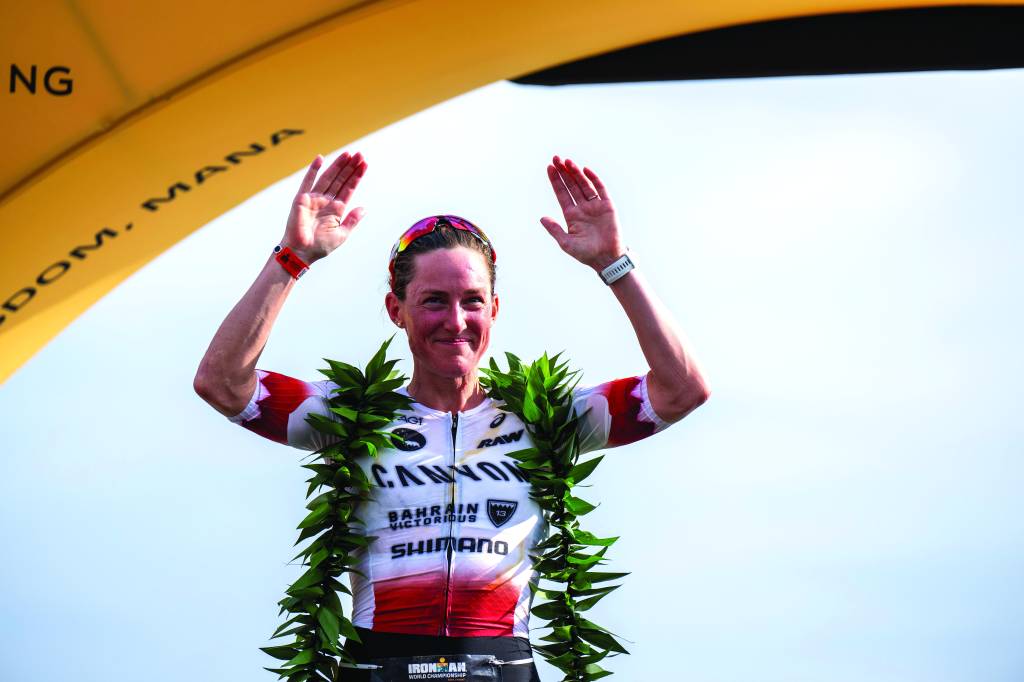
Long-distance racing is often described as a supreme test of patience, but Matthews sees it differently.
“For me it’s more about discipline, which comes naturally to me because it was just part of my childhood” she says. “I come from a military family, where there was always a self-discipline ethos. If you wanted to play, say, a hockey match or a basketball match at the weekend, you needed to do the training.”
That philosophy carried seamlessly into elite sport. Matthews’ training environment – now built around her partnership with husband Mark – is structured but largely self-directed. And the results speak for themselves. Few athletes in the sport race with her level of consistency. But self- discipline has another benefit in Ironman racing: emotional control. Over eight hours, frustration can be as damaging as fatigue. So Matthews sets small mental targets within each race: staying positive during monotonous sections of the bike, refusing to panic in the swim, pacing the run so that the second half is as strong as the first.
“It’s about setting small outcome goals throughout, but also small subjective goals in terms of mindset that you can decide if you succeed or not,” she explains. “I think I now have an attitude, based off previous race results, that I should be competing for the win, not just participating in the race. But that attitude is challenging sometimes, it puts a lot of pressure on the idea of winning being the only sort of outcome rather than giving it your best shot.”
The ongoing experiment
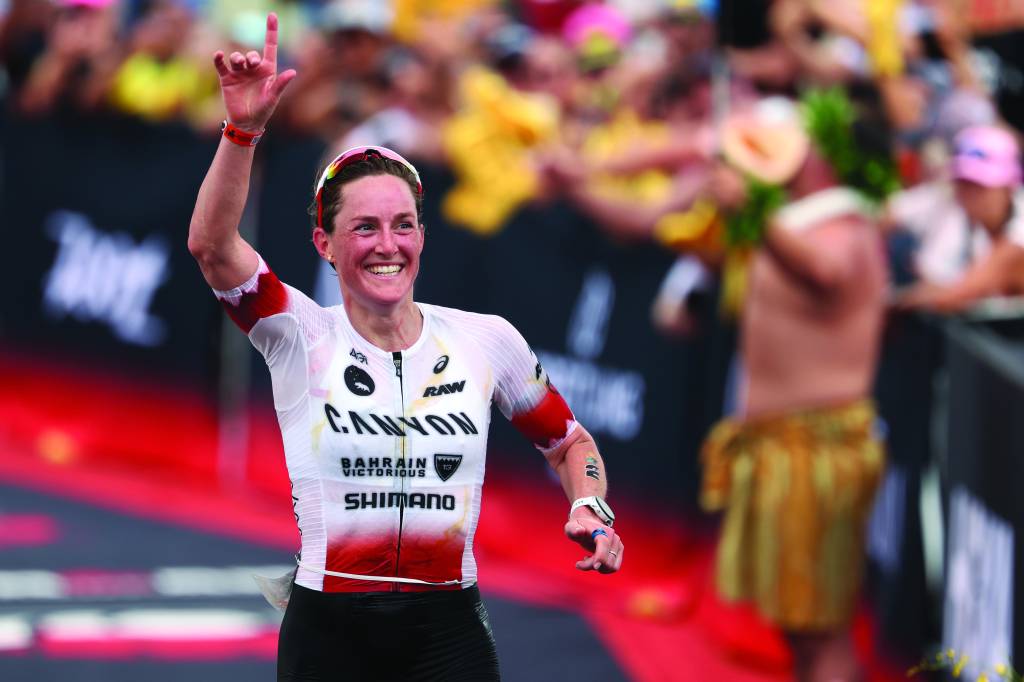
Despite the relentless focus on performance, Matthews insists that triathlon is only one part of a bigger story. If her career ended tomorrow, she says the thing she would be most proud of wouldn’t be podium finishes or records; it would be the life she and Mark have built together.
After recovering from the traumatic road accident that nearly ended her career in 2022, the couple rebuilt their world around professional sport.
“That whole return to racing and the lifestyle we’ve created, that’s what I’d be most proud of,” she says.
It’s a reminder that behind the relentless pursuit of marginal gains sits a more human motivation. Matthews doesn’t measure success purely in numbers. When she eventually steps away from racing, she hopes her peers will remember something simpler.
“That I was fair,” she says. “And that I was a good competitor to race against.”
For now, though, the experiment continues. Somewhere along the way there may be a world title, perhaps even the first sub-eight women’s finishing time. But whatever happens, Matthews knows the process won’t end there. Because the question still hasn’t been answered. How good can she get?


 Liz Barrett
Freelance sports journalist, copywriter and editor
Liz Barrett
Freelance sports journalist, copywriter and editor