Giro Aerohead Mips 2 vs Lazer Victor KinetiCore: which supersized aero helmet should you buy?
Will a massive time-trial helmet supercharge your triathlon bike leg? We test two enormous TT lids to find out

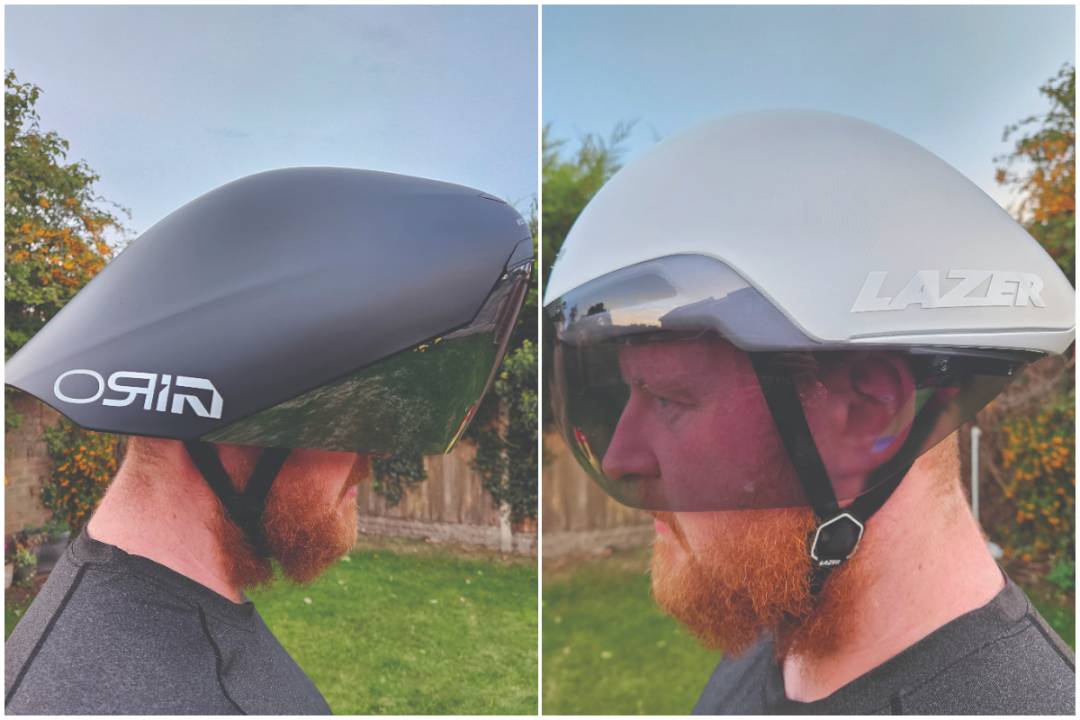
Aero helmets aren’t as popular in elite and age-group triathlon as they used to be, but could the promised watt-savings of the Giro Aerohead Mips 2 and the Lazer Victor KinetiCore change that?
All being equal, both these should be even more aerodynamically efficient than the best aero road helmets.
But is their extra weight and reduced ventilation and visibility worth it? 220 Triathlon Jack Sexty reviewed them in real-world conditions to decide.
Design and features

Here we have two aero helmets, also known as time-trial / triathlon helmets.
Unlike road bike helmets, they forgo vents in favour of a more streamlined smooth front (often covered by a visor) and exterior which sweeps back into a tail.
The idea is to flush oncoming air past your shoulders and back as quickly as possible to reduce drag. You can read more about the differences between road, aero road and TT helmets in our explainer.

Since launching last year, the internet has collectively gasped every time the outrageous-looking Giro Aerohead Mips 2 has been seen dwarfing the heads of Visma–Lease a Bike riders.
Harboured in a huge protective case, the Aerohead 2 comes with two magnetic visors: one for bright sun, and one for lower light conditions.
The helmet itself has a curious protruding front section and flatter back, all in the name of aero gains, and all meticulously optimised with wind tunnel and CFD modelling.
Meanwhile Lazer’s Victor KinetiCore helmet is aimed squarely at the triathlon market, as it has a shorter tail than the brand’s Volante KinetiCore model to stay aerodynamic when there’s additional head movement.
The Victor comes with one smoke lens visor, suitable for almost all light conditions.
Giro Aerohead Mips 2 vs Lazer Victor KinetiCore specs

Weight weenies, look away now.
The Lazer Victor KinetiCore weighs a chunky 15oz / 424g, but this is on par for TT helmets.
The Giro Aerohead Mips 2 clonks the scales down to 20.1oz / 570g. That’s about two aero road helmets’ worth of mass.
To protect your head from rotational impacts, a key cause of concussion, the Giro incorporates Mips (multi-directional impact protection system) while Lazer uses its proprietary KinetiCore tech.
Although neither have undergone Virginia Tech’s independent helmet safety testing thus far, both brands make some of the highest rated helmets that have.
Helmets with Mips don’t necessarily score better than those with KinetiCore or vice versa. Therefore, both should have very good safety credentials.
Each helmet accepts a visor. Giro supplies the Aerohead Mips 2 with two compared to the Lazer’s one.
| Giro Aerohead Mips 2 | Lazer Victor KinetiCore | |
| Price | $599.95 / £499.99 | $369.99 / £269.99 |
| Weight | 20.1oz / 570g | 15oz / 424g |
| Sizing | S, M, L | S, M |
| Features | Two visors, adjustment dial, anti-pong padding | Rear adjustment dial, tinted visor |
| Safety tech | Mips | KinetiCore |
Performance and fit
Not having tested these helmets in a wind tunnel, I can’t decisively comment on their aerodynamic performance.
What’s more, Giro says the Aerohead Mips 2 was optimised for Visma-Lease a bike’s Jonas Vingegaard, so it probably won’t be as fast for everyone. Indeed, the two-time Tour de France winner’s team mates don’t always wear it in time-trials.
Both its and the Lazer’s smooth outer, visor and tail are indicative of speed though. That’s if you can hold your head in the position the designers intend you to.
In this respect, I found the Victor Kineticore more effective.
As triathletes, particularly over longer distances, we need to move our heads far more than time triallists – which means the shorter tail on the Victor makes sense for the majority, rather than serving a very small cohort of elites who can sustain a perfectly straight head and neck position for hours on end.
Furthermore, I found the padding inside very comfortable. I didn’t encounter any problems with overheating or feeling claustrophobic (both things I’ve experienced with other TT helmets) after a couple of hours in the saddle.
The inside of the Giro Aerohead Mips 2 is comfortable too. However, its sheer bulk caused problems on the open road.
Soon after setting off, any sense of familiarity soon waned.
My size medium weighed 20.1oz / 570g, with a lot of that weight top loaded towards the front – I started to notice it after just 12mi / 20km.
Practically, I think it’d be difficult to use the Aerohead 2 in anything other than closed road races, because turning my head to check the coast was clear at junctions hurt my neck.
There’s not much ventilation with the visor on, but things feel somewhat breezier without it as there’s so much room inside the shell.
Price and value

We’re talking big money for both helmets.
So if you’re asking yourself, do I need an aero helmet for triathlon, the answer is arguably to pay for a wind-tunnel session.
First, this will objectively determine whether this is case. Second, the aerodynamicist will find out which specific model works best for you (the efficacy of aero helmets varies hugely person to person).
In terms of real-world performance, the Lazer Victor KinetiCore presents better value, costing nearly half as much.
Verdict: Giro Aerohead Mips 2 vs Lazer Victor KinetiCore

If you’re willing to spend whatever it takes to achieve the best time trial or short-course triathlon result you’re capable of, the Aerohead Mips 2 is very worthy of your consideration.
We certainly recommend verifying its suitability for your aero position in a wind tunnel prior to purchase considering its vast cost.
Unless you have the inclination and budget for this, it’s difficult to recommend where there are numerous more suitable, and considerably less expensive alternatives.
On the other hand, the stubbier build of the Victor is more reminiscent of an aero road helmet, which may mean its performance in wind tunnels might not quite stack up against the Aerohead 2 or POC’s Tempor.
But in the real world, I think Lazer’s design is likely to be more aero for more of your race, particularly in long-course tri.
That makes the Lazer a Victor by name and in this head to head.
In my review, I called it an “impressive all-rounder that is suitable for all draft-illegal tri” and scored it 85% and 4.5/5.
How we tested
Experienced bike kit tester Jack Sexty reviewed these aero helmets by riding them multiple times on his road bike.
He judged them on potential aerodynamics, weight, comfort, fit, ventilation and value for money.
For more details, see how we rate and test products.


 Jack Sexty
Editor at road.cc
Jack Sexty
Editor at road.cc