Should we split age-group triathlon into fun and fast categories?
Breaking down barriers to make triathlon more inclusive is welcomed, but isn’t always a natural bedfellow for competition. Splitting the two may offer the solution, argues Tim Heming.

A pre-race email for the London T100 race got me thinking: is it time to mark a clear difference between people signing up for an enjoyable challenge and competitive amateur triathletes?
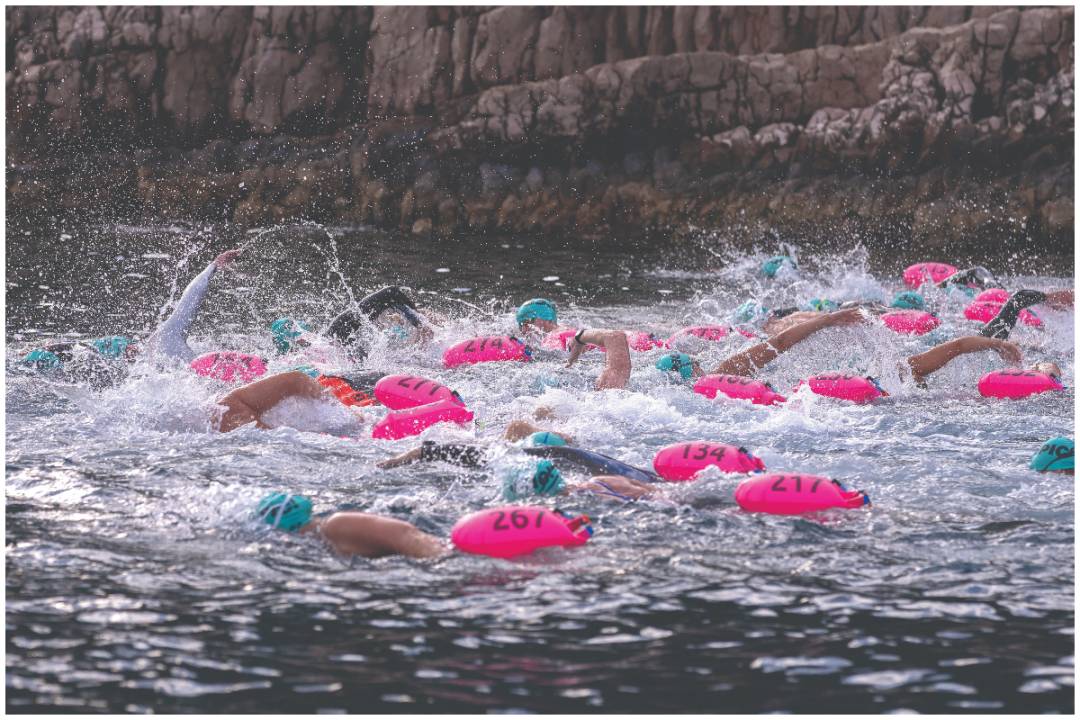
The trigger was T100’s note that should the temperature exceed 24.9 degrees Celsius (scarcely fathomable that we should even be contemplating this – welcome to 2025!), then wetsuits would be replaced with tow floats for the swim.
Taking a tow?

Tow floats are small inflatables tethered to the swimmer’s waist by a short cord.
London is one of the biggest first-timer triathlons in the world, and mitigating the risk of putting thousands of novices in the Thames without the security of buoyant neoprene makes sense from a health and safety perspective – but not from a competitive one.
While the sport might pride itself on fair play, it’s naïve to believe nefarious tactics aren’t deployed in the swim, where it’s hard to spot.
Now there’s a tow float cord to grab – as well as a leg, or pair of goggles.
Even if unintentional, drafting on a triathlete’s hip to save energy could result in a tangle.
Safety vs competition
It’s analogous to the rolling swim start, where athletes are set off at short intervals rather than en masse.
It’s been an excellent safety innovation in the discipline that holds the greatest risk and is favourably received by nervous participants.
But it also takes away from the spectacle and adrenalin rush of the mass or wave start that many competitive triathletes enjoy.
And while it might seem a moot point to many, at the opposing end of the race it renders the worth of the sprint finish against someone in your category largely null and void – because you will have started seconds or minutes apart.
Technology for fairer racing

On the bike, we’re seeing range-finder drafting technology through RaceRanger impress in terms of fairer races in the pro ranks.
And there have been plenty of calls for where it’s needed perhaps even more – in the competitive age-group field.
Yet it would also be an expensive and logistical overkill to introduce it to back-of-the-pack athletes who are purely there for a fun day out.
RaceRanger CEO James Elvery’s solution is a two-tiered system where a competitive age-group wave will have the fully functioning system with sensor units on the front and back of the bikes.
The ‘completers’ just have a rear unit to flag when they are being drafted, rather than offending.
Elvery suggests the competitive athletes should pay slightly more for entry and are the only ones eligible for Ironman world championship qualification.
Sign up for a good time or a quick time

My initial response was that it’s overcomplicating an already detailed sport (i.e. how many sticky race numbers are now provided for various kit and equipment?), but I’m warming to his proposition.
It offers choice on sign-up, and while I’ll maintain triathlon is an individual sport, if someone is facing a 9hr-plus bike leg and just wants to get round, where’s the harm in them achieving it in the company of others who are closer than 12m?
It might make for a more enjoyable experience that keeps them in the sport longer.
RaceRanger’s other selling point for wider integration is that it doubles as an athlete tracker.
If a bike is stopped for too long on the course, or goes completely off-route, it can signal an alert – another tick in the safety box.
The upshot is that a clearer demarcation between performance and fun can help bring more people in to race how they’d like to.
A more relaxed vibe (and rules) can work for entrants who just want to embrace the challenge, but mass starts, non-wetsuit swims, and anti- drafting technology also make for fairer, more dynamic competition for those who want it.


 Tim Heming
Freelance triathlon journalist
Tim Heming
Freelance triathlon journalist