Ironman’s new draft zone brings uncertainty
It won’t be top of every age-group triathlete’s agenda,but steps to reduce the advantage of slipstreaming on the bike lean into the true spirit of non-draft racing.

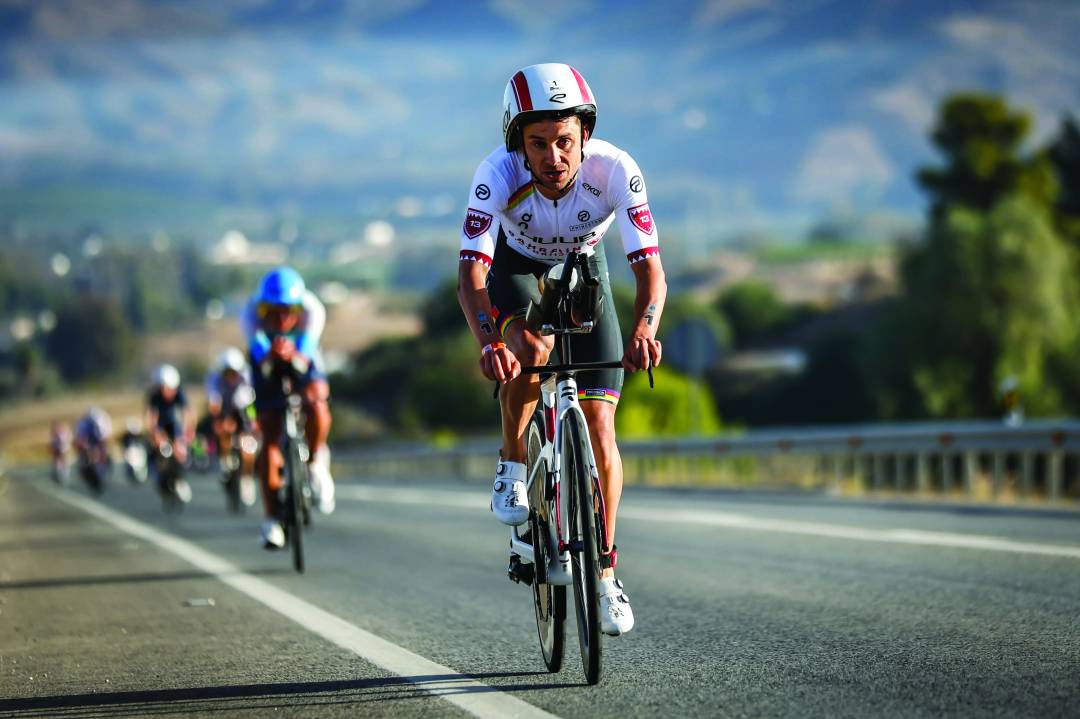
If you’re new to triathlon, you could be forgiven for being a bit nonplussed on hearing that the draft zone in professional Ironman events is being extended by 8m.
There’s always been advocacy for fairer racing, and extending the distance that one rider can legally track another and take advantage of their slipstream has long been a core argument. But if your focus is mainly on completing, the watt expenditure of a pro is unlikely to be a top concern.
Don’t dismiss it completely though. There are several areas of intrigue. Firstly, when we tune in to the World Championship in Hawaii in October – already hotly anticipated as the first time the men and women will race together on the Big Island for four years – there will be an extra level of uncertainty.
Ironman has completed tests in Arizona and we’ve seen a 20m draft zone in operation before, most prominently in T100 racing, but never with such deeply competitive fields over the full distance on a course that is devoid of steep climbs to fragment the field.
There has been some modelling to indicate how much slower the 180km bike split might become for triathletes who typically benefit from longer speed lines – often more prevalent in the men’s racing – but until it plays out, we won’t truly know how it changes the race dynamic.
The obvious assumption is that the bike leg becomes even more important and so athletes renew their efforts to push higher power for longer, with equipment and riding positions that minimise drag. It might give fresh hope for a strong swim-rider, who is buoyed by knowing they can’t be pack hunted on the Queen K as we’ve seen in previous years.
The flipside is that the best athletes will just adjust to cope. For example, we’ve seen USA’s Taylor Knibb ride away from world championship-strength fields over both 12m (Ironman 70.3) and 20m (T100) racing. We’ve already seen GB’s Lucy Charles-Barclay win the biggest races as a solo time-trial from the cannon.
And it would be a punchy call to suggest the Norwegian trio of Kristian Blummenfelt, Gustav Iden and Casper Stornes, have been reliant on an inadequate draft distance for their success to date. We just don’t know, and that’s always a plus in sport.
On the downside, the draft zone extension will also be relevant to the faster age-group men (still operating at 12m) whose race has more impetus to be entangled with the women’s pro field if poorly handled by organisers. There have been fewer criticisms of Ironman’s scheduling in recent years as they’ve focused on a clean field of play for women professionals with more staggered start times. Ironman hasn’t yet said how they’ll tackle this situation but the overlap may still be too minimal to matter.
Any age-groupers waiting for the 20m zone to extend to amateur racing shouldn’t hold their breath. Ironman’s official reason is that the speeds don’t justify it, however, it’s more to do with course density and not having to restrict entry numbers. As a corporate business, it’s not an unexpected stance to take, and perhaps there are ways it can be introduced into the amateur ranks in future.
There will be challenges. Potentially a bigger issue is the assistance given by the motorcade at the front who bring the broadcast pictures. In that scenario, the 20m rule could exacerbate that advantage, with the net result of making the race more unfair – the very thing it seeks to avoid.
But let’s give the change a chance. It shows that Ironman has listened and acted on feedback and it’s a lean into the purity of non-drafting racing. While I appreciate we’re not all pros and 12m or 20m is not top of the agenda when the distance itself is daunting, a bit of intrigue and something to aspire to is always welcome.
It won’t be top of every age-group triathlete’s agenda, but steps to reduce the advantage of slipstreaming on the bike lean into the true spirit of non-draft racing.


 Tim Heming
Freelance triathlon journalist
Tim Heming
Freelance triathlon journalist