All-American Morgan Pearson on Olympic lessons, loss, and his late start to tri
US college track star Morgan Pearson has been unleashing his devastating run speed on the WTCS since 2018, and now it’s T100’s turn. Let’s meet the two-time Olympic medallist…

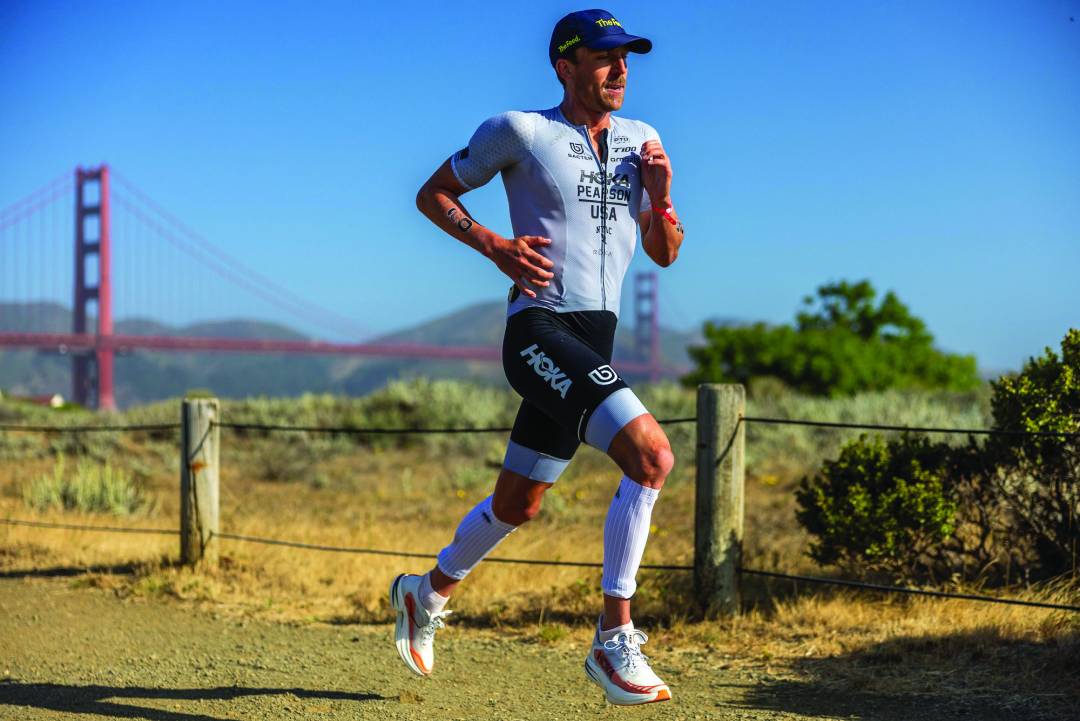
The day Morgan Pearson decided to try his hand at triathlon must have been a celebratory one for the US Olympic selectors. A seven-time All-American in track and cross-country at the University of Colorado, in 2017 he won his age-group at USA Triathlon’s national championships before turning pro the following season.
Despite starting at the comparatively ‘old’ age of 24, Pearson has since proved a solid and safe pair of legs, particularly in the mixed relay format where he’s helped steer the US squad to two consecutive Olympic silver medals in Tokyo and Paris.
The Boulder-based pro has yet to shine as bright on the individual Olympic stage, but the 2028 LA Games are firmly in his crosshairs. For 2025, though, he’s several races in to an ambitious race schedule that’s covering both the WTCS and, in his season debut, the T100.
And it’s after his first 100k race in San Francisco when we catch up with him to talk triathlon bike skills, what went wrong in Paris and his love for Lionel Sanders…
220: Eighth in your first T100, how was the experience?

Morgan Pearson: It was amazing. I haven’t done a tonne of high-level races in the U.S so having my friends and family there was great. I think the biggest takeaway, though, is improving my bike. I’d love to improve my bike power and fitness but the biggest gains will be made on how I ride the bike – so aerodynamics, keeping speed, how I use other cyclists in the race, etc.
The first bike lap, I really shot myself in the foot. My visor was completely fogged so I couldn’t see anything! I was trying my best to not get a draft penalty (only my second non-drafting race and the first one with Race Ranger). I went from leading the race to 14th place in the first five minutes. Most of that had to do with me riding tentatively.
I do think I can clean up my first bike lap a lot, though, and hopefully set myself up for a better ride in general. A few gear changes might help, along with a second race using Race Ranger. I’m also hoping the swim plays a bigger part in the race. I’ve actually felt really solid in the pool – by far the best I’ve felt since breaking my wrist [the result of a bike crash in training in the spring]. Having the field a bit more spread out could potentially help me.
I believe I’m at 60% fitness right now, so if I can stay healthy and consistent I’ll get stronger and more competitive in my later races. [Two weeks after San Fran, Morgan would finish seventh at his second T100, in Vancouver, and clock the fastest swim and run splits.]
220: How much of a setback was missing the opening T100 in Singapore in terms of chasing the T100 title?

MP: Missing Singapore probably wouldn’t have affected my overall T100 score too much. I took a break in February so I likely wouldn’t have done super well there. That being said, getting that race experience would have been huge and might have helped me in San Fran.
Breaking my wrist, however, was super hard on me. Physically I struggled, I was out of the pool for basically two months (unless you count swimming with a cast on!). I also kept getting sick. I wasn’t sleeping well, but I was still biking and running a lot while my body was trying to heal a broken bone. It was just hard physically and mentally, and I wasn’t fun to be around!
I’m really excited for the rest of the season, though. I know I have a lot of room for growth and I’m excited to progress and hopefully compete at the front more.
220: And having raced Yokohama WTCS, which you won last year, what are your thoughts on where everyone’s at for the 2025 season?

MP: I wasn’t in a good place and wasn’t really in the race [Pearson placed 25th], so it’s hard to really say. Matt Hauser and Vasco [Vilaça] seem to be the best right now. Matt’s swim and run combined is really impressive and he’s a smart racer.
220: You won your one and only to date 70.3 in December [at Indian Wells], how was that experience over the middle distance?
MP: It was a lot of fun, and I didn’t put any pressure on myself. I had a busy few weeks leading into the race, balancing some travel, moving and holidays. And I only had the TT bike for maybe four weeks or so, so I trained the best I could given the circumstances. But after Paris I didn’t want to put too much pressure on myself, so to come away with the win was super fun!
Morgan Pearson’s career highlights

While he’s yet to show true consistency, Morgan’s results still show world-beating class – not to mention those two Olympic medals…
- 8th, San Francisco T100, 2024
- 1st, Ironman 70.3 Indian Wells, 2024
- 2 x Olympic Games triathlon relay silver medallist (Tokyo, Paris)
- 1st, WTCS Yokohama, 2024
220: You’ve got a packed schedule this year – WTCS, T100 and run races. How do you make sure you get enough recovery between all that?
MP: It’s about being smart in race selection more than anything. Travelling to San Francisco and doing a 100k distance is way easier than going to Abu Dhabi and doing a sprint (at least in my opinion). For example, I’m skipping Hamburg and London [WTCS and T100, respectively] to get in a nice training block.
I ran a half marathon in January and a few track races but probably won’t do many more run races this year.
220: Talk us through your training set-up.

MP: I’ve been training with [Boulder’s] Flatiron swimming club. They just moved to long course so I’m really excited about that. I’ll also go to [former pro and Olympian] Julie Diben’s masters swim 1-2 times a week.
I just started working with a bike coach, Daniel Holloway, after being a bit frustrated with how I was racing. My numbers were solid in training but I felt I lacked a lot of racecraft. This summer, we’re planning on doing some bike races together, too, where he coaches me mid-race. He won USA crit nationals a few times so he’s very good with that stuff.
And on the run, [2000 triathlon Olympian] Ryan Bolton does my overall training and running. Balancing it all has been a work in progress but we’re getting there.
220: What do you do in your down time?
MP: I have less down time than you’d think. I try to use Normatec [compression] boots and play a video game or read for an hour or so in the middle of the day. At night, I cook with my girlfriend and watch a TV show.
220: Like many elites, you regularly share your training on Instagram. Do you enjoy that side of the job?
MP: Yes, it’s cool to share my training. Hopefully some people enjoy seeing it. I don’t take myself too seriously but I do try to put myself out there. I just try to be consistent and genuine to myself. If I wanted to I could probably work the algorithm a bit more. I do post a lot but I don’t really put too much thought into it. I care about performance, and social media is part of the job.
220: Tell us about your Paris Olympics experience compared to Tokyo. Another amazing silver medal but a very different Games experience.

MP: The individual race will haunt me the rest of my life [Pearson placed 31st]. However, I really liked how we came together as a team and got the silver medal.
In Tokyo, I showed up completely exhausted. My older brother Andrew passed away in the March [from an undiagnosed heart ailment in his sleep] so just making the team was a monumental effort. I think if things had gone differently I could have been more competitive but I was dealing with a lot.
The relay was super special, though. I only started the sport in 2018 so to go from someone who didn’t know anything about triathlon in 2017 to an Olympic medalist in four years was pretty cool.
220: An American male has yet to win an individual Olympic tri medal. Why do you think that is?
MP: We didn’t prepare correctly last year. The swim was insane and despite asking for help with how to navigate a current multiple times, I didn’t get much help outside of ‘watch the women’s race’ or ‘get in good feet’. It was too little too late, and I should have been prepared for the currents.
I could have hired an expert or prepared in a more professional manner instead of hoping for the best and relying on my swim fitness. If we’d prepared for the unique conditions, I believe we would have had a good chance.
220: Compatriot Reese Vannerson’s been getting a lot of attention, how much are you keeping an eye on these youngsters coming through the ranks?
MP: I’m happy for him. When I started, triathlon USA men were garbage. Getting a top 15 in a WTCS was considered a big deal. We’re still a far cry from teams like France, but I’d say in general we’ve improved which is cool to see.
220: How much support do you get from USAT [the USA’s British Triathlon equivalent]?

MP: $20k living stipend, a camp budget that changes – but basically helps me pay for most triathlon expenses – health insurance, and travel and lodging per diem for WTCS races. Ryan, who works for USAT, is a huge support to me, both training and emotionally.
220: So, LA 2028, is that the ultimate short-course goal right now?
MP: Yes and no. I put so much on Paris, so right now I’m just trying to enjoy being able to do this.
220: If you could steal any triathlete’s skills, whose and what would they be and why?
MP: Lionel Sanders’ ability to push himself. Lionel is one of my biggest inspirations in the sport and in life. He never gives up and is the ultimate fighter.
220: What’s your ultimate goal in triathlon?
MP: Olympic gold.

A day in the life of Morgan Pearson
An average day for Morgan Pearson involves banter with the lads, compression boots and plenty of food…
7:30am: Wake up naturally. Coffee, write in training journal, no breakfast
8:30am: Leave for pool – get there early for activation and mobility
9am: 5km set in a 25m pool, with 3km main set
10:30am: Swim finishes, catch up with a few of the other training guys – banter!
11am: Get home, big breakfast
11:30–1pm: Shower, relax, Normatec boots, emails, get bike ready etc. more food
1–4pm: Bike ride with interval (hard ride)
4pm: Get home and run off the bike, 4–5 miles
4:45pm: Heavy snack/late lunch
5pm: Core/mobility work then sauna
7pm: Make dinner, eat, clean up
8:30–10pm: Watch a show or movie with my girlfriend
10pm: Sleep
For more catch-ups with the pros, check out our latest news and stories hot off the press.


 Liz Barrett
Freelance sports journalist, copywriter and editor
Liz Barrett
Freelance sports journalist, copywriter and editor