Oakley Aro7 helmet review: a good visor with disappointing speed and ventilation
The Oakley Aro7 boasts big claims and a hefty price, but does it live up to its billing? Let's find out...

220 Triathlon Verdict
Decent visor and an improvement on the previous model, but there’s tough competition in this genre. Score: 75%
Pros
- Visor performs well
- More versatile than before
Cons
- Poorly ventilated
- Buckle and strap are flawed
Jan Frodeno once wore a variation of the Oakley Aro7 helmet during his Ironman-conquering escapades, although he often opted for a custom tail extension over the stubby aero road helmet versions of the previous Aro7 and now 2024’s sequel.
Out of the box and the latest version of the Aro7 instantly has broader appeal than 2017’s more time-trial-focussed and aerodynamically aggressive release. This had plastic shields covering the ears in a bid for heightened drag reduction and a much larger integrated visor.
How we tested aero road helmets
Along with a dozen aero road helmets, we tested the Oakley Aro7 in a wind tunnel to estimate its performance in a 40km / 25mi time-trial at two different speeds. We also rode the aero helmets on the road to determine their fit, comfort and ventilation while evaluating their features and value. For more details, see how we rate and test products.
Oakley Aro7 fit and ventilation
Elsewhere, the latest Aro7 sees the magnetic chinstrap of the previous model sadly replaced with a conventional buckle. This required a little more faff with cold post-swim fingers or full-fingered gloves, but it was easier to do up than the Kask Elemento.
The internal Boa retention system is slick at finding an ideal fit. But I struggled to get the split strap system to sit flush on my face, especially behind the ears.
The Aro7’s limited venting struggles when faced with the ventilation offered by the aero road helmet competition. It compares favourably to the ventilation offered by most time-trial lids (and indeed its predecessor).
Oakley Aro7 safety and style
MIPS’ Air Node system is utilised inside. It’s comfortable and works neatly with the padding.
There’s also a plastic mold on the inside of the helmet’s forehead area for added comfort.
Frustratingly the stickers that came on the helmet have left some marks on the outside.
The Aro7 is still a striking-looking helmet and is much more stylish and less cumbersome than the pointy tailed TT options of the past.
Like its predecessor, the Aro7 hasn’t been tested by the Virginia Tech institute for safety.
Aero performance

We’ve yet to see any wind-tunnel data to justify the Aro7’s lofty price tag, but it was reportedly purely designed using Computational Fluid Dynamics (CFD).
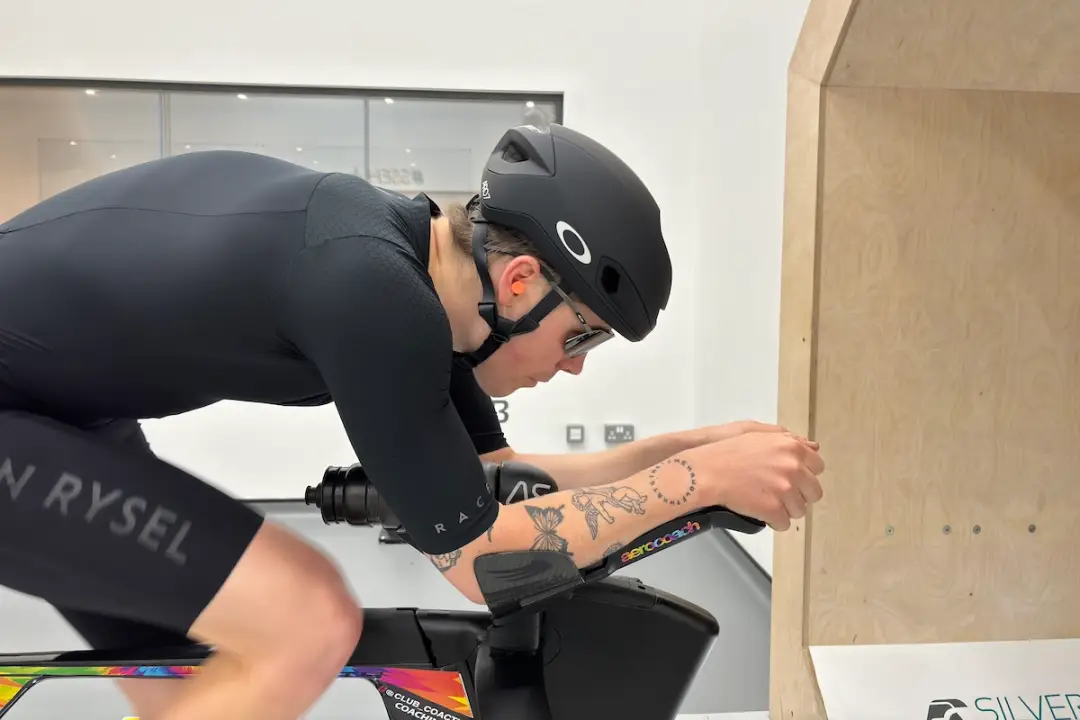
We tested the Aro7’s aerodynamic abilities in our independent wind-tunnel analysis of 11 aero road helmets at the Silverstone Sports Engineering Hub with The Bike Tailor.
Its performance over our baseline Decathlon helmet at a 7.5° yaw angle with the rider on tri-bars was just 2secs faster over a 40km / 25mi bike leg at 30km/h / 19mph and 4secs slower when riding at 40km/h / 25mph.
The results place it 10th in the standings on both accounts.
The big caveat is that the Aro7 was tunnel tested without its visor attached in order to use the same sunglasses we used with other helmets.
However, our previous tunnel time has highlighted how much faster TT helmets are with their designated visor attached, so we’d certainly suggest using this with its visor if you’re racing in the Aro7.
Visor, weight and value for money

Happily, the supplied clear and tinted Prizm visor offers plenty of clarity in an array of riding conditions and felt securely attached with the magnets.
I did occasionally struggle to locate its upside-down position when on the move, but it felt secure when positioned upside down and it didn’t compromise on the Aro7’s ventilation.
The Aro7’s weight comes in at 370g / 13oz for a medium with the visor attached, which is similar to Abus’ Gamechanger Tri/TT offering but 30g heavier than the Giro Vanquish MIPS.
Happily, it’s $200 / £150 cheaper and more versatile than the previous Aro7 model (also included is a carry case and a soft bag), but $260 / £272 is still a mighty amount to drop on something that’ll struggle on hot, hilly races and is unlikely to be used on training rides.
For a helmet seeking to occupy the middle ground between an aero road helmet and a TT lid, there’s not enough here to dislodge the $300 / £250 Giro Vanquish MIPS from our head.
Meet our tester
Matt Baird brings more than a decade of endurance sport and equipment testing experience to this review of the Oakley Aro7 helmet. A regular contributor to 220 Triathlon since 2008, Matt has raced across the full spectrum of the sport, from super-sprint events to Ironman, as well as duathlons and off-road triathlons, giving him a well-rounded perspective on performance kit. A familiar sight on the roads and trails around Bristol, he is also the author of Triathlon!, former editor of Cycling Plus, and the current editor of Countryfile, combining deep cycling knowledge with extensive experience in the outdoors industry.
Oakley Aro7 helmet specs
| Price: | $260 / £270 (US pricing is without visor) |
| Weight: | 370g / 13oz (medium, with visor) |
| MIPS? | Yes |
| Vents: | 7 |
| Colour: | Black only |
| Features: | Prizim lens visor with magentic attachment |


 Matt Baird
Editor of Cycling Plus magazine
Matt Baird
Editor of Cycling Plus magazine