What are the benefits of planking for triathlon training?
They're not the most enjoyable of exercises but they are very beneficial to your triathlon training. Physio Brad Beer explains everything you need to know about planking…

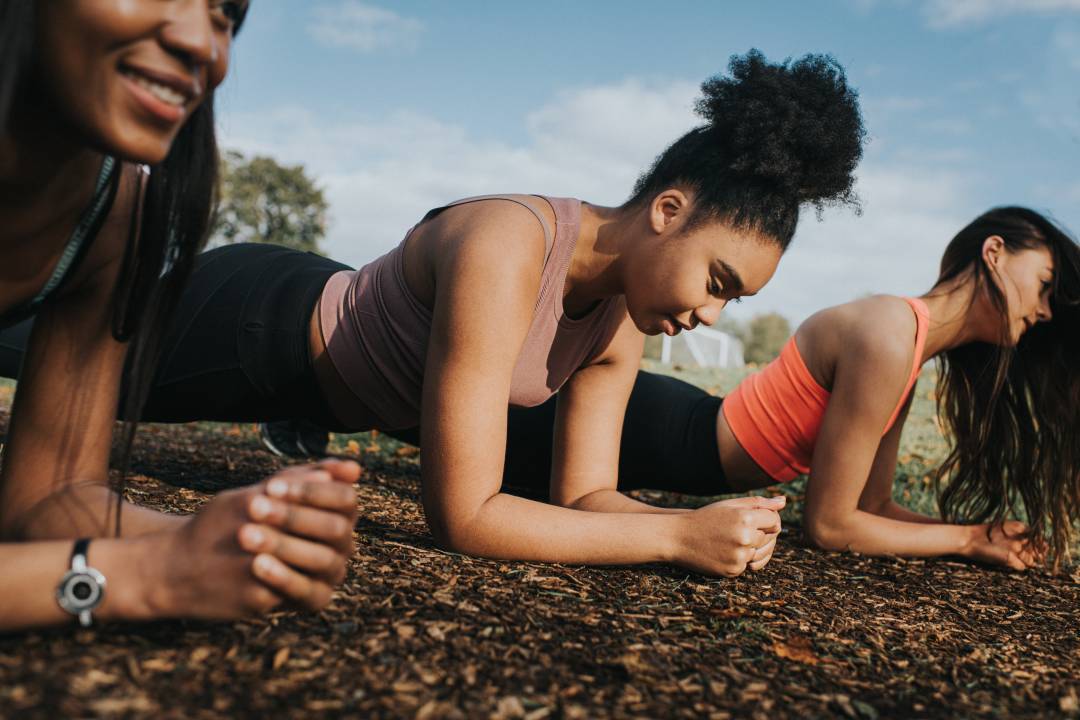
Planking isn’t the most enjoyable exercise but it brings lots of benefits for triathletes – sorry about that. Here’s everything you need to know about planking for your triathlon training plan.
What is a plank?

The plank is an isometric bodyweight exercise that strengthens the stabilising muscles of the shoulder, trunk and hips against gravity.
Traditionally, it’s performed on either the hands or forearms with both feet on the floor, holding the body off the ground for as long as possible.
The beauty of the plank is that it can be modified to suit the specific needs of triathletes to boost swimming, cycling and running performance. It can also be easily progressed or regressed to accommodate triathletes of all abilities.
Unlike traditional core exercises such as the sit-up, planking does not place high compressive loads on the lumbar vertebrae, delivering benefits to triathletes with lower back pain.
What’s the right way to plank?

To get the most out of the plank, it’s important to keep the body in a straight line from head to toe. This means not sagging through the shoulders and lower back, or lifting the hips too high.
Your supporting hand/elbow should be stacked directly underneath your shoulders. Avoid holding your breath – we breathe when cycling, swimming and running so there’s no need to do this.
Squeeze your glutes to bring your pelvis into a slight posterior tilt to avoid excessive lumbar extension.
What are the benefits of planking for triathlon?

Planking delivers benefits for triathletes in all three disciplines because it works the shoulders, abdominals and glutes.
Swimming
Planking challenges the stabilising muscles of the shoulder, which can improve power through the catch and pull. It can also improve energy transfer from the upper body to shoulder to core and hips as we rotate in the water.
Cycling
Maintaining a time-trial position requires solid abdominal and erector spinae muscle strength and endurance. Planking is a great way to work on this, improving comfort and control on the bike.
Running
Plank variations that improve anti-rotational strength (e.g. side plank) minimise excessive trunk movement for efficient running.
The side plank has also been shown to be one the best exercises for activating the gluteus medius muscle.
Deficiencies in this muscle are linked to running related injuries such as ITB syndrome, MTSS (medial tibial stress syndrome), and gluteal tendinopathy.
How can I progress my planking?

You can always increase the duration and frequency of planking, however, the best way to progress planking is to add dynamic challenge and vary positions.
This is not only less boring, but works a greater number of muscles in ways that can take your triathlon performance to the next level.
Examples include:
- Progressing to side plank or a reverse plank to work the obliques and posterior chain
- Planking on an unstable surface
- Adding in trunk, arm and leg movements
- Adding external load (e.g. performing with a weight vest or performing a plank + row)
What are the different ways to plank?
Front plank variations
- Leg abduction/extension lifts (with band): either move on leg to the side or lift it vertically
- Plank jacks (star jump action with legs): dynamically move both legs outwards and inwards
- Opposite arm/leg lift: Also known as the bird-dog plank, start on your hands and lift the opposite leg and arm
- Mountain climber or opposite knee to elbow planks: with your arms in the press-up position, move one knee towards your elbow
- Perform on stability ball with stir the pot/ rollout: rest your elbows on a balance ball and roll it forwards and backwards
- Front plank with twist: starting either from your hands or elbows, rotate to either side
- Add in a row: pull up a dumpbell with one arm while using the other to hold steady
- Plank walkouts: walk out hands as far as you can in front of you
- Plank with feet against a wall: start on your hands, move your feet up a wall and hold it
- Hip dips to one side: alternately drop your hips to either side
Side plank variations

- Dumbbell twist: pull up a dumbell with your top arm while rotating your torso
- Top leg abduction lift: raise your top leg vertically
- Adductor plank: put your top leg on an elevated surface, like a gym bench, while keeping the bottom leg beneath it
- Top elbow to knee crunch: move your top arm and top leg together
- Supporting hand on a ball and perform a twist: rest your bottom arm on a balance ball instead of a mat and twist your upper body
Why not work these exercises into our free eight-week strength building training plan for triathletes.


 Brad Beer
Sports and exercise physiotherapist
Brad Beer
Sports and exercise physiotherapist