The evolution of swimrun: How a Scandinavian challenge became a worldwide sport
Next year marks the 20th anniversary of ÖTILLÖ launching the sport of swimrun. But, amidst the celebrations, just how healthy is the sport in the UK? We gamely venture to the Isles of Scilly to find out...

The seagrass meadow sways beneath my feet, the crystalline waters offering an underwater experience that could be lifted straight from the Caribbean (or the Outer Hebrides).
I’m swimming in my trail shoes and exit onto the fine white sands of the Isles of Scilly and continue to run in my wetsuit. It’s multisport, but not as I’ve ever known it. And I’m having a blast.
The 16km Scilly Swimrun has taken me out of my comfort zone, pushed my physical limits and afforded me an incredible eye-popping immersion into the landscape of the Isles of Scilly’s main island of St Mary’s.
Exploration, adventure and endurance feats are all in healthy supply, and all without a puncture or snapped brake cable in sight. I just keep asking myself: why haven’t I done this before?

“You’ve only got to look at these islands to know that they’re built for swimrun,” says Scilly 60’s Wez Swain, who took over the Scilly swimrun events in 2023.
“Swimrun events should be happening here as it’s a phenomenal place for the sport. I say that the swimruns here are events rather than races as I don’t want people just to solely focus on the need to win or getting the best possible time; it’s also about immersing yourself in this amazing environment.”
My race has taken me around the perimeter of St Mary’s, a course involving seven runs and seven swims over its 16km route, as well as some scrambling, rock climbing, orienteering and snorkelling.

After an amphibious journey of over three hours, I’ve blisters on top of blisters, to go with chafing in places I didn’t know chafing could exist.
These become badges of honour when I return to the mainland via the Scillonian ferry a fully paid-up member of the swimrun cause, however.
But just how healthy is the sport itself as it prepares to celebrate a major milestone in 2026? Let’s look at swimrun’s past, present and possible future to find out…
Swimrun’s origin story

Like the birth of Ironman in the 1970s, the origins of swimrun are now engrained in multisport mythology. The sport began as a bet in a pub in the Stockholm Archipelago in 2002 following a debate between Anders Malm, Janne Lindberg, and Jesper and Mats Andersson over which pair could reach the island of Sandhamn from Utö the fastest.
The idea of swimrun in Sweden started to gain momentum before adventure racers Michael Lemmel and Mats Skott were invited to become involved and turn it into the first professional and commercial swimrun race.
ÖTILLÖ – “ö” meaning island, “till” being to in Swedish – was born in 2006 and would soon become a global series in which pairs-only racing, with athletes often bound by ropes, was the norm.
In contrast to the existing, often pool-based swim-followed-by-a-run aquathlon format, swimrun’s distances from the beginning were less standardised and involved multiple swim and run disciplines in each race, invariably on trails and in the open water and without transitions.
There was also the unique, anything-goes kit aspect to swimrun that felt like a throwback to triathlon’s formative and maverick years in the 1980s especially.
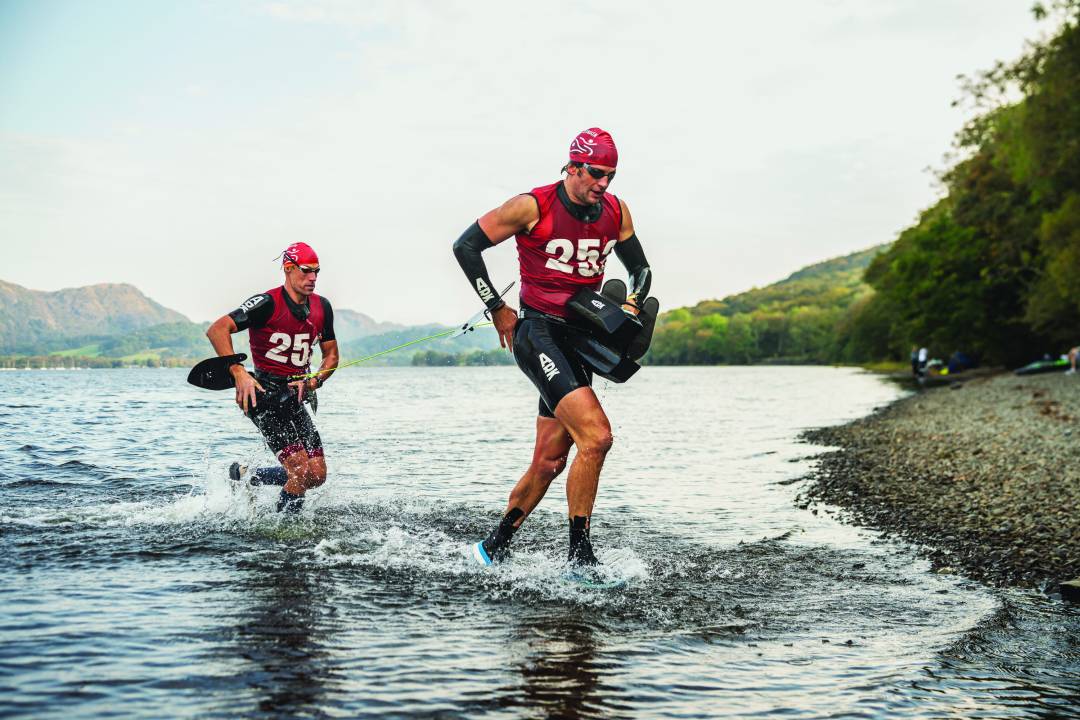
Catch paddles, buoyant calf guards and pull buoys were – and continue to be – common sights on the course, while racers have been known to drill holes in their shoes for better post-swim drainage and fashion DIY swimrun suits. Eyeing an opportunity, established triathlon brands released lines of swimrun suits, while swimrun shoes also became a thing.

ÖTILLÖ would become the Ironman of swimrun, intrinsically tied to the sport and its growth, as well as the host of the sport’s most storied race, the annual Swimrun World Championships in the Stockholm Archipelago.
Like Scilly, that island paradise is ideal for swimrun’s island-to-island format, yet the sport has also witnessed growth away from archipelagos, including in France, Switzerland and the USA.
“I first took part in a swimrun in 2015 in Loch Lomond,” says Chloe Rafferty, who launched Love SwimRun Events a year later.
“It was different, combined two of my favourite sports and didn’t have many rules. There was very little swimrun-specific kit available so you had to make your own! Swimrun seemed more like an adventure or a journey than a race, and it was often in some pretty spectacular locations.”
That’s not to say the sport hasn’t suffered bumps in the road during its growth. Event organisers Breca, who hosted swimruns in the UK and New Zealand, went into receivership, while the UK has witnessed a host of cancelled races for a variety of reasons in 2025, including the weather, water conditions and low entry numbers.

“We’re finding that people are entering events very late, which we cannot cope with financially or in terms of time it takes to put on an event,” says Jude Palmer of Run Surrey Hills, an experienced swimrunner and coach who also organises the South East Swimrun Series.
“People seem to be very drawn to ‘landmark’ type events with the bigger brands rather than smaller one offs. And those small numbers mean we don’t have the budget to invest in lots of marketing.”
Wez Swain has seen strong year-on-year growth with his Scilly swimrun events, albeit from relatively low base numbers, with the races also benefiting from the backing of the Visit Isles of Scilly tourist board.
“I don’t think the overall swimrun numbers are really growing nationwide. I think the biggest barrier could be people feeling self-conscious about running around in a wetsuit and worrying if people think it’s a fancy dress thing. But then, every now and again, someone like yourself comes along and loves it.”
Given the thrills I’ve experienced in Scilly, it’s easy to see how swimrun could provide an entry point to multisport for trail runners and open-water swimmers of all ages.
There’s also the fiscal benefit of omitting the most expensive discipline in a triathlon, as well as dispensing with the logistical issues of travelling with a bike.
Not that triathlon, with its televised spectacles and the continued power of the Ironman and Olympic Games brands, is in danger of losing its crown as the ruler of the multisport roost.
Pair play

The chief reason for my own initial reluctance to race a swimrun was the pairs-only aspect that has been with the sport since its formative years.
As a triathlete with a woeful DNS record (thanks, gouty ankles), the thought of letting down someone else as well as myself has put me off entering, as much as I once loved and now miss team sport camaraderie.
It’s a point picked up on by Rafferty. “When I first started swimrun, all the events had epic distances and you had to be a team of two. This was difficult for me as I didn’t know many people that were keen to take on the challenge. That’s the reason I started Love SwimRun Llanberis – to offer an accessible distance event with the option of solo entries.
“I got a lot of slack for it at the time! These days it’s much easier to get into swimrun as there’s so much kit available, loads of information online, events that offer short distances and solo entry options. I just don’t know why swimrun isn’t more popular.”

Swimrun organisers, including ÖTILLÖ, have followed Love SwimRun’s lead by offering both solo spots and pair options at their races, even if it goes against the swimrun manifesto set in Sweden in the noughties.
“The solo category was about bringing down an entry barrier,” says Dominik Leu of ÖTILLÖ, who host a wealth of races on both sides of the Atlantic. “We’ve seen quite a few racers who started swimrun as solo racers and then, often during a race, finding someone who was moving along at a similar speed and then they teamed up for the next event.”
Nonetheless, experienced swimrunners still maintain that embracing swimrun as a pair helps maximise the enjoyment of the sport.
“The general understanding at ÖTILLÖ is that swimrun is supposed to be practiced as a team,” adds Leu. “It’s more fun and part of the challenge, and the number of solo participants across our races is generally smaller than the number of people participating as teams.”

ÖTILLÖ are also lending their name to Merit races from independent organisers in a bid to grow the sport, with points on offer for their Swimrun Ranking System, including Gritty Rascal Events’ Swimrun Gower and Coniston in the UK.
The organiser of those events, Gary Pavitt, has revived the former Breca events under a new brand and is seeing signs of an uplift.
“Gritty Rascal Events has doubled entries at Swimrun Gower in its second year and we’re up by around 15% at Swimrun Coniston, which will almost certainly be in the top three by participation in the UK.
“If events are marketed well then they seem to attract quite a few people, like the I SwimRun event in Dorset and Windermere’s Great North Swimrun. I can see a trend where more people are doing shorter races over the longer ones. It’s not an expensive sport to get into as you don’t need a bike and you don’t even need a wetsuit for some of the experience races.”

Pavitt is also one of the driving forces behind British Swimrun, a new organisation aiming to promote the sport in the UK. “I first came into swimrun and saw a loose collection of disparate race organisers doing their own thing, especially after the demise of Breca, which was arguably Britain’s biggest swimrun organiser.
“There was nothing even approaching a national governing body, so I spoke to some of the other event organisers and decided it was time to collaborate more to mature swimrun in the UK.”
British Swimrun have also created a rankings system for swimrunners and a platform for swimrun organisers to help promote their events. “The overall aim of British Swimrun is to promote and develop swimrun across the British Isles, with the intention to be the national governing body of swimrun,” adds Pavitt.
“It’s about supporting the event organisers and athletes and growing the visibility of the sport, enhancing safety standards, yet retaining that free-spirited and adventurous swimrun culture. Longer term, we’d like to support coaching, taster sessions and elite athletes.”

Pavitt has seen a similar approach reap the rewards in France under the Fédération Française de Triathlon, and swimrun is flourishing across the channel.
And with the passion displayed by Pavitt, Rafferty, Swain and more that I’ve spoken to in the UK, the will is there for swimrun to exist as a thriving niche of triathlon, offering a fresh challenge to both newcomers and those of us searching for fresh multisport avenues over personal bests.
As for inspiration for your own swimrun journey, I’ll leave you in the experienced hands of Rafferty. “Just do it! There’s now buckets of free information online to help you with kit choices and training tips. It’s a great sport and, once you get your head around running in your wetsuit and swimming in your trainers, you’ll experience a real sense of freedom and adventure.”
Top 5 UK swimruns for 2026

Great North Swimrun – 13 June 2026
Both short (12.6km) and standard (23.9km) distances are available at the Great North Swimrun as one of Britain’s biggest swimrun showcases in the Lake District.
Studland Swimrun – 13 June 2026
Another biggie, this time in Studland in Dorset, with short (8.4km), middle (11km) and long (22.4km) courses starting on Knoll Beach.
Scilly Swimrun – 9–12 July; 27–28 August 2026
Swimrun returns to Scilly in 2026 with two major weeks of racing for the Scilly Swimrun in both July and August, including a new 20km Northern Traverse event.
The Eliminator – Dates TBA
These unique and beginner-friendly swimrun Eliminator events in Liverpool and Aberdyfi, Wales, offer an eliminator format where the time to complete each lap reduces as the race goes on.
Swimrun Gower – June 2026
Full (41km), Gritty (20.7km) and sprint (11.7km) courses are available at the Swimrun Gower set corker in South Wales, with the peninsula’s beautiful coast traversed on all of the routes.
Inspired to start training for your first swimrun? Check out our free 12-week swimrun training plan to get started.


 Matt Baird
Editor of Cycling Plus magazine
Matt Baird
Editor of Cycling Plus magazine