How Spencer Matthews delivered the fastest ever Ironman in Antarctica during Project Se7en
In an exclusive interview with 220 Triathlon, Matthews talks sleepless nights, 13mm wetsuits and why the human body is so remarkable.

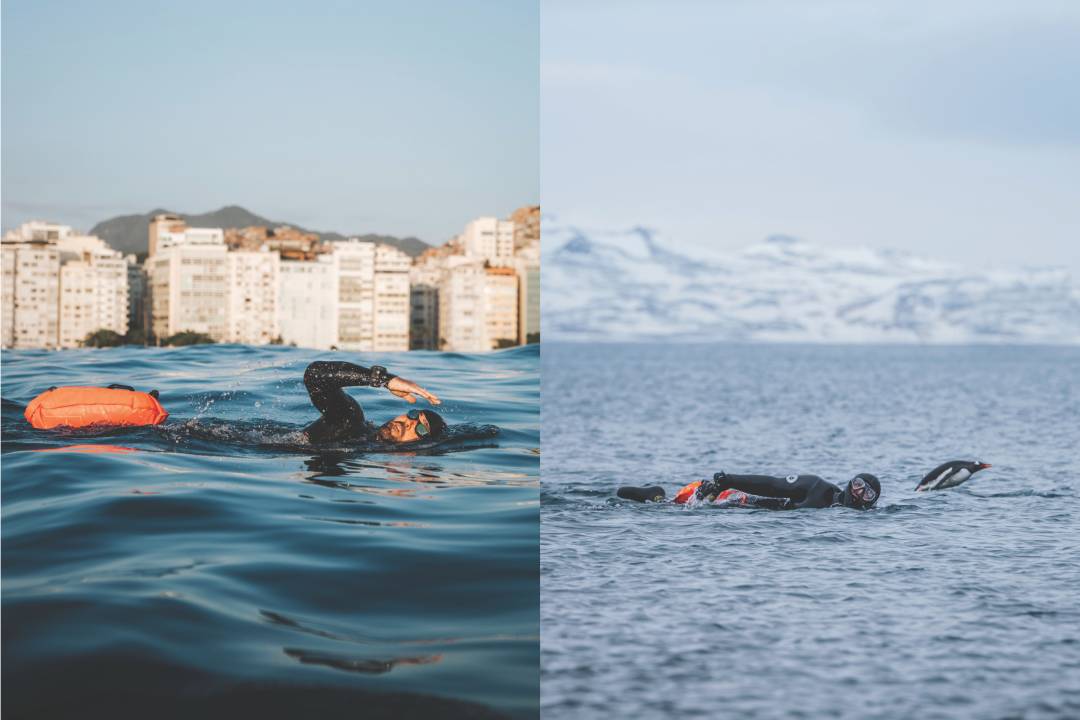
In a three-week period in November and December 2025, endurance athlete, entrepreneur and former star of Made in Chelsea Spencer Matthews completed Project Se7en: seven Ironman-distance triathlons on seven different continents, setting a new Guinness World Record.
It takes a lot to worry Spencer Matthews. The former television star has a breezy and engaging self-confidence and tends to see the world in terms of what he can achieve, rather than reasons not to try. But even Matthews lost sleep over the prospect of a 3.8km swim in the icy Antarctic Ocean.
The Antarctic swim was the defining challenge of Project Se7en and made the other six triathlons seem straightforward in comparison.
“It’s concerning. Antarctica is generally concerning,” Matthews tells 220 Triathlon in an effusive and expansive video call less than a week after Project Se7en’s successful conclusion.
“If you don’t take it seriously and you’re not prepared, the chances of facing problems are pretty high. As a team, we love to control what we can control and Antarctica is pretty tough to control. There are things outside of your power that can be very harmful.
“I’ve always been a guy that can sit in a black cab and go to sleep,” he adds. “On the Tube, whatever. I’m a good sleeper. But I couldn’t sleep, night after night. I think there was a part of my brain which was pretty worried.”
A huge challenge

Project Se7en was a huge physical, logistical and mental challenge. Of course, Matthews had to face the basic fitness challenge of being able to put seven almost back-to-back iron-distance triathlons together.
On top of that, there was the logistical challenge of getting from A to B (then onwards to C and all the way to G) without delays, lost luggage or missed flights. An extra layer of complication was added with the recovery – a pressurised plane cabin is the worst environment for swollen, damaged muscle fibres – and the jetlag.
Project Se7en started in London, then Matthews and the crew hopped seven time zones west to Arizona, then nine hours east to Cape Town, a further six hours east to Perth, then four hours back west to Dubai and seven hours further west to Rio.
The final journey from Rio to the tiny airstrip at the Base President Eduardo Frei Montalva on the far northern tip of the Antarctic Peninsula involved no more change in degrees of latitude, though there would be a huge drop in degrees Celsius.
It was this Antarctic triathlon, specifically the swim, which frightened Matthews the most. Matthews’ coach and planner Chris Taylor described Project Se7en as a challenge of two halves – the first six iron-distance triathlons, and then Antarctica.
Matthews is not the first person to do an iron-distance triathlon in Antarctica. The first person to complete seven on seven continents, Anders Hofman, set the precedent in 2020.
The movie Project Iceman (find it online) documents Hofman’s preparation for his exploit, along with the triathlon itself, a lonely slog in the austere, monochromatic desolation of white snow and black water.
A long aerial shot of the Dane looking tiny in the vast ocean and moving painfully slowly has no commentary, just a subtitle reading, ‘tense, brooding music’. This was what Matthews had to face in order to complete Project Se7en.
Warmth over speed

The most important consideration for Matthews’ Antarctic swim was quite a basic one: staying alive. Staying warm would have to take priority over speed and comfort, even if it meant being in the water longer.
With the water temperature at around 0°C, Matthews had to choose between an industrial diving wetsuit, which would keep him warm, even too warm, but would be restrictive, uncomfortable and slow, or a triathlon wetsuit designed for five or six degrees, which would be much faster but very cold.
“I chose the warmer option with less mobility, only because becoming hypothermic could end the challenge,” he says. “That’s an unpredictable issue to deal with.
“I’ve been hypothermic before, and providing you can get warm quickly, it’s okay. But you don’t have that certainty in Antarctica. It was a bit risky, after six full-distance tris, with my body already pretty depleted, to take the risk on the temperature.”
It didn’t help that Matthews tore the diving wetsuit when he was putting it on, putting a big rip in the leg. His crew duct-taped the suit as best they could, while Matthews’ memory of the start of the swim was that he was boiling hot in the wetsuit… while his face got so cold he lost all feeling in his jaw and mouth. His left hand went numb immediately.
“You start worrying about potential permanent damage,” he says. “I think if you were to rationalise things, which you absolutely have to, you pretty quickly realise that’s probably not a reality, but all of these horrible thoughts enter your mind almost immediately when you feel you’re in trouble.
“There was an awful lot of drag. I could see the sea floor – there were lots of rocks, so you could understand how fast or slow you were moving because there was something to monitor, and I was pulling three or four strokes just to get anywhere.
“I knew straight away that this was going to be painfully slow. ‘I hope it’s faster than two hours,’ was what I was thinking, because obviously the longer you’re in the water, the more trouble you may face and the more exposed you are. It was actually a really fearful experience.”

Matthews had been prepared for the mental challenge. However, the physical challenge of the swim was far greater than he’d anticipated.
“The physicality of it was extraordinary. When I got out of the water, I felt physically probably the most depleted of the whole challenge. I was very, very sweaty – it was like being in a sauna. I’d had a 13mm neoprene wetsuit on and in any conditions that’s just going to suck you dry. I felt horrendous,” he says.
Matthews sweated out a lot during the hour and 47 minutes he spent doing the swim, and immediately afterwards his body also got rid of the couple of litres of sea water he’d swallowed, a process graphically and colourfully documented on his Instagram feed.
He wasn’t elated to finish, just relieved, and in such a hurry to get out of the heavy, sweaty wetsuit that he asked his helpers to cut it off, though in the end they refused. “I just wanted to be able to breathe properly,” he says. “If I could have ripped it off me, I would have.”
After the swim, the Antarctic bike ride and run were almost anticlimactic. The crew had flown fat bikes over, but Matthews ended up borrowing a mountain bike from a Chilean national who worked at the airstrip, a much faster option.

The initial plan had been to use the runway for the ride, but bad weather had pushed all flights back a day, so Matthews rode 140km up and down a 200m strip of potholed track until the airstrip closed at 11 and he could do the final 40km on the runway.
“I was comfortable with it, kept it in a really low gear and quite high cadence, not putting too much strain through the body,” he says. “I thought about my wife a lot, thought about my kids a lot, listened to music I love on repeat and did two-to-three-hour stints.
“I’d go in for a coffee and a couple of slices of toast, back out again, and when it’s done, it’s done. You just put yourself in the reality that this is where I’m going to be for the next 20 hours, and that’s that.”
And it was the same again for the run: 7k chunks on a 600m lap, with the odd coffee stop at the car. If anything, Matthews’ legs felt good – the spinning on the bike meant he didn’t have the muscular strain he would normally carry into the run.
“I think Tom, the director of the film, wished there was more drama,” he says. “But it was just one foot in front of the other until I was done.”
Establishing a routine

Project Se7en was dominated by the Antarctic triathlon and Matthews’ fears about it, but there were plenty of highs along the way. With flights running smoothly and the triathlons proceeding as planned, there was time and space to enjoy the globetrotting.
The second triathlon of the seven was the official Ironman event in Arizona, where Matthews achieved easily his fastest time: 12:51:53. The night before the race, Matthews and film director Tom climbed a hill near the hotel and watched what Matthews describes as “the greatest sunset in history”.
This was also a moment of reflection – Matthews, who lost his older brother Michael when he was 10, says: “That was a beautiful moment, and quite early in the journey, but in times like these, I couldn’t help but feel that Mike was shining down on me ahead of Arizona, which was a lovely moment.”
As Project Se7en unfolded, the team got into the rhythm of the challenge. Arizona was followed by Cape Town, and then Perth, two brutal travel legs where the long journey times were exacerbated by unfavourable west-east travel during which entire nights of sleep were lost.
But once they were travelling west again, to Dubai and Rio de Janeiro, the time zone-hopping became their friend. In the end, Matthews says the jetlag didn’t really affect the team, because the routine was king: arrive somewhere, check into the hotel and get some sleep, set up the bike and gear, crack out the triathlon, then pack up and leave.
“When you were in it, you were in it, and you dealt with the cards that you had in front of you at the time,” he says. “I gave little or no thought to what lay ahead; I just managed the moment I was in.”
And now Spencer Matthews is a double world record holder – the fastest individual to complete seven iron-distance triathlons on seven continents, along with the fastest recorded Ironman on Antarctica.
“I’m very proud of what the team has achieved,” he says. “I designed this to really test my mental and physical ability and it absolutely delivered that in spades. I think the human body is a pretty remarkable piece of kit. If you have to, you can crack on with seemingly whatever you put in front of it.
“I enjoy this kind of challenge. I like pushing myself mentally and physically. I find the crushing low moments interesting. I obviously have what I’d consider to be a pretty nice life, so to feel crushed down, beaten, is good for anyone. Suffering physically through difficult times and things makes me feel very alive.
“Persuading yourself that you can do this stuff is incredibly important. When your mind fills with dread, doubt and fear, that is precisely the time you have to tell yourself, I’m the guy for this. I can do this.”
The full Project Se7en schedule:
- Nov 13: London
- Nov 16: Arizona Ironman
- Nov 19: Cape Town
- Nov 22: Perth
- Nov 25: Dubai
- Nov 28: Rio de Janeiro
- Dec 4: Antarctica
To find individual routes, see Matthews’ Strava
Who is Spencer Matthews?

Spencer Matthews is an endurance athlete, entrepreneur and reality television star who first rose to prominence as a cast member of Made in Chelsea. Educated at Eton, his life was struck by tragedy when his older brother Michael Matthews died descending Mount Everest in 1999 after becoming the youngest British person ever to reach the summit.
Spencer Matthews later took part in a documentary, Finding Michael, in which he visited Everest with advice from explorer and presenter Bear Grylls, in an unsuccessful search for his brother’s body.
After Made in Chelsea, Matthews took part in Celebrity MasterChef, and won the fourth series of the ski-jumping reality show The Jump.
He is married to Irish television presenter Vogue Williams (whose appearance on I’m a Celebrity, Get Me Out of Here! coincided with Matthews’ Project Se7en) and is the founder of CleanCo, which makes non-alcoholic cocktails.
As well as his Project Se7en record, Matthews has run 30 marathons in 30 days in Jordan, also a Guinness World Record for consecutive marathons on sand.
About James’ Place
Spencer Matthews undertook Project Se7en to raise funds for James’ Place, a charity which offers life-saving therapy to suicidal men. James’ Place had come up in a few unrelated conversations, and when Matthews looked into it, he knew he’d found his cause. “It felt serendipitous,” he says.
“I knew that male suicide numbers were at an all-time high, and that it was a crisis. But when I began to dig into it and learned the most likely thing to kill you is yourself, if you are a 35-year-old or younger man in this country, I was quite blown away by that. I met with [trustees] Claire Milford Haven and Harry Stanley and just fell in love with the work that they do.
“They’ve got a near 100% record of saving men in suicidal crisis; they see people within 48 hours. If we can raise funds, that’s great, but we can also do a great job of raising awareness around it, which can allow James’ Place to physically save lives in real time.”


 Edward Pickering