“I find the crushing low moments interesting”. Spencer Matthews shares the highs and lows of his extreme triathlon challenge

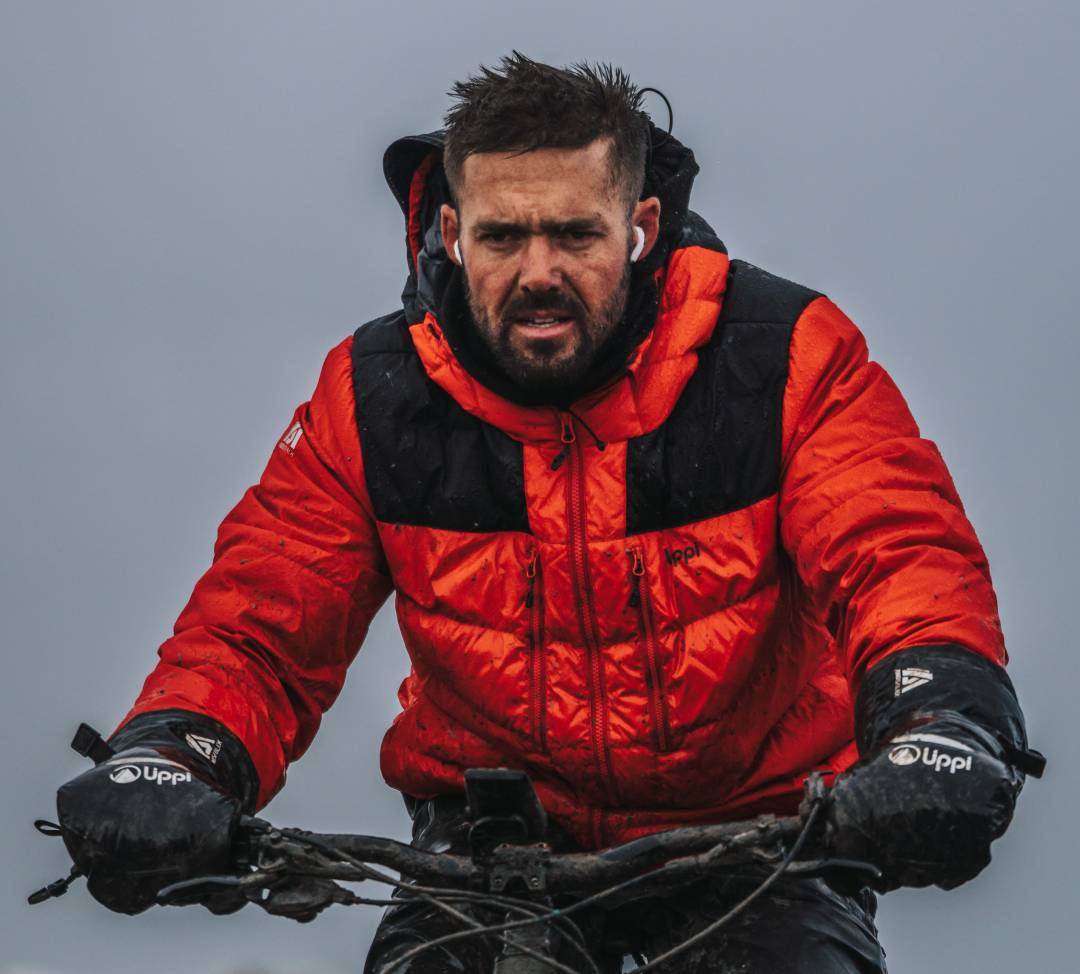
Fresh from 21 days of mind-blowing triathlon action around the globe, Spencer Matthews found some time to kick back and talk to 220 Triathlon about extreme multisport, extreme wetsuits, racing on ice and the challenges he has his eye on next…
Spencer Matthews, television personality and entrepreneur, is now a multiple Guinness World Record holder. The former Made in Chelsea star achieved the physical, mental and logistical challenge of completing seven Ironman-length triathlon challenges on seven different continents, in just 21 days.
A globe-hopping itinerary took him from London, through Ironman Arizona, Cape Town, Perth, Dubai and Rio, before the toughest part of the challenge, Antarctica. In ticking off all seven in such a short period of time, he set a new world record, and at the same time achieved the fastest Ironman-distance triathlon ever in Antarctica.
Now back in the UK, just days after swimming in 0-degree waters and riding and running interminable short loops on adverse terrain for the final part of his challenge, Matthews made time to chat with 220 Triathlon.
In our exclusive interview he tells us about his exploits and sense of achievement in doing all seven of his triathlons, and reflect on the motivations that drive him, the decision to raise money for the James’ Place charity, and the equipment dilemma that saw him swimming in a 13mm neoprene wetsuit…
220 Triathlon: Congratulations on the two world records. What’s your immediate perspective on the whole Project Se7en challenge?
Spencer Matthews: I’m very proud of what the team has achieved, and what’s been done. I designed this to really test my mental and physical ability and it absolutely delivered that in spades. I think the human body is a pretty remarkable piece of kit – if you have to, you can crack on with seemingly whatever you put in front of it.
We didn’t really suffer from jetlag because we literally didn’t have time to. We would arrive somewhere, get a few hours’ kip in the hotel room, build the bikes and hit the Ironman, then pack up and leave. When you were in it, you were in it, and you dealt with the cards that you had in front of you at the time.
I gave little or no thought to what lay ahead. I literally just managed the moment I was in, and I think ultimately it’s been an extraordinary experience, but one that thankfully was very successful.

Seeking a challenge
220: Why did you do this, and did that change from before the challenge to now?
SM: I enjoy this kind of challenge. I like pushing myself mentally and physically. I find the crushing low moments interesting. I obviously have what I’d consider to be a pretty nice life, so to feel crushed down, beaten, is good for anyone. Suffering physically through difficult times makes you experience all kinds of things. It’s great for personal development, good for my mind, and makes me feel very alive.
Being able to raise funds and awareness for James’ Place, for men who are suffering far more than I did at any stage of the challenge, is massive, which is a segue into pride and a real sense of achievement for me. Which I of course value as well.
Then there’s the example that you set for your kids. I’ve been very fortunate to grow up in an environment where I’ve really admired the people in my own house. I’ve always really admired my dad, my brother, both brothers in fact, who were both very competitive, very adventurous… I’ve grown up in an environment which has allowed me to feel that I can do cool things as well. I want my kids to grow up in a world where they look at difficult things and think, I could do that.
I think it’s healthy to want to tackle big things, or difficult things. Boredom is a thing for me. If I’m coasting along work-wise, if I don’t feel challenged, I drop into a slightly mundane feeling of work being a bit the same, home life feeling a bit the same. I’m very lucky with what I do and who I get to spend time with – I couldn’t love my wife more, and obviously my kids, but having a big almost dangerous aggressive challenge on the horizon is exciting for me. It makes me feel alive and well.

Iron-distance in Antarctica
220: Let’s talk about Antarctica, the last leg of the challenge. Was the experience of it very similar to what you anticipated it would be?
SM: I suppose so. I feared it for a while and downplayed it to my family a bit, but it was a very genuine concern. I like to live in a stress-free, concern-free way if I can, but I did lose sleep over the Antarctic swim. I watched Project Iceman, the Anders Hofman documentary, a couple of times. I spoke to Connor Emeny, [with Hofman] the only other person to have done an Ironman on all seven continents, and… it’s concerning.
Antarctica is generally concerning. If you don’t take it seriously and you’re not prepared, then the chances of facing problems are pretty high. As a team we love to control what we can control and Antarctica is pretty tough to control. There are things outside of your power that can be very harmful.
I had a choice to make when it came to the wetsuit. There was this big, thick, almost industrial-level diving wetsuit, which I knew would limit movement and not be particularly slick in the water. It’s not designed for swimming. The chances of being cold would be pretty slim, and you could even be too hot, really claustrophobic. Or you could pick a triathlon wetsuit that’s designed for five-six degrees, knowing that you’re going to be really cold.
I chose the warmer option with less mobility only because becoming hypothermic could end the challenge. I’ve been hypothermic before, and providing you can get warm quickly, it’s… okay? But you don’t have that certainty in Antarctica and the weather’s pretty unpredictable. It was a bit risky for me, after six full-distance tris, with my body already pretty depleted, to take the risk on the temperature.

I tore the wetsuit putting it on, in the leg. That was a bit of a moment. We duct-taped around my legs to close it up and got in the water, and I was uncomfortably hot to begin with, while my face was freezing – I didn’t have any control of my jaw or mouth. My left hand lost it straight away – really numb, freezing cold.
You start worrying about potential permanent damage, just because that’s where your mind goes to. I think if you were to rationalise things, which you absolutely have to, you pretty quickly realise that’s probably not a reality, but all of these horrible thoughts enter your mind almost immediately when you feel you’re in trouble.
And then, there was an awful lot of drag. I could see the sea floor, so you could understand how fast or slow you were moving, and I was pulling three or four strokes to get anywhere. I knew straight away that this was going to be painfully slow. I hope it’s faster than two hours, was what I was thinking. Obviously the longer you’re in the water the more trouble you may face. I was thinking, I’m really hot now, but I’m sure that will change. If water seeps in I’ll suddenly become freezing. It was actually a really fearful experience.
Key moment of the challenge
220: What was the balance of physical and mental challenge?
SM: It was far more physical than I’d imagined. Mentally it was about where I imagined it would be. But the physicality of it was extraordinary. When I got out of the water I felt physically probably the most depleted of the whole challenge. Very very sweaty, like being in a sauna. I’d had a 13mm neoprene wetsuit on and in any conditions, that’s just going to suck you dry.
I felt horrendous getting out of the water. You would expect to be elated getting out, but I was just relieved. I nearly pulled in halfway through, just because it was that much of a struggle. And then just thought, if I get out now and have a break, getting back in to do the next half is going to be a bit of a mental block. I’m never going to do this again, so let’s stick with it.
You know when you’re in a sauna and you can’t wait to get out, because you can’t even think clearly? It was that, for nearly two hours. I couldn’t wait to get the wetsuit off – I asked Chris to cut the wetsuit off me when I got out. I just wanted to be able to breathe. He didn’t do it and we just pulled it off normally. If I could have ripped it off me, I would have.
220: It felt like the swim was the focal point of the whole challenge.
SM: In the month before going, I would have the odd completely sleepless night. I would lay in bed from 9pm to 3 in the morning just not being able to sleep, and I couldn’t figure it out. I’ve always been a guy that can sit in a black cab and go to sleep. On the tube. Whatever. I’m a good sleeper. But I couldn’t sleep night after night after night. Since completing the challenge, and specifically after that swim, I’ve had no issues sleeping at all. I think there was a part of my brain which was pretty worried about that.

Riding on the ice
220: How was the bike ride? It looked a lot less complicated than the swim.
SM: I knew that the bike ride was going to take between 16 and 20 hours depending on where we ended up. We had clearance to use the runway, which was tarmacked and relatively flat, but we didn’t have the luxury in the end, because weather pushed the Tuesday flights into Wednesday, which was when we were racing. I was given the option of going up and down this 200m strip which was really potholey, with ice and snow everywhere.
It was quite difficult to just switch off – I had to pay attention to where the wheel is all the time, and I couldn’t really cycle straight. I did 140k of that and eventually the airport closed at 11pm and we ventured out onto the runway, which was surprisingly inclined, more like a pyramid shape, to slow the planes down when they land. I’m not sure it was much better but it was easier to switch off. Fortunately I have some experience of switching off and gliding through things – I’ve done a 24-hour track run before.
The cycle went pretty well. It would be easy to drift into a very negative territory when you know you’ve got an 18-hour stint ahead of you but broadly speaking I was very comfortable with it, kept it in a really low gear, at quite a high cadence, not putting too much strain through the body. I thought about my wife a lot, thought about my kids a lot, listened to music I love on repeat and did 2-3-hour stints. I’d go in for a coffee and a couple of slices of toast, back out again and when it’s done it’s done. You just put yourself in the reality that this is where I’m going to be for the next 20 hours and that’s that. The challenge is to try and switch off.
220: The bike looked fairly heavy duty…
SM: We brought two fat bikes over from Chile. There was a Chilean guy who worked at the airport. He took one look at the fat bikes and was like, you’re going to be slow on that, I’ll bring you up a mountain bike. That was pretty helpful, I’d have been a fair few hours more on the fat bike because they’re super slow.
The final marathon
220: How was the marathon?
SM: Again, I think Tom, the director of the film, wished there was more drama. As you might expect, I was pretty spent by then, and we were 24 hours into a 28-hour stint, so my energy levels were pretty low and enthusiasm had fully dissipated. I was struggling to speak properly but actually the legs felt okay. Ordinarily after coming off the bike they’d feel a bit worse than they did because I wasn’t putting any real wattage through the bike, so there was no muscular strain; it was just very long. I just cruised 7k chunks and stopped for the odd coffee. Again, it was about a 600m lap, so pretty mundane. It was just one foot in front of the other until I was done.

220: In terms of the whole challenge, what were the high points?
SM: The moment where you get back to the hotel after the success of each race was great. London was a really good milestone for me – that was the first time I’d done an Ironman-distance tri. I hadn’t strung it all together ever, so that was quite a good mental milestone. Getting home and feeling muscular pain and tension but knowing I wasn’t injured and knowing I was capable of stringing it all together was nice.
We had the most remarkable sunset in Arizona the night before the race. Tom and I climbed this little hill near the hotel and witnessed what one could only describe as the greatest sunset in history. That was a beautiful moment, and quite early in the journey, but I like to feel that my brother was with me at times like these [Matthews’ brother Michael died descending from the summit of Mount Everest in 1999].
Finishing the official Ironman in Arizona was pretty cool, and considerably faster than the others. It was nice to be an official Ironman.
Travelling the world, going to seven continents in 21 days, is pretty cool in itself. I had lots of moments of joy and pride, but didn’t allow myself to get too comfortable at any stage because I knew things could go wrong at any point.
The next challenge
220: What’s next in terms of endurance challenges?
SM: I’ll have a little think. I love the idea of trying to run up and down Kilimanjaro in a single push. I don’t know why I’m drawn to that, but I would love to give it a crack to see if I could summit and get back down in a single go. Which I’ve no idea if I can do, really, it just came to me the other day.
220: And there’s an unscratched itch with your marathon time, right?
SM: I would love to go sub-three, but I’ve not given it the time it deserves. I threw Berlin into my schedule very late – I got a place a week before, which Adidas were very kind to give me. I haven’t done a training block to specifically crack a sub-three, yet. I also didn’t take music around Berlin, which was a barbarically stupid thing to do. That three hours and six minutes of pain was pretty real without music. I’ve never run at that pace without music even for a kilometre, that was a really bad decision that I’ll never make again.

220: Your wife, Vogue Williams, was on I’m a Celebrity… get me out of here! at the same time as your challenge. You probably have a lot to talk about…
SM: We had a go at catching up last night but she was absolutely exhausted. It was 6am for her by the time she got into bed so I imagine we’ll catch up properly over the next couple of days. We’re going away for the weekend now with my whole family and we’ll have a proper catch-up, but I’m very proud of her. I’d have liked to see more of her in the show, but that’s just me wanting her to shine in the way I know she can. I’m very proud of her and delighted to be back with her.
Mental strength and fundraising
220: You said at the start that the human body is a remarkable thing. But the human mind is also a remarkable thing…
SM: Persuading yourself that you can do this stuff is incredibly important. When your mind fills with dread, doubt and fear, that is precisely the time you have to tell yourself, I’m the guy for this, I can do this, I know I can do this; let’s focus on achieving it. It’s fine to doubt stuff and prepare for it, but when you’re in it, those feelings just get in the way. You’re far better off trying to be positive and confident and trying to move through it with a positive mindset. The negativity in your mind feels crushing, if you allow it.

220: And finally, why did you choose James’s Place as the charity to benefit from this challenge?
SM: James’s Place was mentioned to me by two or three quite close friends in the run-up to Project Seven. It felt serendipitous, it came to my attention via several sources, when I wasn’t even asking about it. I didn’t have any real knowledge or understanding of the male suicide crisis in the UK in any detail.
I knew that male mental health was in a bad place and I had heard that male suicide numbers were at an all-time high, and that it was a crisis. But I learned the most likely thing to kill you is yourself if you’re a 35-year old or younger male in this country. I was quite blown away by that as a fact, and I met with James’s Place and met Claire Milford Haven [founder] and Harry Stanley [trustee] and just fell in love with the work that they do.
I felt it was a tremendous outfit and they’ve got a near 100 per cent record of saving men in suicidal crisis, they see people within 48 hours and it just came to my attention that perhaps men don’t know that there is this kind of lifeline out there.
If we can raise funds that’s great but we can also do a great job of raising awareness around it, which can allow James’s Place to physically save lives in real time. It felt like a really strong match.
Thank you to Spencer Matthews and his team for so generously giving their time for this interview. To support James’ Place go to Spencer’s fundraising page and to find out more about the charity or to seek support for yourself or another man in crisis, visit the website. An expanded version of this interview will appear in the issue of 220 Triathlon on sale Friday 23rd January, subscribe here.
All images: Stone Visuals UK


 Edward Pickering