Outcry leads to Ironman changing Kona qualification system

The backlash over the new system to earn slots to the Ironman World Championships in Hawaii triggered a quick change, but it’s tinkering that doesn’t risk upsetting its core customers, argues Tim Heming.
There was an amusing skit on social media where a young female triathlete professed to having the key to unlocking Ironman World Championship qualification – glue on some facial hair and pretend you’re a 50-plus-year-old-man.
The astute jibe was aimed at the new Ironman qualification system that appears to be favouring the older male age groups, with potential women qualifiers suffering as a result.
The performance-based qualification system was introduced in August for 2026 and – with the race returning to just one day in Kona from next year – pitted men and women against each other using an age-graded system for coveted race slots.
Explaining the full detail would take the rest of this column, but suffice to say, there is unrest that women are not only being frozen out, but disenfranchised from even entering a race to qualify in the first place. You can read more in our feature on women in triathlon from earlier this year.
When six-time world champion Mark Allen puts his name behind a petition for immediate change it’s clear Ironman has a problem, although – claiming they finally have enough data to properly analyse how it’s panning out – CEO Scott DeRue has now taken steps to address the situation.
Tweaking the system
In a session with Ironman’s chief, he outlined hypotheses as to why the qualifiers are looking skewed, including that in the races since August, the most competitive women were already at or preparing to race the World Championship in Hawaii (the men’s equivalent having been in Nice in September). Overarchingly, if we accept the premise that the top 20% in each gender might look to qualify for Hawaii, the global pool of women wanting to do Ironman just isn’t yet large enough.
To compound the disparity, Ironman also acknowledged that more women than men were turning down slots that were then being snapped up by men in the rolldown.
Ironman is now tweaking things by adjusting the system so that any slot that rolls off an age-group podium stays in its gender pool. This stops the status quo of when a slot isn’t taken by any of the top three women in an age-group it effectively goes to a man 96% of the time.
The second change is that the age-group-graded performance pool will ring-fence slots for each gender depending on proportional participation at the race. For example, if 850 men and 150 women are racing, 15% of performance pool slots will go to women.
This might help sort out some of Ironman’s immediate problems and push the female slot allocation in Hawaii closer to the 30-35% that was projected rather than the 20% we’re currently in line for.
The problem with any measure like this though is that it doesn’t change the fundamentals.

Ideological disparity
There’s an ideological disparity between triathletes who believe there should be equal representation – 50-50 (or close to it) across the board – and triathletes who say because 80% of the customer base of Ironman are men, men should have a proportional number of slots.
Ironman would like more women there, and it would quell the dissenting noise, but they are not prepared to risk alienating their current core customer base to do it.
If I took anything away from an hour hashing it through with DeRue, In Marbella, it was always going to be evolution not revolution. The company felt burned financially after low numbers for a women’s-only race in Nice last year and they’re not entertaining that again.
The usually measured DeRue is not easily ruffled. The only time I saw him bristle was when I suggested ‘why not 50-50 in Kona?’. That’s not happening any time soon.
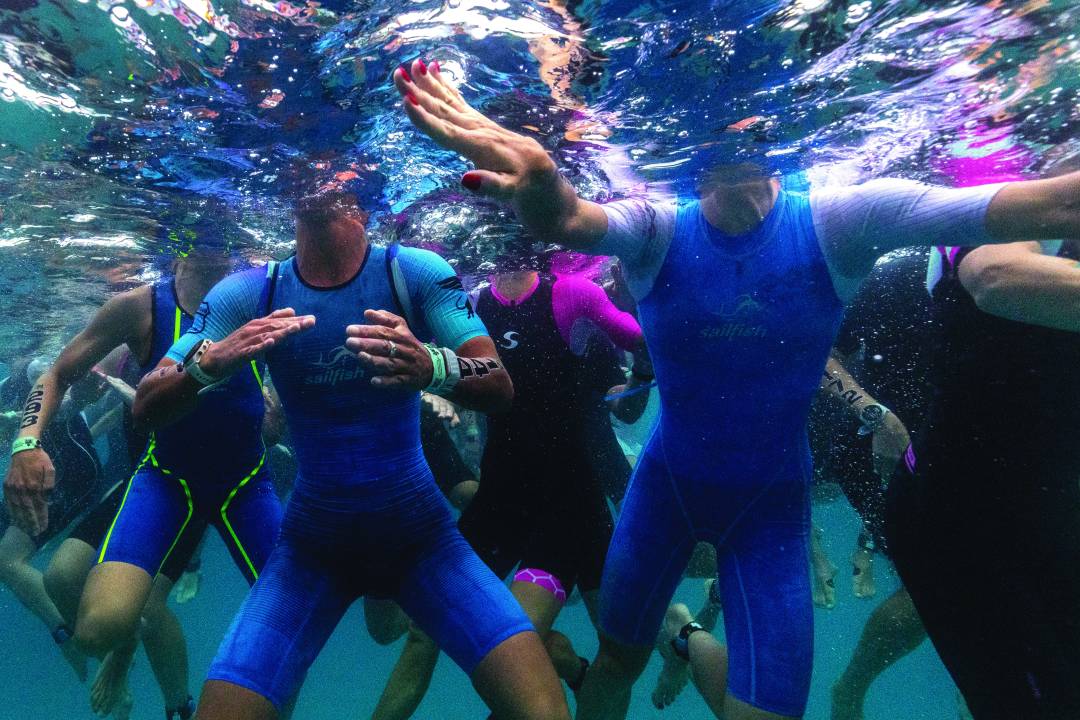
Image: Athletes prepare to compete in the swim portion during the 2025 IRONMAN World Championship Women’s Race on October 11, 2025 in Kailua Kona, Hawaii. (Photo by Sean M. Haffey/Getty Images for IRONMAN)


 Tim Heming
Freelance triathlon journalist
Tim Heming
Freelance triathlon journalist