$200k bonus sweetens the strain as injury ends Kat Matthews’ chances of Ironman 70.3 glory
A calf pull helped prevent determined Brit from finally lifting an Ironman world title, but a bumper set of results in 2025 meant she still topped the Ironman Pro Series and took triathlon’s biggest prize cheque


Kat Matthews chances of a first Ironman world crown after five runner-up finishes still looked on when she started the half-marathon in third place and immediately clawed back time on the leaders.
“I felt so positive,” she said post-race. “I thought: ‘This is it. It’s my race. There’s less than 4mins to the front.’ I think that’s the closest I’ve ever been [starting the run].”
But then fate made a cruel intervention. “About two weeks ago I had a small strain as I got back into running post Kona. I rehabbed it, run-walked, and was pain-free for about 10 days,” the former British Army physiotherapist said, referencing her second place at last month’s full distance Ironman World Championship.
“I took two days off running, but unfortunately, clearly the load was too much and I felt it go after about 2km, and it got progressively worse. There was no function in it, and I knew that was not going to get me to the finish.”
Despite having to drop out, the Ironman Pro Series points Matthews acquired in previous races – chiefly victory in Texas, and runners-up spots in both Hamburg and Hawaii – had given her a significant buffer over Solveig Lovseth.
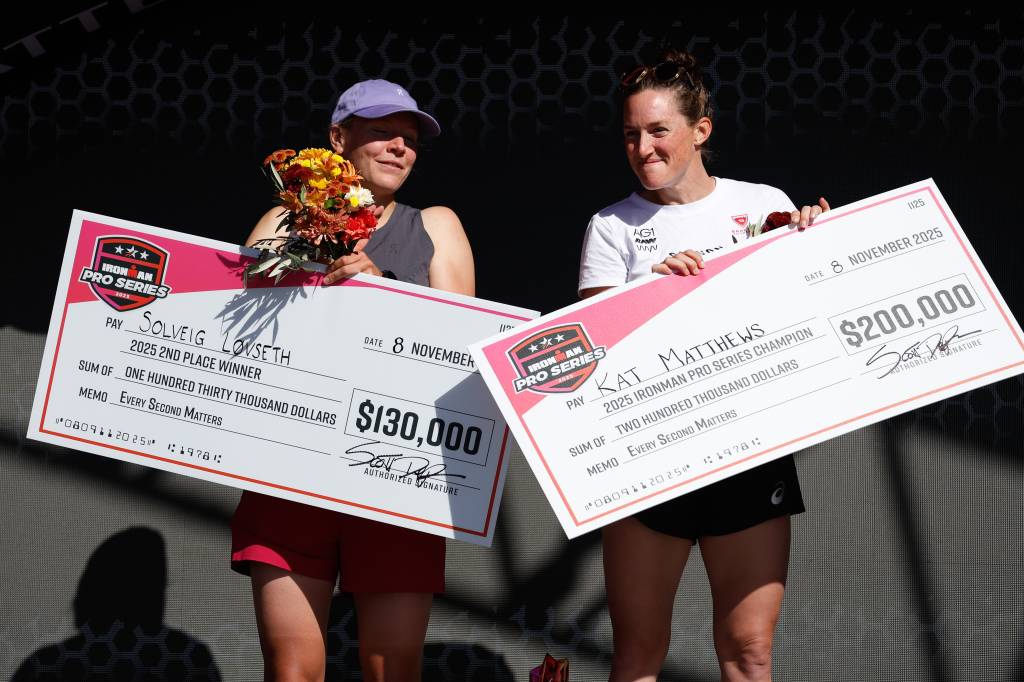
It was enough of an advantage that even if Matthews didn’t finish in Spain, the Norwegian would have to be within 100sec of the winner to clinch the series title and take the $200,000 top prize, with second place receiving $130,000.
Lucy Charles-Barclay delivered one of the performances of her career to win the race, while Lovseth finished almost 10min behind in sixth place.
“Someone asked me at 3km if I was ok and I said I was dealing with a $70k issue here,” Matthews continued. “But within minutes it came to my realisation that Solveig was more than 2min from the front, so it looked like I was secure.”

Matthews was also thankful to her team for some strategic planning that meant she had completed the full quota of five counting Ironman races before starting in Marbella; the ‘safety net’ race being one of the regular 70.3s she won [Wales and Austria] that meant a DNF here wasn’t defining.
“It will definitely factor into our plan [again] next year,” she explained, having won the top prize in 2024 as well. “We were maybe going to risk it with a five-race Pro Series, but we’ll do the bonus race again.”
While Pro Series success softened the blow, the priority goal of the day was to finally end the Ironman World Championship hoodoo after several near misses that started with second place in the Ironman World Championship in Utah in 2022 and included further runners-up spots at the full distance in Nice (2024) and Hawaii (2025), and at 70.3 in Lahti, Finland (2023) and Taupo, New Zealand (2024).
The day started by going to plan. “I’m really proud of how I raced,” she said. “At the start, in terms of my mentality, I committed to the effort rather than worrying about my fitness not being great post-Kona, and I know everyone was suffering with that.
“I really committed to the swim, and finally it was a good swim. Another wetsuit swim, sure, but a good one tactically. On the bike, I put the effort in where I planned to, and I’m really proud that that paid off as well.
“I rode as well as I could have done, and I hit the run and felt really good. Lucy has been running well this year, so I didn’t know [if I could win], but I knew that I was in control of my effort, and I set out feeling so good.”
With Matthews known for being analytical about her performances, why did she feel the calf injury occurred?
“I haven’t really sat on it too long, but I think the travel [from Hawaii, was a contributing factor] and I committed to enjoying myself in Kona after the race – I’m probably going to beat myself up for being a bit too relaxed post-race.”
“[Following the initial calf sprain] we took time off until it was pain-free and I’ve learnt in the past with calf injuries that sometimes you can’t do anything about them.
“I say with slopey shoulders that I’ve got great genetics for running, but what comes with that is the calf load, and maybe I run using them a bit too much.”


 Tim Heming
Freelance triathlon journalist
Tim Heming
Freelance triathlon journalist