How to prepare for a non-wetsuit triathlon swim
When temperatures soar and water temperatures rise, there's a chance your triathlon may be non-wetsuit. But what does this mean for you – and how can you make sure you perform to your best without your trusty wetsuit on?

When temperatures soar and water temperatures rise, there’s a chance your triathlon may be non-wetsuit. But what does this mean for you – and how can you make sure you perform to your best without your trusty wetsuit on?
Go to any summer triathlon and a lot of the chat pre-race will be about the swim – mainly “what’s the water like”? For many triathletes this can mean nerves around water temperature. Will it be too cool? Or will it be too warm and is there a risk that wetsuits might be banned?
First, let’s explore what ‘non-wetsuit’ means and what the rules are at the moment. Under World Triathlon competition rules which can be downloaded in full here, (updated 18th January 2025) wetsuit use varies based on age-group and distance of the swim as in the table copied below:

For the majority of us (adults and under 60 years old), this means we’re looking at the middle table which means for distances below and including Olympic distance wetsuits will be banned over 22°C. They are also optional between 16°C and 22°C and mandatory below 15.9°C.
Once you go over 1500m (so we’re looking at 70.3 and full iron-distance) there’s a little more leeway due to the length of time in water. So wetsuits are now forbidden over 24.6°C which also expands the ‘optional’ category a little too.
For elites, under-23s, juniors and youth athletes the top table is the one you need and for age-groupers over 60 it’s the bottom table – which simply means you have the same parameters as the longer-distance category for athletes 59 and under regardless of which distance you are racing.
Other considerations
Of course it’s a little more complex than that and with health and safety the priority, other things have to be taken into consideration. Maximum time in the water is also considered under World Triathlon guidelines, as is whether a swim needs to be shortened or cancelled due to high or low temperatures.
Advice is also given to race organisers based on air temperature and weather conditions, so if you feel like geeking out on all the possible eventualities then it’s worth checking out the full competition rules guidance as well as the British Triathlon competition rules if you are in the UK.
So when will you know whether you can wear a wetsuit or not? World Triathlon guidance has this advice for race organisers:
“Water temperature must be taken one hour prior to the start of the event on competition day. It must be taken at the middle of the course and in two other areas on the swim course, at a depth of 60 cm. Where the average measured figure is 27 ºC or below, the lowest measured temperature will be considered as the official water temperature. Where the average measured figure is above 27ºC, the highest measured temperature will be considered as the official water temperature.”
Of course you can get a steer on whether you are likely to be without your wetsuit in the days running up to the event and by taking an informed look at the weather in the preceding week. Also look at previous years’ events. Many that are non-wetsuit will tend to be every year – so bear this in mind when choosing your event!

Wetsuits optional
One of the most common things I get asked as an open-water swim coach is whether athletes should wear a wetsuit if they are optional. My advice here is to consider your swimming ability, how comfortable you are in a wetsuit, how competitive you want to be and also the distance of your swim.
Most swimmers are faster in a wetsuit due to the hydrodynamic nature of the coated neoprene and the additional buoyancy offered by the rubber. So if you are looking for a speedy time, especially over a long distance, then the time spent taking the suit off in transition will likely be easily saved over the swim.
However if you’re doing a shorter distance and are a strong swimmer, or are non-competitive and don’t want to wear a wetsuit, then you may prefer to swim without it. Just make sure if the temperatures are at the lower end of the optional category that you are well-acclimatised and confident you can complete the distance without getting cold.
Wetsuits banned
Now we come on to the category that gives most swimmers the fear – when wetsuits are banned!
The athletes most likely to worry about swimming without a wetsuit are generally the slower swimmers or those who got into triathlon without a background in swimming.
As I’ve already mentioned, wetsuits can offer quite a bit of help in the swim so less confident swimmers or those with poor body position and/or sinky legs may worry about not having that extra support, especially if all their training swims have been done in a wetsuit.

Below is my advice for a non-wetsuit swim:
- Improve your technique without a wetsuit. The key here is to swim often without a wetsuit – even if you are doing all your training in open water. This may mean heading to the pool if local open water is too cold and you may also want to consult a local coach or tri club to receive some advice on swim technique or use one of our many free training plans. Improving your body position will work wonders if you tend to rely on your suit to keep you afloat. Don’t over-use your pull buoy in training, either!
- Acclimatise to cooler water. Once open-water temperatures start to reach higher numbers locally (so into the ‘optional’ window) it’s worth doing short swims without a wetsuit and/or just taking it off at the end of your swims to see how the water feels against your skin. Acclimatisation comes from exposure to the water (though keep it short and be guided by how you feel) so the more you can get used to doing this, even for short dips/swims, the more confident you will feel on race day.
- Practise different transitions. Get used to doing brick sessions (swim to bike) both with and without a wetsuit on. Obviously with the wetsuit is trickier, but it’s also worth thinking about how you’ll feel without a wetsuit. You may be a bit soggier to start with, depending how well your wetsuit fits – plus out onto the bike if you’re cooler from the swim you may feel chillier as you start cycling. Just be aware of these things. Some of you may consider a swim skin too like the pro triathletes will often wear in non-wetsuits swim. These are a close-fitting, highly compressive water-wicking garment which goes on top of your tri-suit and helps you slip faster through the water. They can be notoriously difficult to get on and off though, so the faff may not be worth the return!
- Try and relax. Practise is key here as it will take a lot of the panic out of finding out you won’t be wearing your wetsuit on race day. Get used to entering the water and breathing to calm your nervous system. It can be tempting to swim harder and kick harder when we’re nervous, so be aware of this and don’t let yourself start fighting with the water. Good technique will see you swimming faster than panicky thrashing! Focus on a long body and legs with good rotation and measured breathing.
- Remember everyone is in it together. Chances are if you’re nervous, so are a lot of other people! I always try and avoid the nervous ‘trash talk’ at the start of events and focus on my own swim. If you’ve done the prep and the training, just enjoy the experience and feel lucky to be doing a triathlon somewhere warm (and hopefully beautiful enough!) to not need a wetsuit. Plus if your time is a little slower, then chances are the whole field will be as well.
- Remember your sun cream! Plus if possible, try and use sunscreen that is marine-safe to protect the water you are swimming in and which will also last the duration of your race, unless you are able to re-apply in transition. It’s worth noting that if your tri-suit has thin mesh panels the sun may be able to get through, so apply cream to those areas as well even though they are covered. Finally – if your warm swim is going to be sunny too, then make sure your goggles are up to the job!
Read more
- How much cold water swimming do you need to do to keep your acclimatisation up?
- How to master open-water swimming for race day
- How to start swimming as a beginner
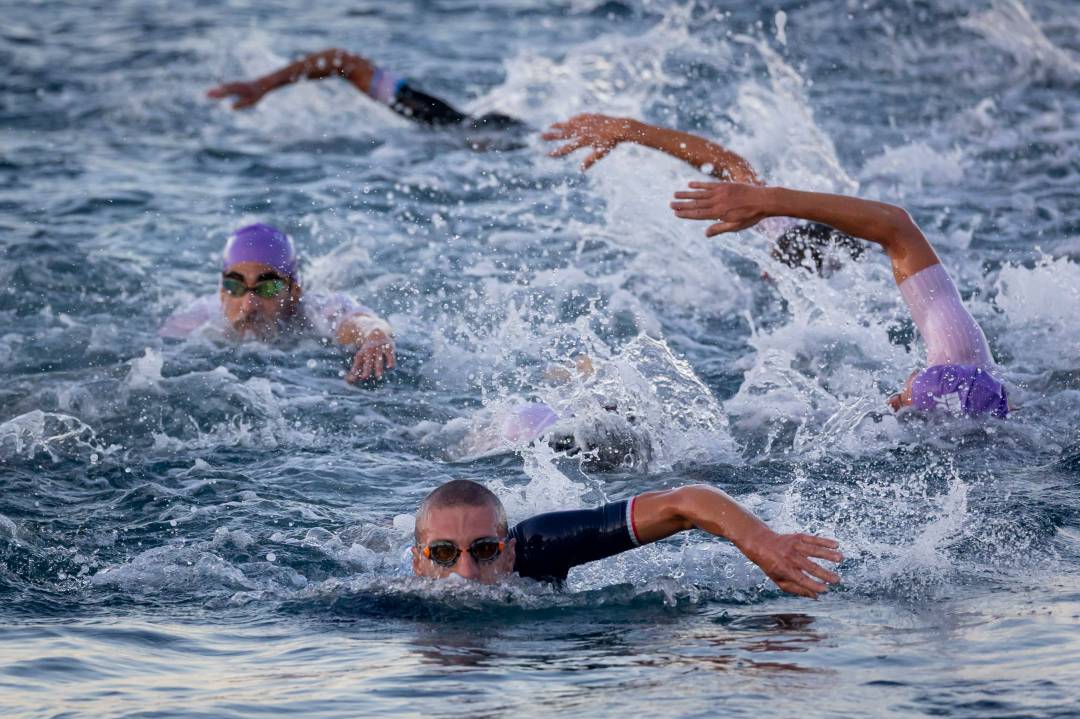
Lead image: Athletes compete in the swim leg during the 2025 Ironman 70.3 Nice on June 29, 2025 in Nice, France. (Photo by Jan Hetfleisch/Getty Images for Ironman)


 Helen Webster
Editor, 220 Triathlon
Helen Webster
Editor, 220 Triathlon