Breath analysing masks, ventilation sensors and bargain power meters: sports tech that will change your life in 2026
These cutting-edge sensors could transform your training but don't all come cheap.

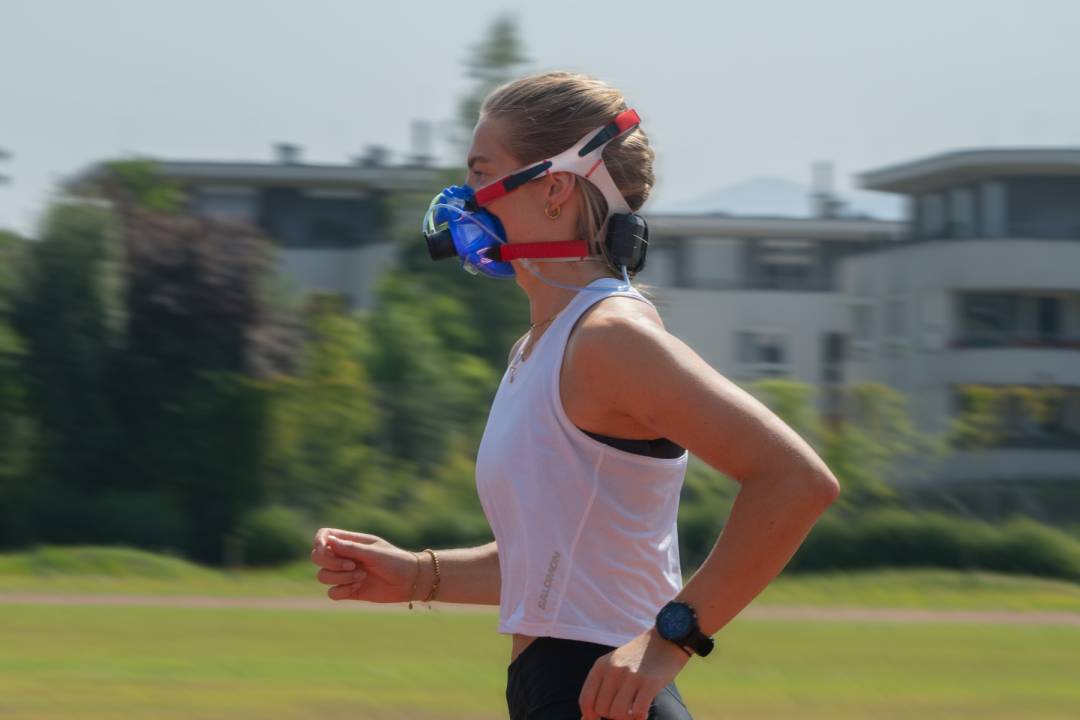
Sports tech has never measured as much data as accurately, potentially delivering major performance gains if we use them correctly.
Increasingly, sensors are bringing the ability to record key performance metrics out of laboratories into homes and onto training routes.
While the price of some physiological trackers remains prohibitive, other products are affordable on the budgets of ambitious amateur athletes.
Read on to find out which sports tech I predict will continue to be insightful and influential in 2026.
Carbohydrate oxidation rate measurement

Most endurance athletes know they should consume more carbohydrates during training and racing than the traditional 30-60g per hour, without knowing quite how much.
It’s possible to estimate how many carbohydrates you expend based on speed and intensity (power meter data gives cyclists a better idea than most) and base your hourly carb intake on this.
You then have to guess through trial and error whether your gut can tolerate this amount. But being able to stomach carbohydrates during exercise is not necessarily the same as being able to oxidise them for your muscles to use.
Until recently, the only way to find out your oxidation rate was an expensive laboratory test.
Now a British company called ExoAnalytics is selling a test you can do at home in 90 minutes for £350.
Using a technique called exogenous carbohydrate oxidation testing, ExoAnalytics will provide you with personalised fuelling recommendations for training and racing.
First you’ll capture a pre-exercise breath sample in a tube. You’ll then drink a carbohydrate drink mix containing carbon-13 stable isotopes as you run on a treadmill or ride on a turbo trainer.
In the last 10 minutes of the test, you will put on a metabolic mask and breathe into it. After finishing you’ll give another breath sample.
Once you’ve sent back your samples, ExoAnalytics prepares your report.
While £350 isn’t cheap, knowing your carb oxidation rate could save you a lot of money in wasted sports nutrition like energy gels.
If you can only oxidise 60g per hour of carbohydrates but are consuming 90g, you could probably fuel 30% less without performance detriment.
On the other hand, the test could reveal that you are holding yourself back by underfuelling. Solving that is much cheaper than buying a new triathlon bike.
And luckily if your current levels of fuelling are spot on, there’s no harm in confirming that.
Breathing sensors

In sports science, researchers tend to use training zones based on lactate or ventilatory thresholds. These metabolic thresholds better reflect physiological changes caused by exercise intensity than threshold heart rate or Functional Threshold Power.
Most lactate and ventilatory testing requires laboratory-grade equipment, making it expensive and impractical to do in the field.
The Tyme has come
But TymeWear has developed the Vital Pro chest strap to measure your breathing rate outdoors.
The strap consists of a standard heart-rate monitor and breathing sensor which measures breaths per minute, air volume per breath and air volume per minute. The sensors sit next to each other on your chest or on your back.
TymeWear claims the device calculates your metabolic thresholds (ventilatory threshold one and two, and VO2 max) to produce personalised training zones. Training based on these instead of heart-rate based zones is a surer way to improve fitness, according to the brand.
Currently used by WorldTour cycling team Visma–Lease a bike, the Bluetooth-enabled sensors can pair with up to four devices and integrates with Garmin Connect, intervals.icu and WKO5.
The strap alone will set you back $299 and includes access to TymeWear’s basic app features for free. For an additional $150 a year, you’ll receive individualised training recommendations.
Set against the best heart-rate chest straps costing about $100, this is a big investment. Yet some of the best multisport watches cost several times more.
If you’re considering having laboratory lactate and ventilatory threshold testing for several hundred dollars or pounds, TymeWear looks competitive. The brand claims to be nearly as accurate and it can measure your breathing rate whenever you want.
Lab-grade accuracy on the move

If you’ve got the inclination and budget to step up accuracy to laboratory standard, and harvest a heap of data, SpiroFit takes on-the-go measurement further.
The portable mask assesses your cardiorespiratory fitness through breath analysis at rest or during exercise.
Without needing external calibration, SpiroFit says the mask’s medical-grade sensors measure oxygen consumption and carbon dioxide exhalation, which you can read in real-time on the app.
From this gas exchange data it calculates your VO2 max, substrate utilisation (the proportion of carbohydrates and fats you oxidise at a given intensity) and ventilatory thresholds.

Being a mask, albeit a light one you can run and cycle in, SpiroFit isn’t intended for regular use like TymeWear.
Instead, the brand recommends performing a step or ramp test while wearing the mask. You or your coach can then use the granular data you’ve gleaned to personalise carbohydrate intake and training zones, and track aerobic capacity.
It’s also possible to wear the SpiroFit for key training sessions. International triathlon coach Guido Vroemen, for example, uses a SpiroFit mask to ascertain in real-time that his athletes are performing intervals at precisely the right intensity.
The snag of Spirofit’s sophistication is cost. At €5,495, it’s something that’s only feasible for a professional coach to invest in for a team or group of endurance athletes.
Cheaper power meters

Okay, power meters have been around for ages. But they’ve never been as cheap and, yes, I mean in absolute terms, or as good.
If you’ve never used one before due to the price and missed out on training insight and precision, consider Magene. It claims its PES 515 spider-based power meter records watts with +/-1% accuracy at the remarkably low price of $299/£299.
The Chinese brand, which is supplying power meters to WorldTour cycling team XDS Astana, claims its P715 power meter pedals are also accurate to +/-1%.. These power pedals significantly undercut the competition from Favero and Garmin.
We’re yet to review either power meter, but testing from other publications and consumer reviews suggests they’re high quality.
Not so long ago, power meters cost $3000 and were the preserve of professional cyclists. So it’s great to see this valuable training tool become accessible to more riders.


 Jack Evans