Suunto Aqua review: I’ll be using these classy waterproof headphones for more than just swimming
Are these feature-packed swimming headphones the solution to beating boredom in the pool, as well as tracking your training?

220 Triathlon Verdict
These are a classy set of headphones. Sound quality is great underwater and they are also useful for running and indoor cycling with a choice of sound settings. Construction feels solid.
Pros
- Excellent sound quality
- Reliable in testing
- Extra features
- Sport-specific settings
- Great battery life
Cons
- Controls a bit complicated
- Ear loop not for everyone
- Need access to music files
Introduction
Head to any swimming pool and waterproof headphones for swimming are becoming more and more ubiquitous.
This is partly to do with increased availability, but also with the adoption of bone conduction technology. This works superbly in water and avoids the faff of trying to create a seal. In-ear headphones can often be difficult for this.
I’ve tested several sets of waterproof headphones over the last 12 months. I’m happy to report they have made a huge difference to my training, to the point I believe they’re the training hack I never knew I needed. I don’t use them on every swim, but on the days I need to swim long in open water, or just need to motivate myself in the pool, they’re a game-changer.
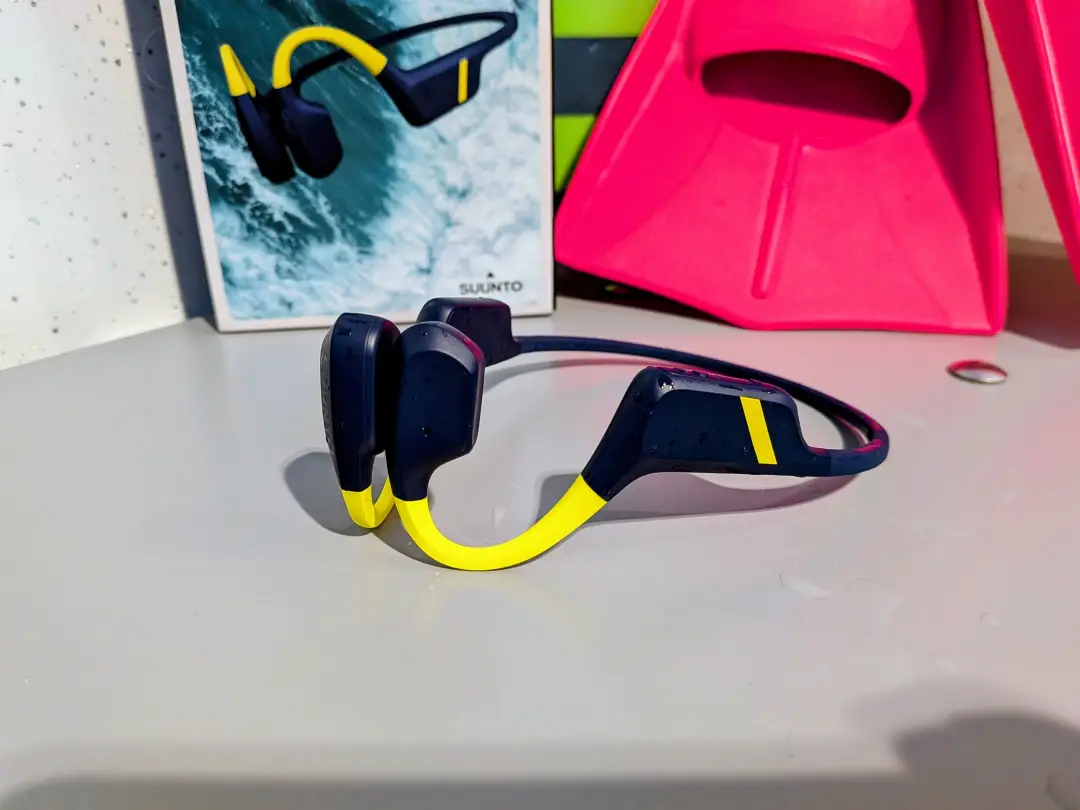
In this test I’m looking at the Suunto Aqua headphones which come in two colourways. There’s blue/green as shown here or plain black.
How we test waterproof headphones
Each set of headphones is put through the same testing process. First they are assessed for ease of set-up. How simple is it to download music on to them ready for swimming and to charge them? I’ll then consider how simple they are to use and how comfortable the fit is as well as how easy they are to use once in the water. Sound quality is assessed with the same playlist featuring a range of types of music added to each set to compare tone and how quality of playback. At a minimum I will do several swims in each set of headphones in the pool of one to two hours – though in summer when the water is warmer I’ll also test waterproof headphones on longer lake swims as part of my training. You can find out more about how we test and rate products here.
Unboxing the Suunto Aqua headphones
Inside the box there a few components, all neatly packaged and easy to access. You don’t get a manual – there is a leaflet included with QR codes that lead you to the Suunto app and also a quick start guide. They are easy to follow and install, though.
The package includes the bone conduction headset, a charging pod and a charging cable with USB-C connector. Additionally there’s a pair of earplugs and a cloth bag with drawstring to keep it all together.
From the off this feels like a premium package. The materials feel solid, it’s well-finished and the buttons have a satisfying click about them. I like to know when I’ve pressed a button it’s worked!
There are a few settings to get used to though. These headphones have three sound modes – underwater, outdoor and general which adjusts the tone of playback to suit the conditions. Music can sound a bit muffled underwater so the underwater mode acts to sharpen everything up a bit.
These are also designed to be used for running and outdoor use. I would never recommend cycling outdoors with any kind of headphones on. However I did also use them for running and general daily use throughout the test period.

The cloth bag is a nice touch as it also works to absorb any last drops of moisture after use. If I’m honest, I would prefer a hard case though as I do worry about damaging them when they’re in my swim bag.
I did like the neon touches on this set though. it made them much easier to find than a plain black set, especially when in my pile of swim kit!
Charging and set-up
Charging is simple – you pop the unit inside the charging pod, click it shut and attach the cable. A full charge will give you 10 ours of playback. Additionally that pod also acts as a power bank so you can charge on the fly and will give you an extra 20 hours.
Music needs to be downloaded onto the Suunto Aqua headphones, which may prove a pain if you only stream music. Find options in our wider group test if you want to record streamed music to your headphones.
I used an Apple Music account and added some CDs. It was very simple to drag the files over and create playlists.
You can also use the headphones to stream music via Bluetooth, which is my preference when not in the pool. You will need to download music for offload listening while you swim though and the headphones can carry 32GB of offline audio.

When it comes to changing functions and swapping between online and offline audio as well as controlling playback, you have two buttons on one side and one larger one on the other. At first I found remembering them a bit complicated, but you can set up the buttons to work as you please which is helpful.
You can also change settings in the app which is clearly designed and simple to use.
For some functions changed when pressing the buttons you get a vocal notification and I would have appreciated this for more functions (such as switching on/off and between online/offline) as I wasn’t sure what mode I was in at times. I did get used to this with time and use though.
You can also set a ‘head control’ feature which means the headphones can be controlled via head movements – if you don’t mind looking a bit daft or don‘t want pressing buttons to interfere with your stride when changing tracks or answering calls.
Using the Suunto Aqua for sport
I tend to use music for long swims where I need to zone out and just check in on pace now and again. Last year I trained for end-to-end lake swims which meant pool swims of two hours-plus as well as lake swims over over four hours. With this in mind, clarity of sound, a decent battery life and comfort are key for me,
The Suunto Aqua are bone conduction headphones which hook over the ear and sit alongside your ear (almost on the cheekbones) and then transmit the audio through your skull – sounds weirds, works brilliantly well! You will need to use earplugs as well though to cut out water noise in your ears.
For shorter swims I found these headphones comfortable enough, but over an hour the hooks started to become a bit uncomfortable on the top of my ears. I have found this with all headphones of this design though, so it’s not specific to Suunto. If you are the same, then a set that clips onto your goggles straps such as the H20 Audio Sonar range may work better for you.
Wearing them without a swim cap on top did make them more comfortable, so if you swim without a cap or have very short hair that may be an option (personally I like to keep my hair in a cap and it’s a bit gross when you end up with hair floating around in the pool!).

Where these headphones excel is in the sound quality. Using the ‘underwater’ setting the music became sharp and clear and the clarity was superb.
On land you can use ‘general’ or ‘outdoor’ which alters the tone of your music to suit quieter or noisier spaces.
Extra technology
A note on waterproofing – the Suunto Aqua is rated IP68 and are manufacturer-tested at depths up to 5 meters for up to 2 hours. I swam longer than that with them, but it’s worth noting that that is Suunto’s recommendation.
Interestingly, the Suunto Aqua also has technology built in to record and assess your swim sessions which is something I haven’t seen in a set of headphones before. Head to the app and you’ll find a breakdown of your distance and pace, including a SWOLF score and breakdown of the types of stroke done. They will also record head pitch angle, breath frequency, and glide time
I found this to be relatively accurate and any inconsistencies I could identify as being because of swim drills (the unit often recorded drills as breaststroke) or missed lengths.
A ‘neck health’ feature is a nice touch too, where the unit will assess head position and also give you feedback on your spine position and remind you to move if you sit still too long!
Verdict
Overall I enjoyed using the Suunto Aqua and they definitely earned a spot in my kit bag long term. They feel classy and well-made and I don’t have any concerns over longevity so far in testing.
How much the tracking features will replace my wrist-base Garmin stats is doubtful, but it’s a nice added feature if you don’t already wear a sports watch.
Being able to use them for daily use and running is great too, the different audio settings as well as the ability to answer and take calls on the unit is very helpful.
My only real negative is the fact these irritate the top of my ears if used for very long swims. With most swimmers only being in the pool for an hour at a time though, I doubt that’s a deal-breaker for many people (and this may just be me!).
If you only stream audio, you may also find it a faff having to have music files available to download.
Sound quality is superb though and the unit was reliable in testing and had a great battery life – so on the whole, these come highly recommended!
H20 Audio Sonar 2 Pro Specs
| Measurements | 95 x 128 x 47 mm | |||
| Weight | 35 g / 1.23 oz | |||
| Case material | Silicone + Titanium Alloy | |||
| Water resistance | IP68 5m/2h | |||
| Battery | Rechargeable lithium-ion | |||
| Battery charge time | Under 1 hour | |||
| Battery life | 10 hours plus 20 hours in charge pod |


 Helen Webster
Editor, 220 Triathlon
Helen Webster
Editor, 220 Triathlon