How can I increase my cycling speed?
Looking to boost your bike speed without spending much? Read our advice on tech, technique and planning.

Once you’ve got into cycling and started to ride further, everyone has wondered ‘how can I increase my cycling speed?’
The obvious answer is to pedal harder, but we’ve explained how to increase cycling power in a separate article. Here, I’ll focus on my top seven tips for tech, technique and routing that should see your average speed on the bike improve.
1. Get more aero

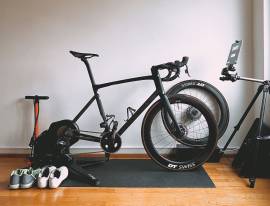
It’s always tempting to upgrade your road bike or splurge on the best carbon aero wheels in a bid to boost your cycling speed
I’ve asked will a more expensive road bike will help me ride faster and concluded only marginally and at a poor financial return.
This is principally because the rider is responsible for 80% of the drag that increases air resistance, slowing us down.
Therefore, you have much more to gain by optimising your body position. Generally getting lower, narrower and longer at the front and keeping your head inline with your shoulders works wonders.
At home you can work on your position for free by placing a mirror next to your turbo trainer. Or a performance-oriented professional bike fit should also help you save watts.
If you have money to spend on aero upgrades, first read our guide on how to get more aero on a bike on a budget.
2. Lower your rolling resistance

Many stock bikes come fitted with tyres and inner tubes that hold you back due to their high rolling resistance.
Upgrading tyres and tubes to fast rolling options saves a lot of watts per dollar spent and often improves grip, ride quality and comfort too.
For example, replacing a standard butyl inner tube with one made from TPU or latex saves you seven watts at 28mph / 45km/h, according to independent testing by Aerocoach. Switching to a tubeless set-up has a similar benefit.
Even allowing for a slower cycling speed, an efficiency saving of this magnitude will shed minutes off your time in a long bike ride or long-distance triathlon bike leg.
3. Hit the open road

As pleasant as low-traffic country lanes can be to cycle down, they’re often slower than wider, better surfaced roads.
Without riding on dual carriageways, seek out faster, A and B roads when you want to increase your cycling speed. On these roads, there are fewer turns, junctions and hills that cause you to slow down.
To stay as safe as possible on busier roads, consider running the best bike lights and wearing visible clothing while staying out of the gutter.
It’s worth noting though that rural roads are the most dangerous per mile travelled for all kinds of road users, according to the road safety charity Brake.
4. Cut out the climbs
Anyone who’s seen their average cycling speed plummet on a ride with thousands of feet of elevation will know that hills sap your pace – the descents are too brief and technical to compensate for that time slogging uphill.
Hills have a place in a good triathlon training plan, except when you’re aiming to maintain a consistent effort or hold a high speed on the bike.
5. Shelter from headwinds
Most of the time we ride a loop from home, so there are few chances to ride in a single direction with a raging tailwind behind us.
When it is windy and you’re planning a ride, avoid riding directly into the headwind at any point. This will absolutely wreck your average speed in a way that even a strong crosswind won’t.
As I sketch out long ride routes, I usually try to ride back with a tailwind. It’s good for morale when your legs are hurting.
6. Lay off the brakes

Where it is safe to do so (not at stop signs or traffic lights), braking less helps to increase your cycling speed.
Ride behind a competent bike handler and you’ll notice that when cornering and descending they rarely brake thanks to their superior line choice.
By maintaining momentum through corners, they come out of them faster and have to reaccelerate less forcefully.
This cuts seconds on each bend and preserves energy for later in the ride when they can put it to better use, for example, on a hard climb.
7. Join a group ride

In a group of cyclists who are as quick or faster than you, you’ll increase your cycling speed relative to what you can achieve on your own.
Everyone can pull a strong turn on the front, peel off, slightly recover in the wheels and then come through again.
Not only can this collaborative effort be fun, cycling at speed can improve your cornering technique, ability to safely maintain momentum at junctions and pedalling biomechanics.
Riding above your Functional Threshold Power at 95rpm in a fast group is a different muscular effort to climbing at the same power at 80rpm.
What is a good cycling speed?
Ignoring group rides and races where average speeds are high due to the draft effect, solo cycling speeds vary a lot according to the individual’s fitness, intensity, bike and the distance, terrain and surface they’re covering.
A fit club rider can hold 19mph / 30kmph while riding at a steady effort on the flat while a beginner might sustain just over half of that pace.
For more detail, read our full explainer on what is a good cycling pace.


 Jack Evans